How to Calculate a Raise (and Your Real Raise After Inflation)
Calculate a raise percentage, your new salary and paycheck, and what the raise is worth after inflation, with worked examples.
A raise can be described as a percentage or a dollar amount, and it's easy to convert between the two. The more useful question is what the raise is worth after inflation, since a 3% raise in a year of 3% inflation leaves you where you started. This guide shows how to calculate a raise percentage, your new salary and paycheck, and your real raise after inflation, with worked examples.
How to Calculate a Raise Percentage
If you know your old and new pay:
Raise % = (New salary − Old salary) ÷ Old salary × 100
Example: Your salary goes from $62,000 to $66,000.
- Raise amount: $66,000 − $62,000 = $4,000
- Raise percentage: $4,000 ÷ $62,000 × 100 = 6.45%
The same formula works for an hourly wage: going from $20.00 to $21.00 an hour is a ($21 − $20) ÷ $20 = 5% raise.
Always divide by the old salary. Dividing $4,000 by the new salary, $66,000, gives 6.06%, which understates the raise.
How to Calculate Your New Salary
If you know the percentage:
New salary = Old salary × (1 + Raise % ÷ 100)
Example: You earn $55,000 and get a 3.5% raise.
- Raise amount: $55,000 × 0.035 = $1,925
- New salary: $55,000 + $1,925 = $56,925
- Extra per month: $1,925 ÷ 12 = $160.42
- Extra per biweekly paycheck: $1,925 ÷ 26 = $74.04, for a new gross paycheck of $2,189.42
These are gross (before-tax) figures. Your take-home increase will be smaller after federal and state income tax, Social Security, Medicare, and any percentage-based retirement contributions. The salary calculator estimates take-home pay at the new salary.
Your Real Raise After Inflation
Inflation reduces what each dollar buys, so part of any raise only keeps you even. The exact formula for the raise in purchasing power is:
Real raise = (1 + Raise %) ÷ (1 + Inflation %) − 1
Many people simply subtract inflation from the raise. That shortcut is close for small numbers, but slightly overstates the real raise.
| Raise | Inflation | Real raise | Verdict |
|---|---|---|---|
| 2.0% on $55,000 | 3% | −0.97% | Loses purchasing power |
| 3.5% on $55,000 | 3% | +0.49% | Barely ahead |
| 6.45% on $62,000 | 3% | +3.35% | A real raise |
With a 2% raise and 3% inflation, your $56,100 new salary buys what about $54,466 would have bought a year earlier: less than your old $55,000. You got more dollars but a pay cut in real terms. With a 3.5% raise, the new salary is worth about $55,267 in last year's dollars, a real gain of under half a percent.
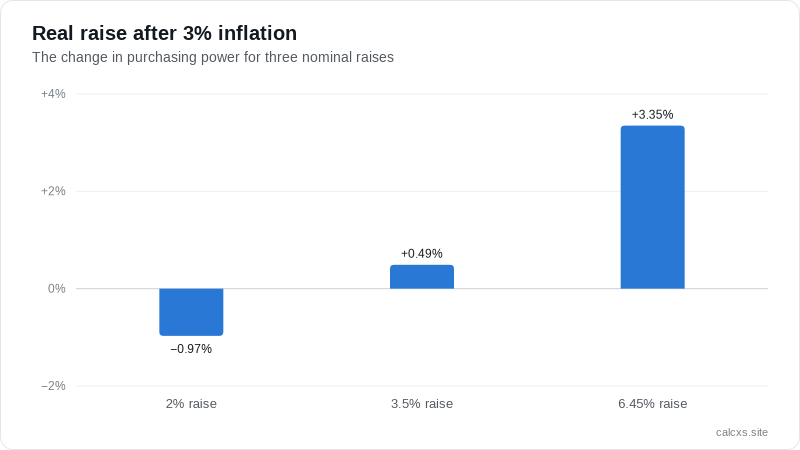 Only the part of a raise above inflation increases what you can buy.
Which Inflation Rate to Use
The usual measure is the Consumer Price Index (CPI) published by the Bureau of Labor Statistics. Use the 12-month change in CPI for the year leading up to your raise. Your personal inflation rate can differ (rent, childcare, or commuting costs might be rising faster or slower than the national average) so it's worth checking your own biggest expenses too. The inflation guide explains real vs. nominal values in more detail.
Is Your Raise a Good One?
A few benchmarks help put a raise in context:
- Inflation. A raise at or below the CPI change only maintains your purchasing power.
- Wage growth. The Bureau of Labor Statistics' Employment Cost Index tracks how much wages and salaries are rising across the economy. A raise below that pace means your pay is falling behind the typical worker's.
- The market rate for your job. If your skills or responsibilities have grown, the relevant comparison is what employers pay for that role now.
- Promotion raises are usually larger than annual merit or cost-of-living increases, since they reflect a new level of work.
Converting a Raise for Hourly Workers
For hourly pay, calculate the new hourly rate and then annualize it:
New hourly rate = Old rate × (1 + Raise %)
Annual pay ≈ Hourly rate × 2,080
A raise from $20 to $21 an hour adds about $1 × 2,080 = $2,080 a year for full-time work. If you work overtime, the raise also lifts your overtime rate: time and a half goes from $30 to $31.50. See how to calculate overtime pay and how to convert hourly to salary.
Asking for a Raise: Do the Math First
- Know your real raise target. If inflation is 3% and you want a 2% real gain, ask for about (1.03 × 1.02) − 1 ≈ 5.1%, not 5%.
- Translate it into dollars. "$3,000 more a year" is often easier to discuss than a percentage.
- Look at total compensation. A smaller raise with a larger 401(k) match or lower health insurance premiums can be worth more than it looks.
Putting It Together
To find a raise percentage, divide the dollar increase by your old salary. To find a new salary, multiply the old one by one plus the raise. Then adjust for inflation with (1 + raise) ÷ (1 + inflation) − 1: only the part above inflation increases what you can actually buy.
The raise calculator shows your new salary, the increase per paycheck, and your real raise after inflation, and the inflation calculator shows how prices have changed over any period.
Frequently Asked Questions
What is a 3% raise on $50,000? $50,000 × 0.03 = $1,500, for a new salary of $51,500. That's $125 a month or about $57.69 more per biweekly paycheck, before taxes.
How do I calculate a raise from an hourly wage? Subtract the old rate from the new rate and divide by the old rate. A raise from $18 to $19.50 an hour is $1.50 ÷ $18 = 8.33%.
Is a cost-of-living adjustment the same as a raise? A cost-of-living adjustment (COLA) is a raise meant to match inflation, so it keeps your purchasing power steady rather than increasing it. Its real value is close to zero by design.
What is a typical annual raise? It varies with the economy, your industry, and your performance. The Employment Cost Index shows the current pace of wage growth nationally, which is a reasonable benchmark for a standard merit raise.
Why does my paycheck go up by less than the raise? The raise is quoted before taxes. Income tax, Social Security, Medicare, and percentage-based deductions such as 401(k) contributions all take a share of the increase.