How Much House Can I Afford on a $60,000 Salary?
The 28/36 rule worked through on a $60,000 income, with stated assumptions and how rates, property taxes, debts, and down payment change the answer.
On a $60,000 salary, the widely used 28/36 rule points to a home price somewhere around $150,000 to $220,000, but that range depends on the details. Your existing debts, your down payment, the interest rate you qualify for, and your local property taxes can each move the answer by tens of thousands of dollars. This guide works through the 28/36 rule step by step on a $60,000 income, shows every assumption, and then tests how the result changes when those assumptions change.
The Quick Answer
Under the example assumptions used throughout this guide (a 7.00% 30-year fixed rate, 1% property taxes, $150 a month for insurance, and no other debts above $400 a month):
| 10% down | 20% down | |
|---|---|---|
| Monthly housing budget (28%) | $1,400 | $1,400 |
| Affordable home price | About $174,000 | About $203,000 |
| Mortgage amount | About $156,000 | About $162,000 |
| Cash needed for the down payment | About $17,400 | About $40,600 |
The sections below show where each number comes from and how to adjust it for your own situation.
Start With Gross Monthly Income
Affordability rules are based on gross income: what you earn before taxes and deductions. On a $60,000 salary:
$60,000 ÷ 12 = $5,000 a month
If you're buying with someone else, add their gross income too, along with their debts.
Apply the 28/36 Rule
The 28/36 rule is a long-standing guideline used in mortgage planning:
- 28% for housing. Your total monthly housing payment (principal, interest, property taxes, homeowners insurance, mortgage insurance, and any HOA dues) should be no more than 28% of gross monthly income.
- 36% for all debt. Housing plus every other monthly debt payment should be no more than 36% of gross monthly income.
On $5,000 a month:
| Limit | Calculation | Monthly maximum |
|---|---|---|
| Housing (28%) | $5,000 × 28% | $1,400 |
| Total debt (36%) | $5,000 × 36% | $1,800 |
Your housing budget is the lower of two numbers: the 28% limit, or the 36% limit minus your other debt payments.
Example: A $300 Car Payment
If your only other debt is a $300 car payment, the 36% limit leaves $1,800 − $300 = $1,500 for housing. The 28% limit is lower at $1,400, so your housing budget is $1,400 a month.
Example: $550 in Other Debts
If you have a $300 car payment, a $200 student loan payment, and $50 in credit card minimums, the 36% limit leaves $1,800 − $550 = $1,250. That's now lower than $1,400, so your housing budget drops to $1,250 a month.
Notice that every dollar of other debt above $400 a month reduces your housing budget dollar for dollar.
Turn the Payment Into a Home Price
A housing payment isn't just the mortgage. To convert $1,400 a month into a price, you have to account for everything that payment covers. Here are the assumptions for this example, yours will be different:
- Mortgage: 30-year fixed at 7.00%. This is an example rate; actual rates change weekly and depend on your credit score, down payment, and loan type.
- Property taxes: 1.0% of the home's value per year. Effective rates vary widely by state and county, from well under 1% to more than 2%.
- Homeowners insurance: $150 a month. Premiums depend heavily on location, the home, and coverage.
- Private mortgage insurance (PMI): 0.5% of the loan amount per year when the down payment is under 20%. Actual PMI rates depend on your credit score and down payment.
- No HOA dues.
With 20% Down
With a $1,400 budget and 20% down, the numbers balance at a price of about $203,000:
| Component | Monthly cost |
|---|---|
| Principal and interest on a $162,450 loan | $1,081 |
| Property taxes | $169 |
| Homeowners insurance | $150 |
| Total | $1,400 |
You'd need about $40,600 for the down payment, plus closing costs.
With 10% Down
A smaller down payment means a larger loan and PMI, so the price drops to about $174,000:
| Component | Monthly cost |
|---|---|
| Principal and interest on a $156,336 loan | $1,040 |
| Property taxes | $145 |
| Homeowners insurance | $150 |
| PMI | $65 |
| Total | $1,400 |
The down payment here is about $17,400. Putting less down gets you into a home with much less cash, but the price you can afford for the same monthly payment is about $29,000 lower.
With More Debt
With $550 in other monthly debts and a $1,250 housing budget, the same assumptions support a price of about $179,000 with 20% down or about $153,000 with 10% down.
How Much of a Mortgage Can I Get on $60,000?
The loan amount is the home price minus your down payment. Under the 28/36 rule and the assumptions above, a $60,000 salary supports a mortgage of roughly $156,000 to $162,000: the loan is similar either way, because a smaller down payment adds PMI, which eats into the same monthly budget.
A lender may approve a larger loan. Using the higher DTI limits described below, the same income could qualify for a mortgage of roughly $225,000 to $234,000, depending on the down payment. Pre-approval from a lender is the only way to know your actual limit.
How Interest Rates Change the Answer
The interest rate has a large effect on purchasing power. Holding everything else constant with a $1,400 housing budget:
| Mortgage rate | Price with 10% down | Price with 20% down |
|---|---|---|
| 6.00% | $189,000 | $222,000 |
| 6.50% | $181,000 | $212,000 |
| 7.00% | $174,000 | $203,000 |
| 7.50% | $167,000 | $194,000 |
| 8.00% | $160,000 | $186,000 |
Each half-point change in the rate moves the affordable price by roughly $7,000 to $10,000 at this income. Shopping among several lenders, and improving your credit score before you apply, can make a real difference.
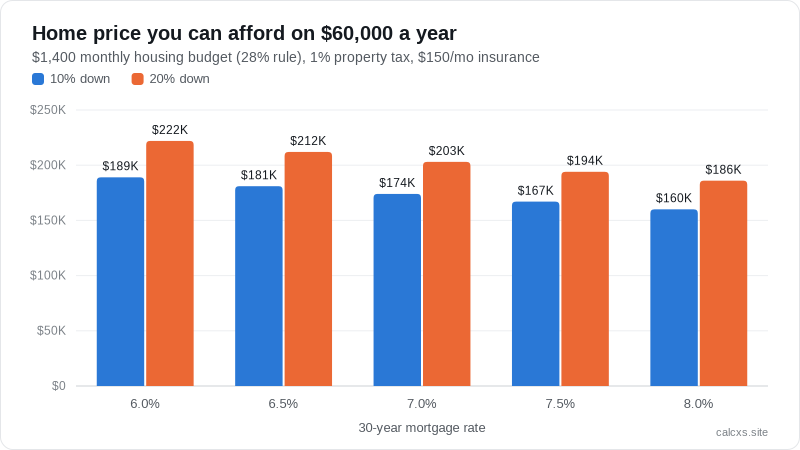 Each half-point of rate moves the affordable price by roughly $7,000 to $10,000.
How Property Taxes Change the Answer
Property taxes are paid every month through your escrow account, so they compete directly with the mortgage for the same budget. With 10% down and a 7.00% rate:
| Property tax rate | Affordable price |
|---|---|
| 0.5% of value per year | $184,000 |
| 1.0% of value per year | $174,000 |
| 2.0% of value per year | $156,000 |
The same $60,000 salary buys roughly $29,000 more house in a low-tax area than in a high-tax one. Look up the actual tax bill for any home you're considering rather than relying on an average. Homeowners insurance works the same way: in areas where premiums are high, the affordable price falls.
What a Lender Might Approve
The 28/36 rule is a planning guideline, not a lender's limit, and lenders often approve more. Freddie Mac's homebuyer guidance suggests spending no more than about 30% of gross monthly income on the mortgage payment, including taxes and insurance: $1,500 on this salary, which would support about $219,000 with 20% down under the same assumptions.
Total debt limits can go much higher. Fannie Mae's guidelines for conventional loans allow a total DTI of up to 45% for some manually underwritten loans and up to 50% for loans approved through its automated system. At 45% of $5,000, minus a $300 car payment, the housing budget would be $1,950: enough, under these assumptions, for a home of about $250,000 with 10% down or $292,000 with 20% down.
That doesn't mean you should borrow that much. A higher payment leaves less for retirement savings, emergencies, and everything else. Remember that the ratios use gross income: if your take-home pay is around $4,000 a month, a $1,950 housing payment plus a $300 car payment would consume more than half of it.
Costs the Rule Doesn't Cover
Even a payment within 28% can feel tight if you don't plan for:
- Maintenance and repairs. Homes need ongoing upkeep, and big items like roofs and water heaters eventually need replacement.
- Utilities, which are often higher in a house than in an apartment.
- Closing costs due at purchase, in addition to the down payment.
- Rising taxes and insurance, which can push your escrow payment up over time even with a fixed-rate loan.
- An emergency fund: ideally kept separate from your down payment savings, so buying the home doesn't leave you with nothing in reserve.
Ways to Afford More
- Pay down other debts. Eliminating a $300 car payment won't raise the 28% cap, but it can free up room when the 36% limit is the binding one.
- Save a larger down payment, which shrinks the loan and can eliminate PMI.
- Improve your credit score before applying to qualify for a better rate.
- Look at lower-tax areas or homes without HOA dues.
- Buy with a co-borrower, whose income counts toward the ratios.
- Ask about first-time buyer and down payment assistance programs, which are offered by many state and local housing agencies.
Putting It Together
On a $60,000 salary, the 28/36 rule caps housing at $1,400 a month, or less if your other debts top $400 a month. Under the example assumptions (a 7.00% rate, 1% property taxes, and $150 a month for insurance) that supports a home of about $174,000 with 10% down or $203,000 with 20% down. Lower rates, lower taxes, and fewer debts push the number up; higher ones pull it down. Lenders may approve you for more, but the 28/36 numbers are a sensible place to start. To compare other incomes under the same assumptions, see the how much house can I afford by salary chart.
Plug in your own income, debts, down payment, and local costs in the home affordability calculator. Use the mortgage calculator to check the payment on a specific home, and the debt-to-income calculator to see where your ratios stand before you talk to a lender.
Frequently Asked Questions
Is $60,000 a good down payment on a house? On many homes, yes. Under this guide's assumptions, $60,000 down with a $1,400 monthly housing budget supports a home of about $220,000: a down payment of roughly 27%, enough to avoid PMI. In higher-cost areas the same $60,000 can fall short of 20%, so compare it with prices where you plan to buy.
Can I afford a $250,000 house on $60,000 a year? Not within the 28/36 rule under these assumptions. With 20% down, the monthly housing payment would be about $1,689, and with 10% down about $1,949: both above the $1,400 guideline. A lender might still approve it, but the payment would take a large share of your take-home pay.
What can I afford with a $60K salary besides a house? The same budgeting logic applies to rent: a common guideline keeps rent near 30% of gross income, or about $1,500 a month on $60,000. The rent affordability calculator works through it.
Does the 28/36 rule use take-home pay? No. It uses gross income before taxes. If you'd rather budget from take-home pay, expect to land on a lower home price.