15-Year vs. 30-Year Mortgage
A side-by-side comparison of 15-year and 30-year mortgages: monthly payments, total interest, equity over time, and how to decide which term fits you.
The two most common mortgage terms in the US are 30 years and 15 years. A 30-year loan spreads the balance over twice as many payments, so each one is smaller. A 15-year loan costs more each month but usually comes with a lower interest rate and builds equity far faster, which can cut the total interest you pay by more than half. Neither is automatically the right choice. This guide compares the two side by side with real numbers, explains where the savings come from, and walks through the questions that decide which term fits your finances.
Why the Term Changes So Much
A mortgage payment has to cover the interest that accrues each month plus enough principal to bring the balance to zero by the end of the term. With a shorter term, more principal has to be repaid each month, so the payment is higher. But a faster-shrinking balance also means less interest accrues each month, and that effect compounds over the life of the loan.
There's a second, separate advantage: lenders typically charge a lower interest rate on 15-year loans than on 30-year loans. A shorter loan is less exposed to long-term rate and credit risk. Freddie Mac's weekly survey of national mortgage rates tracks both terms, and the 15-year average has generally run below the 30-year average.
So the 15-year loan saves interest two ways: a smaller balance for less time, and a lower rate on that balance.
A Side-by-Side Example
Suppose you're borrowing $300,000. The rates below are examples for illustration: check current rates before you decide.
- 30-year fixed at 7.00%
- 15-year fixed at 6.25%
| 30-year | 15-year | |
|---|---|---|
| Monthly principal and interest | $1,995.91 | $2,572.27 |
| Number of payments | 360 | 180 |
| Total paid | $718,527 | $463,008 |
| Total interest | $418,527 | $163,008 |
The 15-year payment is $576.36 higher each month: about 29% more. In exchange, total interest falls by $255,518, and the loan is paid off 15 years sooner.
On the 30-year loan, you'd pay more in interest ($418,527) than you borrowed. On the 15-year loan, interest comes to a bit more than half the loan amount.
How Fast Equity Builds
The difference in equity is just as striking. Here's the remaining balance on each loan over time:
| After | 30-year balance | 15-year balance |
|---|---|---|
| 1 year | $296,953 | $287,530 |
| 5 years | $282,395 | $229,094 |
| 10 years | $257,437 | $132,255 |
| 15 years | $222,057 | $0 |
After five years, the 30-year borrower has paid down only about $17,600 of principal while paying roughly $102,000 in interest. The 15-year borrower has paid down nearly $71,000. That gap matters if you sell, refinance, or need to borrow against your home: more equity means more options, and it provides a cushion if home prices dip.
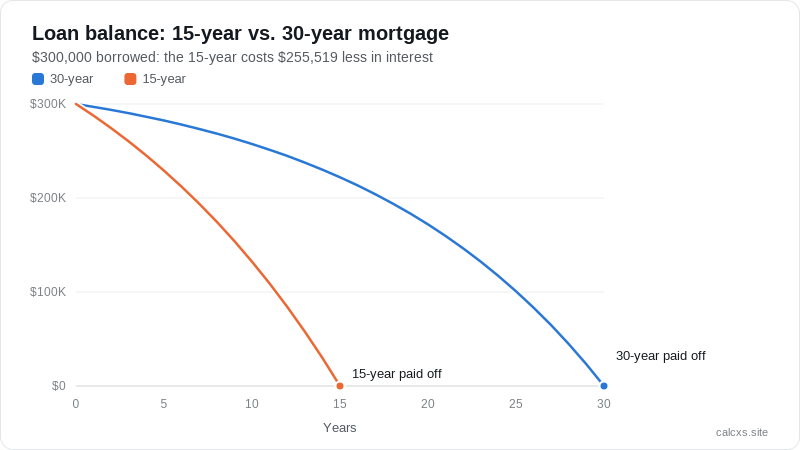 The 15-year balance falls much faster from the very first year.
The Case for a 30-Year Mortgage
The lower payment is not just a convenience. It has real advantages:
- Easier qualification. A lower payment means a lower debt-to-income ratio, which can be the difference between approval and denial, or between two different homes.
- Budget flexibility. If your income drops or an expense spikes, a smaller required payment is easier to keep up with.
- Freedom to prepay. Many mortgages let you pay extra principal whenever you like. With a 30-year loan you can choose to pay as if it were a shorter loan in good months and fall back to the required payment in tight ones.
- Room for other goals. The $576 difference in the example could go to retirement accounts, an emergency fund, or paying off higher-interest debt.
Paying a 30-Year Loan Like a 15-Year Loan
What if you take the 30-year loan but voluntarily pay the 15-year amount of $2,572.27 every month? Because the 30-year loan's rate is higher, it doesn't quite match the 15-year results:
| True 15-year | 30-year paid aggressively | |
|---|---|---|
| Payoff | 180 months | 197 months |
| Total interest | $163,008 | $204,371 |
You'd finish in about 16½ years and pay roughly $41,000 more in interest than with the actual 15-year loan: the price of keeping the option to lower your payment whenever you need to. For some households, that flexibility is well worth it.
The Case for a 15-Year Mortgage
- Far less interest. In the example, the savings exceed a quarter of a million dollars.
- Built-in discipline. The required payment forces fast payoff even when you'd be tempted to spend the difference.
- Debt-free sooner. Owning your home outright by your 50s or early 60s can make retirement much easier to fund, since housing is often the largest expense.
- Faster equity, which reduces the risk of owing more than the home is worth.
The "Invest the Difference" Argument
A common argument for the 30-year loan is to take the lower payment and invest the difference. Whether that works depends on returns you can't know in advance.
In the example, investing the $576.36 monthly difference for 15 years at an assumed 6% annual return (compounded monthly, before taxes) would grow to about $167,617. But at that point, the 30-year borrower still owes $222,057, while the 15-year borrower owes nothing. In this case the 30-year borrower is roughly $54,000 behind.
For investing the difference to come out ahead, your after-tax investment returns generally need to beat your mortgage rate, and you need to actually invest the money every month rather than spend it. Investment returns are uncertain; mortgage interest savings are guaranteed. When mortgage rates are low and you're investing in tax-advantaged accounts, the math is closer; when rates are high, paying down the mortgage looks better.
Taxes
Mortgage interest is deductible only if you itemize deductions on your federal return, and many households take the standard deduction instead. If you do itemize, the deduction reduces the effective cost of interest somewhat, which slightly narrows the gap between the two terms. It rarely changes the conclusion: you don't come out ahead by paying a dollar of interest to save a fraction of a dollar in tax. IRS Publication 936 explains who can deduct mortgage interest and the limits that apply.
How to Decide
Ask yourself these questions:
- Can you afford the 15-year payment comfortably (not just qualify for it) while still saving for retirement and keeping an emergency fund?
- How stable is your income? Variable or commission-based income makes the flexibility of a lower required payment more valuable.
- Do you have higher-interest debt? Paying off a credit card charging 20% or more beats prepaying a mortgage at 6% or 7%.
- Are you capturing any employer retirement match? Skipping a match to fund a higher mortgage payment usually costs more than it saves.
- How long will you stay? If you'll likely sell within a few years, the faster equity of a 15-year loan matters less than your monthly cash flow.
If you answer yes to the first question and your other financial goals are on track, a 15-year loan is hard to beat. If the higher payment would stretch you, a 30-year loan with voluntary extra payments gives you much of the benefit with a safety valve.
Other Terms Exist
Lenders also offer 10-, 20-, and 25-year fixed-rate loans. A 20-year term can be a middle ground: a payment between the two, with a large share of the interest savings. And if you already have a 30-year loan, refinancing into a shorter term later is an option, though it comes with closing costs and depends on the rates available at that time. The refinancing guide shows how to work out the break-even point.
Putting It Together
A 15-year mortgage has a higher payment but a lower rate and a much faster payoff, which together can cut total interest by more than half. A 30-year mortgage costs far more over its life but keeps the required payment low and leaves room for other priorities. If the 15-year payment fits comfortably alongside your savings goals, it's usually the cheaper path; if not, a 30-year loan with extra payments when you can afford them is a sensible compromise.
The mortgage payment chart lists 30-year and 15-year payments side by side for loans from $100,000 to $1,000,000. Run both terms with your own loan amount and rates in the mortgage calculator. If you already have a mortgage, the refinance calculator shows whether moving to a shorter term saves enough to justify the closing costs, and the home affordability calculator shows how each term changes the price you can afford.
Frequently Asked Questions
How much higher is a 15-year mortgage payment? It depends on the loan amount and the two rates. In this guide's example, a $300,000 loan costs $2,572.27 a month over 15 years at 6.25%, versus $1,995.91 over 30 years at 7.00%: $576.36, or about 29%, more.
Is it harder to qualify for a 15-year mortgage? It can be. The higher payment raises your debt-to-income ratio for the same loan amount, so some borrowers qualify for a smaller loan on a 15-year term. Limits vary by lender and loan program. The home affordability calculator shows how each term changes the price you can afford.
Can I switch from a 30-year to a 15-year mortgage later? Yes, by refinancing into a shorter term, which comes with closing costs and depends on the rates available at the time. Another option is to keep the 30-year loan and make extra principal payments, which shortens the payoff without changing the required payment.
Is there a penalty for paying off a mortgage early? Many mortgages have no prepayment penalty, and federal rules restrict them on most loans made today. Whether your loan has one is stated on its Loan Estimate and Closing Disclosure. Check before making large extra payments.