How Extra Mortgage Payments Save Interest
Why extra principal payments save so much interest, with amortization results for monthly extras, one extra payment a year, and lump-sum prepayments.
Paying a little extra on your mortgage is one of the simplest ways to save money on a home, and the savings are often much larger than people expect. An extra $100 or $200 a month can cut years off a 30-year loan and save tens of thousands of dollars in interest. This guide explains why extra payments work so well, shows exactly how much different strategies save on the same loan, and covers the practical details (and tradeoffs) to consider before you start.
Why Extra Payments Work
Each month, your lender charges interest on your current balance. Your regular payment covers that interest first, and whatever is left reduces the principal. Early in a 30-year loan, interest takes most of the payment.
Take a $300,000 loan at 7.00% for 30 years. The monthly principal and interest payment is $1,995.91. In the first month:
Interest = $300,000 × 7.00% ÷ 12 = $1,750.00
Principal = $1,995.91 − $1,750.00 = $245.91
Nearly 88% of that first payment is interest. Only about $246 reduces what you owe.
Now suppose you add $200 to that payment. The entire extra $200 goes to principal, because the interest for the month has already been covered. That lowers the balance the next month's interest is calculated on, and the month after that, and every month for the rest of the loan. Each extra dollar of principal you pay today stops generating interest for as long as the loan would otherwise have lasted.
Because the required payment on a fixed-rate loan doesn't change, the interest you avoid shows up as additional principal in every future payment. The loan pays itself down faster and faster, and it ends early.
What Different Strategies Save
All of the examples below use the same $300,000, 30-year loan at 7.00%. With no extra payments, you'd make 360 payments and pay $418,527 in total interest. These figures come from a month-by-month amortization of the loan; the 7.00% rate is an example, and your own savings depend on your balance, rate, and remaining term.
Extra Every Month
| Extra per month | Payoff time | Time saved | Interest saved |
|---|---|---|---|
| $100 | 25 years, 10 months | 4 years, 2 months | $69,338 |
| $200 | 22 years, 11 months | 7 years, 1 month | $116,640 |
| $500 | 17 years, 4 months | 12 years, 8 months | $200,235 |
An extra $100 a month adds up to roughly $31,000 of additional principal over the shortened life of the loan, and it saves more than twice that in interest. At $500 a month, you save about $200,000 and own the home outright more than a decade early.
One Extra Payment a Year
Making the equivalent of 13 payments a year instead of 12 is a popular approach. You can do it by adding one-twelfth of your payment (here, $166.33) to every monthly payment:
| Strategy | Payoff time | Time saved | Interest saved |
|---|---|---|---|
| One extra payment a year | 23 years, 9 months | 6 years, 3 months | $102,424 |
This is the idea behind biweekly payment plans: paying half the monthly amount every two weeks results in 26 half-payments, or 13 full payments, a year. You can get the same effect on your own by adding one-twelfth of a payment each month. Before signing up for a biweekly program, check whether it charges fees and whether the money is actually applied to your loan every two weeks or held until the full payment is due.
A One-Time Lump Sum
Windfalls such as a bonus, tax refund, or inheritance can go straight to principal. Here's what a single $10,000 prepayment does, depending on when you make it:
| When you pay $10,000 | Time saved | Interest saved |
|---|---|---|
| Month 1 | 3 years | $62,662 |
| Year 5 (month 60) | 2 years, 2 months | $43,092 |
| Year 10 (month 120) | 1 year, 7 months | $28,287 |
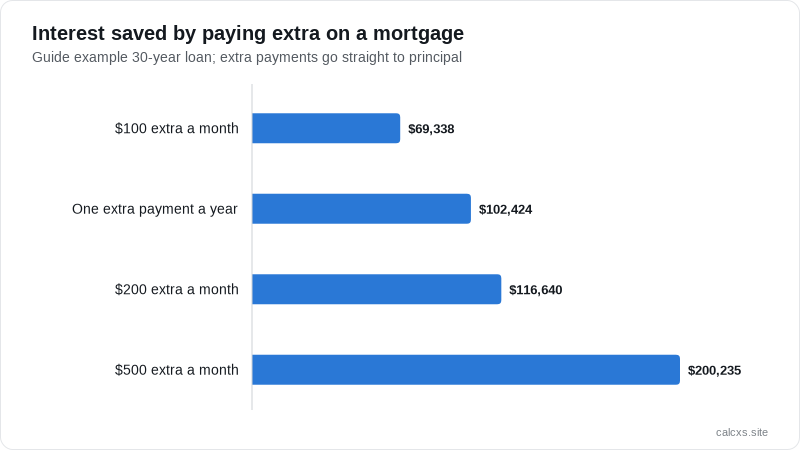 Interest saved over the life of the loan by each strategy.
Earlier Is Better
The lump-sum table shows the most important rule of prepaying: timing matters. The same $10,000 saves more than twice as much interest in month 1 as in year 10, because it has more years in which to avoid interest.
The same is true of monthly extras. An extra $200 a month from the start saves $116,640. If you wait until year 11 to begin paying that same $200 a month, you save $44,243 and finish about 3½ years early: still worth doing, but a much smaller payoff.
That doesn't mean it's ever too late. Any extra principal saves the interest it would have accrued for the rest of the loan. It just means a given dollar goes furthest in the early years.
Your Guaranteed Return
Paying down a 7.00% mortgage is equivalent to earning a guaranteed 7.00% on that money, because every dollar of principal you eliminate stops costing you 7.00% a year. There's no market risk and no tax on the "return."
That's a useful way to compare prepaying against other uses of the money:
- Pay off higher-rate debt first. A credit card at 20% or more is a far better target than a mortgage at 7%.
- Capture any employer retirement match before prepaying. A match is an immediate return that's hard to beat.
- Keep an emergency fund. Money you send to your mortgage is hard to get back out quickly. You can't withdraw extra principal if you lose your job; you'd need to sell, refinance, or borrow against the home.
- Compare with investing. Long-term stock market returns may be higher than your mortgage rate, but they're not guaranteed and they fluctuate. The lower your mortgage rate, the more the comparison favors investing; the higher the rate, the more prepaying looks attractive.
If you itemize deductions on your federal return, the mortgage interest deduction lowers your effective rate somewhat. Many households take the standard deduction, though, in which case the deduction doesn't change the math at all.
Practical Details
Make Sure It Goes to Principal
When you send extra money, tell your servicer to apply it to principal. Otherwise, some servicers may treat it as an early payment of next month's bill instead of a reduction in your balance. Check your next statement to confirm the balance dropped by the full extra amount.
Your Payment Won't Go Down
On a standard fixed-rate mortgage, extra payments shorten the loan; they don't lower the required monthly payment. If you'd rather have a lower payment after a large prepayment, ask your lender whether it offers a recast, which recalculates the payment on the new balance over the remaining term, usually for a fee.
Check for a Prepayment Penalty
Many mortgages have no penalty for paying early, but some do. Your loan documents will say whether a penalty applies and under what conditions.
Prepaying Can End PMI Sooner
If you put down less than 20% on a conventional loan, you're likely paying private mortgage insurance until you build up enough equity. Extra principal payments build equity faster, which can shorten the time until PMI can be removed: an additional saving on top of the interest.
When Extra Payments Make the Most Sense
- You have a stable emergency fund and no high-interest debt.
- You're already saving enough for retirement.
- Your mortgage rate is relatively high.
- You plan to stay in the home for many years.
- You value being debt-free, especially as retirement approaches.
If you might sell within a few years, prepaying still saves interest and leaves you with more equity at sale, but the savings are smaller because the loan won't run long enough for the full effect.
Putting It Together
Extra mortgage payments save interest because every dollar goes straight to principal and stops accruing interest for the rest of the loan. On a $300,000 loan at 7.00%, $200 extra a month saves about $117,000 and seven years, and one extra payment a year saves about $102,000. Start as early as you can, make sure the money is applied to principal, and weigh prepaying against higher-rate debt, retirement savings, and your emergency fund.
To see your own savings, enter your loan and an extra payment amount in the mortgage calculator. For car loans, student loans, and other installment debt, the loan calculator shows the same effect, and the refinance calculator helps you compare prepaying with refinancing into a lower rate or shorter term. The guide to when to refinance explains how to judge that trade-off.
Frequently Asked Questions
How much does an extra $100 a month save on a mortgage? On a $300,000, 30-year loan at 7.00%, an extra $100 a month saves $69,338 in interest and pays the loan off 4 years and 2 months early. Your savings depend on your balance, rate, and remaining term; the mortgage calculator shows your own numbers.
Do biweekly mortgage payments save money? Yes, because 26 half-payments a year add up to 13 full payments instead of 12. On the same $300,000 loan, that saves $102,424 and 6 years and 3 months. You can get the same effect by adding one-twelfth of your payment each month, and it's worth checking any biweekly program for fees.
Is it better to pay off your mortgage early or invest? It depends on your rate and priorities. Prepaying earns a guaranteed return equal to your mortgage rate, while investing may earn more but isn't guaranteed. Paying off higher-rate debt, capturing an employer match, and keeping an emergency fund usually come first.
Is it too late to make extra mortgage payments? No. Any extra principal saves the interest it would have accrued for the rest of the loan, though a given dollar goes furthest early on. On the example loan, starting $200 a month in year 11 still saves $44,243 and ends the loan about 3½ years early.