What Is a Good Debt-to-Income Ratio?
What counts as a good DTI and the limits for conventional, FHA, VA, USDA, and jumbo loans, with a worked example and ways to lower your ratio.
Your debt-to-income ratio (DTI) is one of the first numbers a lender checks, but there's no single cutoff that applies everywhere. Conventional, FHA, VA, and USDA mortgages each set their own limits, auto and personal lenders use their own, and the maximum a lender will approve is usually well above what's comfortable to live with. This guide lays out what counts as a good DTI in general and the limits for each major loan type.
What Is a Good Debt-to-Income Ratio?
DTI is your total monthly debt payments divided by your gross monthly income:
DTI = Monthly debt payments ÷ Gross monthly income × 100
As a general guide for the back-end ratio, all debt payments, including housing:
| DTI | What it generally means |
|---|---|
| Under 36% | Good. Within the traditional 28/36 guideline; most loans are available and the budget has breathing room. |
| 36% to 43% | Manageable. Most mortgage programs still approve it, but expect closer scrutiny and less flexibility in the budget. |
| 43% to 50% | High. Some programs allow it with strong credit, savings, or automated approval; the budget is tight. |
| Over 50% | Very high. Few mortgage options; more than half of pre-tax income already goes to debt. |
For the front-end ratio (housing alone) 28% or less is the traditional target.
If you haven't calculated yours yet, start with how to calculate your debt-to-income ratio.
DTI Limits by Loan Type
Limits depend on the program, how the loan is underwritten, and your credit score and savings. Individual lenders can also set stricter limits than the program allows.
| Loan type | Typical housing (front-end) limit | Typical total (back-end) limit |
|---|---|---|
| Conventional, manual underwriting | N/A | 36%, up to 45% with strong credit and reserves |
| Conventional, automated underwriting (Fannie Mae) | N/A | Up to 50% |
| FHA | 31% | 43%, higher with compensating factors or automated approval |
| VA | N/A | 41% guideline, combined with residual income |
| USDA | 29% | 41% |
| Jumbo | Varies by lender | Often around 43%, sometimes lower |
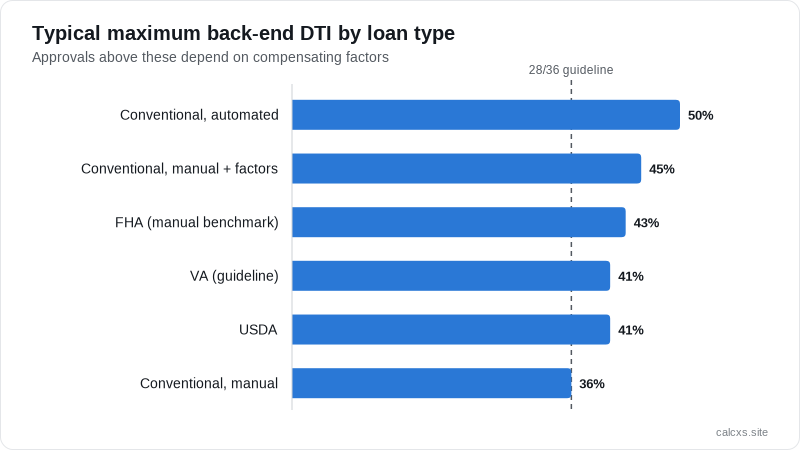 Typical back-end DTI limits; approvals above these depend on compensating factors.
Conventional Loans
Conventional loans that follow Fannie Mae's guidelines set the limits most lenders use:
- Manually underwritten loans: a maximum total DTI of 36%, which can rise to 45% if the borrower meets higher credit score and cash reserve requirements.
- Loans approved through Fannie Mae's automated system (Desktop Underwriter): a maximum of 50%.
Most conventional loans today are approved through automated underwriting, which is why you'll often hear "50%" as the conventional maximum. In practice, a ratio near 50% is approved only when the rest of the application is strong.
FHA Loans
FHA loans are designed for borrowers with smaller down payments or lower credit scores. Under HUD's underwriting guidelines, manually underwritten FHA loans use benchmark ratios of 31% housing and 43% total. Those limits can go higher when a borrower has compensating factors, such as significant cash reserves, a minimal increase in housing payment, or residual income. Loans approved through FHA's automated scorecard can be approved at higher ratios when the rest of the file supports it.
VA Loans
VA loans use a 41% DTI guideline, but it isn't a hard cap. VA also requires residual income: the money left each month after major expenses, which varies by family size and region. A borrower over 41% can still be approved with a written justification from the lender, and if residual income is at least 20% above VA's guideline, that extra review isn't required. Conversely, a borrower under 41% still needs adequate residual income.
USDA Loans
USDA guaranteed loans for rural and some suburban areas set a 29% limit for the housing payment (principal, interest, taxes, insurance, and association dues) and a 41% limit for total debt. Loans can exceed these with compensating factors.
Jumbo Loans
Jumbo loans exceed the conforming loan limits that Fannie Mae and Freddie Mac can buy, so each lender sets its own rules. Many cap DTI around 43%, and some go lower or require larger reserves in exchange for a higher ratio.
Auto Loans and Personal Loans
Car lenders and personal loan lenders don't publish universal DTI limits. Many prefer a total DTI under about 40% to 50%, including the new payment, and weigh it alongside your credit score and income stability. A lower DTI often qualifies you for a better rate, not just an approval.
A Worked Example by Loan Type
Say your gross income is $7,000 a month, and you have $600 a month in car and student loan payments. You're considering a home with a total housing payment of $2,100.
- Front-end DTI: $2,100 ÷ $7,000 = 30.0%
- Back-end DTI: ($2,100 + $600) ÷ $7,000 = $2,700 ÷ $7,000 = 38.6%
How that plays out:
| Program | Housing limit | Total limit | Result |
|---|---|---|---|
| Conventional (automated) | N/A | 50% | Within the limit |
| Conventional (manual) | N/A | 36% (45% with factors) | Needs strong credit and reserves |
| FHA | 31% | 43% | Within both benchmarks |
| VA | N/A | 41% | Within the guideline; residual income must also qualify |
| USDA | 29% | 41% | Housing ratio slightly over 29% |
The same borrower looks different under each program. To bring the USDA housing ratio down to 29%, the housing payment would need to fall to $2,030 a month.
The Maximum vs. What's Comfortable
Being approved at 45% or 50% doesn't mean the payment is affordable. DTI ignores taxes, groceries, utilities, child care, and saving for retirement. At a 50% DTI, half of your pre-tax income goes to debt payments before any of those are paid.
A few signs your DTI is high for your budget, even if a lender approves it:
- You can't save at least 10% to 15% of income for retirement.
- You don't have an emergency fund, or can't add to it.
- Unexpected costs go on a credit card.
How to Improve Your DTI
- Pay off small debts entirely. A paid-off card or loan removes its payment from the ratio completely.
- Target the largest payment relative to its balance, often a car loan near the end of its term.
- Avoid new debt before applying, including financing furniture or a new car.
- Add documented income, such as a co-borrower or stable second job.
- Lower the housing payment with a cheaper home, a larger down payment, or by shopping for insurance.
The debt payoff calculator shows how fast you can clear the debts that are holding your ratio up.
Putting It Together
A DTI under 36% is good by almost any standard. Between 36% and 43%, most mortgage programs still work. Above 43%, you'll depend on automated approval, compensating factors, or a program with higher limits, and the budget will be tight. Know which program you're applying for, because conventional, FHA, VA, and USDA loans each measure the ratio a little differently.
Use the debt-to-income calculator to find your front-end and back-end ratios, and the home affordability calculator to see the price a given ratio supports.
Frequently Asked Questions
Is 40% a good debt-to-income ratio? It's above the traditional 36% guideline but within the limits of most mortgage programs. Lenders may look more closely at your credit and savings, and your monthly budget will have less room.
What is the maximum DTI for a mortgage? For conventional loans through Fannie Mae's automated system, 50%. FHA and VA loans can be approved above their benchmarks with compensating factors. There's no universal maximum.
Does DTI include rent? When you apply for a mortgage, the lender uses the proposed mortgage payment instead of your current rent. For other loans, lenders often include rent in your monthly obligations.
Does DTI affect my credit score? No. Credit reports don't include income, so DTI isn't part of your credit score. Lenders calculate it separately.