How Much House Can I Afford?
How lenders and financial planners think about affordability, and the income, debt, and down payment rules that determine your budget.
Lenders and financial planners don't answer "how much house can I afford" with a single number: they use ratios that connect your income, your existing debt, and your down payment. Understanding those ratios lets you answer the question yourself, before a lender does it for you. This guide applies the 28/36 rule at several incomes, shows what the down payment and PMI change, adds up the full cost of owning, and stress-tests the result.
The Front-End Ratio: Housing Cost vs. Income
The front-end ratio compares your total monthly housing cost (principal, interest, property tax, insurance, and any HOA fee) to your gross monthly income. A commonly cited guideline caps this around 28%, though conventional loans can sometimes go higher depending on the lender and your overall financial profile. On a $7,000 monthly gross income, a 28% front-end ratio points to roughly $1,960 a month available for housing costs combined.
The Back-End Ratio: Total Debt vs. Income
The back-end ratio, also called debt-to-income (DTI), adds your other debt payments (car loans, student loans, credit card minimums) on top of housing costs, then compares the total to gross income. The classic guideline is 36%, and many loan programs allow 43% or more depending on the loan type and your credit profile. This ratio is often the binding constraint: a low front-end ratio doesn't help if other debt pushes your back-end ratio too high.
For what counts as debt, see how to calculate your debt-to-income ratio or the debt-to-income calculator.
The 28/36 Rule at Different Incomes
Your housing budget is the lower of two limits:
Housing budget = lesser of:
  28% × gross monthly income
  36% × gross monthly income − other monthly debt payments
Here's the same $600 a month of other debt (say, a car payment and a student loan) at four household incomes:
| Annual income | 28% limit | 36% limit minus $600 | Housing budget |
|---|---|---|---|
| $50,000 | $1,167 | $900 | $900 |
| $80,000 | $1,867 | $1,800 | $1,800 |
| $120,000 | $2,800 | $3,000 | $2,800 |
| $160,000 | $3,733 | $4,200 | $3,733 |
At $50,000 and $80,000, the back-end limit binds: the $600 in other debt eats into the housing budget dollar for dollar. At $120,000 and above, the 28% cap takes over. The switch happens where other debt equals 8% of gross income, the gap between 36% and 28%. Above that line, paying off debt raises your housing budget; at $80,000, eliminating just $67 of monthly debt would lift it from $1,800 to about $1,867. The auto loan calculator and credit card payoff calculator help you see how fast those payments can go away.
The $60,000 case, including how rates and property taxes shift the answer, is worked through in how much house can I afford on $60K. If you've saved $60,000 rather than earn it, see whether $60,000 is a good down payment.
From Budget to Home Price
Converting a budget into a price takes assumptions. These are examples, yours will differ:
- 30-year fixed mortgage at 7.00% (an example rate, not a quote)
- Property taxes of 1.0% of the home's value per year
- Homeowners insurance of 0.5% of the home's value per year
- PMI of 0.5% of the loan amount per year when less than 20% is down
- No HOA dues
| Housing budget | Price with 10% down | Price with 20% down |
|---|---|---|
| $900 | about $118,000 | about $137,000 |
| $1,800 | about $236,000 | about $274,000 |
| $2,800 | about $368,000 | about $426,000 |
| $3,733 | about $490,000 | about $568,000 |
The home affordability calculator runs this with your own numbers, and the how much house can I afford by salary chart covers 13 salaries from $40,000 to $200,000 with no other debts.
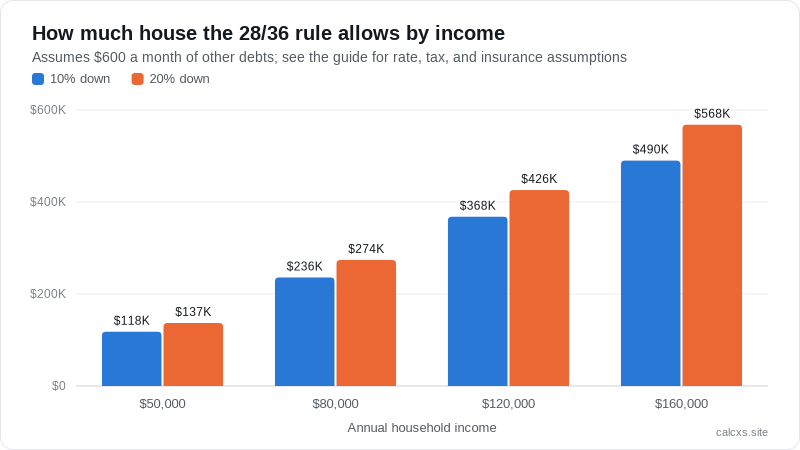 Home price under the 28/36 rule at four incomes, with 10% or 20% down.
The Down Payment's Double Effect
A larger down payment does two things simultaneously: it reduces the loan amount (and therefore the monthly principal-and-interest payment), and (if it reaches 20% of the home price) it typically eliminates private mortgage insurance (PMI), an added monthly cost. Both effects push more home price into reach for the same monthly budget.
A $400,000 Home at Three Down Payments
Using the same example assumptions:
| 5% down | 10% down | 20% down | |
|---|---|---|---|
| Down payment | $20,000 | $40,000 | $80,000 |
| Loan amount | $380,000 | $360,000 | $320,000 |
| Principal and interest | $2,528.15 | $2,395.09 | $2,128.97 |
| Property taxes | $333.33 | $333.33 | $333.33 |
| Homeowners insurance | $166.67 | $166.67 | $166.67 |
| PMI | $158.33 | $150.00 | $0 |
| Monthly total | $3,186.48 | $3,045.09 | $2,628.97 |
Going from 10% to 20% down costs $40,000 more in cash and lowers the monthly payment by $416.12: about $266 of that from the smaller loan and $150 from dropping PMI.
PMI Doesn't Last Forever
On conventional loans, the Homeowners Protection Act lets you ask the lender to cancel PMI once your balance is scheduled to reach 80% of the home's original value, and requires it to end automatically at 78%, provided you're current on payments. Following the original amortization schedule in this example:
| Down payment | Reaches 80% of original value | Automatic cancellation at 78% |
|---|---|---|
| 5% | Month 130 (about 10.8 years) | Month 142 (about 11.8 years) |
| 10% | Month 101 (about 8.4 years) | Month 115 (about 9.6 years) |
With 10% down, PMI at $150 a month until automatic cancellation adds up to about $17,250; with 5% down, about $22,483. Extra principal payments reach those thresholds sooner. FHA loans follow different mortgage insurance rules.
The Full Cost of Ownership
Property tax, home insurance, HOA fees, and maintenance are easy to underestimate when focusing on the loan itself, but they're a real and ongoing part of the cost of owning. A home that looks affordable based on principal and interest alone can strain a budget once these are added in.
Taking the $400,000 home with 10% down from above, here's how the monthly cost builds up:
| Layer | Monthly | Running total |
|---|---|---|
| Principal and interest | $2,395.09 | $2,395.09 |
| Property taxes | $333.33 | $2,728.42 |
| Homeowners insurance | $166.67 | $2,895.09 |
| PMI | $150.00 | $3,045.09 |
| Maintenance reserve (1% of value a year) | $333.33 | $3,378.42 |
The loan payment alone is about 71% of the true monthly cost. The 1% maintenance figure is a planning assumption, not a measured average: older homes and harsher climates can need more, and repairs arrive in lumps.
Lenders count the first four lines in your ratios; keeping that $3,045.09 at 28% of gross income takes about $130,500 a year. Maintenance appears in no lender ratio, which is why it's easy to forget. Also budget for HOA dues if any, higher utilities, closing costs, and escrow payments that can rise every year even on a fixed-rate loan.
Stress-Testing Your Budget
Take the $120,000 household from above, buying a home at about $426,000 with 20% down: a monthly housing payment of about $2,800, exactly 28% of gross income, plus $600 in other debt.
| Scenario | Monthly housing | Housing ratio | Total ratio |
|---|---|---|---|
| Base case | $2,799.85 | 28.0% | 34.0% |
| Rate rises from 7% to 8% before you lock | $3,033.17 | 30.3% | 36.3% |
| Taxes and insurance rise 25% | $2,932.98 | 29.3% | 35.3% |
| Household income falls 20% to $96,000 | $2,799.85 | 35.0% | 42.5% |
None of these scenarios is extreme. Each pushes housing past 28%, and two push total debt past 36%. A few ways to build in margin:
- Target less than 28%. Budgeting 25% of gross income ($2,500 a month here) supports a home of about $380,000 under the same assumptions.
- Rerun the payment at a higher rate in the mortgage calculator. If one point breaks the budget, you're shopping at the edge.
- Keep reserves after closing. Three months of this household's housing and debt payments is about $10,200; six months is about $20,400.
- Test on take-home pay. Bills are paid from net pay, alongside savings, child care, and everything else the ratios ignore.
Fannie Mae's automated underwriting allows total DTI up to 50% on conventional loans, but an approval shows what a lender allows, not what your budget can comfortably carry.
Putting It Together
Start with your gross monthly income, apply a front-end ratio to estimate a housing budget, check that budget against your back-end ratio with existing debt included, and then work backward to a home price using your planned down payment and current mortgage rates. Then add the costs lenders don't count and test whether the payment survives higher rates, taxes, or lower income.
The mortgage calculator will show you the exact monthly payment (including tax, insurance, and PMI) for any home price and down payment combination, so you can test different scenarios against your own budget directly.
Frequently Asked Questions
How much house can I afford making $120,000 a year? With $600 a month in other debt, the 28/36 rule points to a housing budget of about $2,800 a month. Under this guide's example assumptions, that supports a home of about $368,000 with 10% down or about $426,000 with 20% down. Your rate, taxes, and debts will move the answer, so run your own numbers in the home affordability calculator.
Can I get a mortgage with a debt-to-income ratio over 36%? Often, yes. Many loan programs allow 43% or more depending on the loan type and your credit, and Fannie Mae's automated underwriting allows up to 50% on conventional loans. Limits vary by lender and loan, and a higher ratio leaves less room in your monthly budget.
When does PMI go away on a conventional loan? You can ask the lender to cancel it once your balance is scheduled to reach 80% of the home's original value, and it must end automatically at 78% if you're current on payments. In this guide's 10%-down example, that automatic cutoff comes at month 115, about 9.6 years in. FHA loans follow different mortgage insurance rules.
How much should I budget for home maintenance? A common planning assumption is 1% of the home's value a year: about $333 a month on a $400,000 home. Older homes and harsher climates can need more, and repairs tend to arrive in lumps rather than evenly. Lenders don't count maintenance in their ratios, so it's up to you to plan for it.