Is $60,000 a Good Down Payment on a House?
What $60,000 covers at different home prices, how it affects PMI and your monthly payment, and whether to put all of it down.
Sixty thousand dollars is a lot of money to save, and it's a strong start on a home purchase. Whether it's a good down payment depends almost entirely on the price of the home you're buying. On a $300,000 house it's a full 20%; on a $750,000 house it's 8%. This guide shows what $60,000 covers at different prices, what it means for your monthly payment and mortgage insurance, and how to decide whether to put all of it down.
The Short Answer
$60,000 is a good down payment for homes priced up to about $300,000, where it reaches the 20% mark that avoids private mortgage insurance on a conventional loan. Above that, it's still a solid down payment (well above the 3% to 3.5% minimums on many loan programs) but you'll likely pay mortgage insurance, and the monthly payment rises quickly with the price.
You also need money beyond the down payment for closing costs, moving, and an emergency fund. If $60,000 is everything you have, the right target price is lower than the math alone suggests.
What Percentage Is $60,000?
Down payment percentage = Down payment ÷ Home price × 100
| Home price | $60,000 as a down payment | Loan amount |
|---|---|---|
| $200,000 | 30.0% | $140,000 |
| $300,000 | 20.0% | $240,000 |
| $400,000 | 15.0% | $340,000 |
| $500,000 | 12.0% | $440,000 |
| $600,000 | 10.0% | $540,000 |
| $750,000 | 8.0% | $690,000 |
The highest price at which $60,000 is a 20% down payment is $300,000.
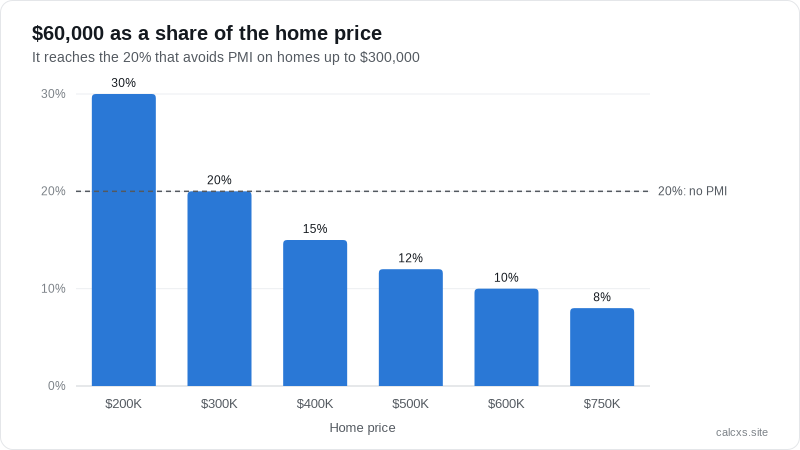 $60,000 reaches 20% down only on homes up to $300,000.
Why 20% Matters
On a conventional mortgage, putting down less than 20% usually means paying private mortgage insurance (PMI). PMI protects the lender, not you, and it's added to your monthly payment until you build 20% equity.
The good news is that PMI isn't permanent. Under federal rules, you can ask your servicer to cancel it once your balance is scheduled to reach 80% of the home's original value, and the servicer generally must end it automatically at 78%, as long as you're current on payments. Extra payments toward principal get you there sooner.
FHA loans work differently: they charge their own mortgage insurance premiums, which on many loans last for the life of the loan regardless of how much you put down.
What $60,000 Down Means for Your Monthly Payment
Here's the estimated monthly housing payment at three prices, using example assumptions: a 30-year fixed rate of 6.5%, property taxes of 1% of the price a year, $150 a month for homeowners insurance, and PMI of 0.5% of the loan a year when the down payment is under 20%. Your actual rate, taxes, insurance, and PMI will differ.
| $300,000 home | $400,000 home | $500,000 home | |
|---|---|---|---|
| Down payment | 20% | 15% | 12% |
| Loan amount | $240,000 | $340,000 | $440,000 |
| Principal and interest | $1,517 | $2,149 | $2,781 |
| PMI | $0 | $142 | $183 |
| Property taxes | $250 | $333 | $417 |
| Insurance | $150 | $150 | $150 |
| Total monthly payment | $1,917 | $2,774 | $3,531 |
| Income for a 28% housing ratio | ≈ $82,000 | ≈ $119,000 | ≈ $151,000 |
The last row uses the common guideline of keeping the housing payment at or below 28% of gross income. With $60,000 down, a household earning around $82,000 a year fits a $300,000 home under that guideline; a $500,000 home calls for about $151,000.
Should You Put All $60,000 Down?
Not necessarily. A bigger down payment lowers your payment, your interest costs, and your PMI, but it also ties up cash you might need.
Compare putting $60,000 versus $30,000 down on a $300,000 home with the same assumptions:
| $60,000 down (20%) | $30,000 down (10%) | |
|---|---|---|
| Loan amount | $240,000 | $270,000 |
| Monthly payment (incl. taxes, insurance, PMI) | $1,917 | $2,219 |
| PMI | None | $113 a month until about 20% equity |
| Interest over 30 years | ≈ $306,000 | ≈ $344,000 |
| Cash kept in reserve | $0 | $30,000 |
Putting all $60,000 down saves about $300 a month and roughly $38,000 of interest over the full term. Keeping $30,000 in the bank gives you a cushion for repairs, job loss, or other emergencies, and with regular payments alone, the 10%-down loan reaches 80% of the original value in about eight years, when PMI can be dropped.
Keep Enough for Everything Else
Before deciding how much to put down, set aside money for:
- Closing costs. Lender fees, title insurance, appraisal, prepaid taxes and insurance. These commonly run a few percent of the loan amount.
- Moving and immediate repairs. New homes almost always need something.
- An emergency fund. Three to six months of essential expenses, including the new mortgage payment. See how much to keep in an emergency fund.
- Lender reserves. Some loans require you to show a few months of payments in savings after closing.
If those costs come out of the same $60,000, your actual down payment may be closer to $40,000 or $45,000.
When $60,000 Down Makes Sense
- You're buying in a moderately priced market, where $60,000 reaches or comes close to 20%.
- You already have a separate emergency fund and money for closing costs.
- You want the lowest possible payment and the least interest.
When to Put Down Less
- The $60,000 is all your savings. Keeping a cushion protects you from having to borrow on credit cards after a surprise repair.
- You have high-interest debt. Paying off a credit card at 24% usually beats reducing a mortgage at 6.5%.
- You qualify for a low-down-payment program with favorable terms, such as a VA loan or a first-time buyer program, and would rather keep cash.
Putting It Together
$60,000 is a 20% down payment on a $300,000 home, enough to avoid PMI on a conventional loan. On pricier homes it's still a substantial down payment, but you'll likely pay mortgage insurance, and the monthly payment grows quickly. Make sure the down payment leaves enough for closing costs and an emergency fund, and judge the purchase by the monthly payment you can carry comfortably, not just the amount you can put down.
The mortgage calculator shows the payment for any price and down payment, and the home affordability calculator estimates the price your income supports. For more on the income side, see how much house you can afford.
Frequently Asked Questions
How much house can I buy with $60,000 down? It depends on your income, debts, and interest rate more than the down payment. With 20% down and no PMI, $60,000 fits a $300,000 home. Lenders will approve higher prices if your income supports the payment.
Is it better to put 20% down or keep cash? Twenty percent down avoids PMI and lowers your payment, but it isn't worth emptying your savings. Many buyers are better off putting down less and keeping a solid emergency fund.
What's the minimum down payment on a house? Some conventional loans allow 3% down, FHA loans allow 3.5% with qualifying credit, and VA and USDA loans can require no down payment for eligible borrowers.
Does a bigger down payment get a lower interest rate? Often, yes. Lenders price loans partly on the loan-to-value ratio, so a larger down payment can qualify for a better rate or lower mortgage insurance.