Fixed vs. Adjustable-Rate Mortgage: Which Is Right for You?
How fixed-rate mortgages and ARMs work, what 5/1 and 5/6 mean, how index, margin, and rate caps set your future rate, and a worst-case payment example.
One of the first choices you make when you finance a home is whether the interest rate should be locked for the life of the loan or allowed to change over time. A fixed-rate mortgage keeps the same rate and the same principal-and-interest payment until the loan is paid off. An adjustable-rate mortgage (ARM) starts with a rate that's fixed for a few years (usually lower than a comparable fixed rate) and then resets periodically based on market rates. This guide explains how ARMs are built, what the numbers in a name like "5/6" mean, how rate caps limit the damage, and how to decide which type fits your situation.
Fixed vs. Adjustable Rate at a Glance
| Fixed-rate mortgage | Adjustable-rate mortgage (ARM) | |
|---|---|---|
| Interest rate | Same for the life of the loan | Fixed for an initial period, then resets |
| Starting rate | Usually higher | Usually lower |
| Monthly payment | Principal and interest never change | Can rise or fall after the fixed period |
| Risk of rising rates | Lender carries it | You carry it, within the caps |
| Best fit | Staying long-term, tight budget, wants certainty | Moving or refinancing before the reset, room in the budget |
How a Fixed-Rate Mortgage Works
A fixed-rate mortgage is the simple case. The interest rate set at closing never changes, so the monthly principal and interest stay the same for the entire term: typically 30 or 15 years. Your total housing payment can still rise if property taxes or insurance premiums go up, but the loan part won't.
The tradeoff is price. Lenders take on the risk that rates will rise while your loan sits at its original rate, and they usually charge for that with a somewhat higher starting rate than an ARM's introductory rate.
How an Adjustable-Rate Mortgage Works
An ARM has two phases:
- The initial fixed period. The rate is locked for a set number of years, commonly 3, 5, 7, or 10.
- The adjustment period. After that, the rate resets at regular intervals for the rest of the loan.
Reading the Name
ARM names tell you both phases. The first number is the length of the initial fixed period in years. The second number describes how often the rate adjusts afterward:
- A 5/1 ARM is fixed for five years, then adjusts once a year.
- A 5/6 ARM is fixed for five years, then adjusts every six months.
- A 7/6 or 10/6 ARM follows the same pattern with a seven- or ten-year fixed period.
Many newer conventional ARMs use the six-month adjustment schedule.
Index Plus Margin
When an ARM adjusts, the new rate isn't set at the lender's discretion. It's calculated from a formula written into your loan documents:
New rate = Index + Margin
The index is a published benchmark rate that moves with the market. For ARMs that Fannie Mae buys, the index is the 30-day average of the Secured Overnight Financing Rate (SOFR), published by the Federal Reserve Bank of New York. SOFR reflects the cost of borrowing cash overnight using Treasury securities as collateral.
The margin is a fixed number of percentage points added to the index. It's set when you take out the loan and doesn't change. Fannie Mae, for example, caps the margin on the loans it buys at 3 percentage points. The sum of the index and margin (the fully indexed rate) is usually rounded to the nearest one-eighth of a percent.
Rate Caps
Caps limit how far the rate can move. They're usually written as three numbers, such as 2/1/5:
- Initial adjustment cap (2): the most the rate can change at the first reset.
- Periodic cap (1): the most it can change at each later reset.
- Lifetime cap (5): the most it can ever rise above the starting rate.
Caps are the single most important feature to understand before choosing an ARM, because they define your worst case. Under Fannie Mae's rules, lifetime caps limit increases, while per-adjustment caps apply to both increases and decreases, so a cap can also slow how fast your rate falls.
A Worked Example
Suppose you're borrowing $350,000 for 30 years and you're offered two loans. These rates are examples for illustration; actual rates change constantly, and Freddie Mac publishes weekly national averages for fixed-rate mortgages if you want a current benchmark.
- A 30-year fixed at 7.00%
- A 5/6 ARM at 6.25% for the first five years, with 2/1/5 caps
The First Five Years
| 30-year fixed | 5/6 ARM | |
|---|---|---|
| Monthly principal and interest | $2,328.56 | $2,155.01 |
| Interest paid in years 1–5 | $119,174 | $105,981 |
| Balance after 5 years | $329,461 | $326,680 |
The ARM saves $173.55 a month, or about $10,413 over the five-year fixed period. Because more of each payment goes to principal at the lower rate, the ARM's balance is also about $2,780 lower at the end of year five.
What Happens at the First Reset
At month 61, the ARM's rate becomes the index plus the margin, limited by the caps. Assume a margin of 2.75%. The new payment is calculated on the remaining $326,680 balance over the remaining 25 years:
| Scenario at reset | New rate | New payment |
|---|---|---|
| Index falls to 2.75% | 5.50% | $2,006 |
| Index is 3.50% | 6.25% | $2,155 |
| Index rises to 4.75% | 7.50% | $2,414 |
| Index jumps; first cap applies | 8.25% | $2,576 |
If rates fall, the ARM's payment drops and the gap with the fixed loan widens. If the index rises to 4.75%, the payment climbs about $259 a month and ends up around $85 above the fixed loan's payment.
The Worst Case
The caps tell you exactly how bad it can get. With 2/1/5 caps starting at 6.25%, the rate can rise to 8.25% at the first reset, then by up to one point every six months, and never above 11.25%:
| Months | Maximum rate | Maximum payment |
|---|---|---|
| 1–60 | 6.25% | $2,155 |
| 61–66 | 8.25% | $2,576 |
| 67–72 | 9.25% | $2,795 |
| 73–78 | 10.25% | $3,019 |
| 79 onward | 11.25% | $3,246 |
In this worst case, the payment rises by about $1,091 a month (roughly 50%) within two years of the first reset. That's the risk you're accepting in exchange for the lower starting payment. It's not the expected outcome, but you should be able to survive it, either by affording the payment or by having a realistic plan to sell or refinance.
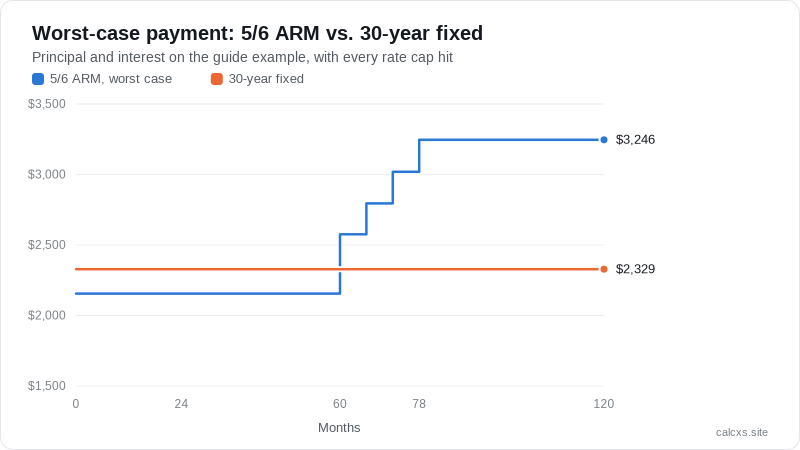 The ARM is cheaper for five years; in the worst case it costs about $900 a month more by month 79.
When an ARM Can Make Sense
An ARM tends to fit when one or more of these is true:
- You're confident you'll sell or move before the fixed period ends. If you sell in year four, you collect the lower rate and never see a reset.
- You expect your income to rise substantially, so a higher future payment would still be comfortable.
- The gap between ARM and fixed rates is wide, making the early savings meaningful.
- You have a cushion of savings that could absorb a few years of higher payments.
When a Fixed Rate Is the Better Choice
A fixed rate usually wins when:
- You plan to stay in the home for many years, well past the initial fixed period.
- Your budget is already tight, and a payment increase of a few hundred dollars would cause real hardship.
- The rate difference is small, so you're taking on reset risk for little savings.
- You value predictability. A payment that never changes makes long-term budgeting easier.
Common Misconceptions
- "I'll just refinance before it resets." That may work, but it depends on rates, home values, your credit, and your income at that future date. Refinancing also has closing costs. Treat it as an option, not a guarantee, and see when refinancing makes sense for the break-even math.
- "The cap protects me." Caps limit how fast and how far the rate rises, but a 5-point lifetime cap still allows a very large payment increase.
- "Lenders qualify me for the worst case." Not necessarily. For ARMs with initial fixed periods of five years or less, Fannie Mae requires lenders to qualify borrowers using a higher qualifying rate to limit payment shock, but that's still not the full lifetime maximum.
- "Fixed is always more expensive." If rates fall, a fixed-rate borrower can refinance; if they rise, the fixed borrower is protected. That flexibility has real value.
Questions to Ask a Lender
- What is the index, and what is the margin?
- What are the initial, periodic, and lifetime caps?
- How often does the rate adjust after the fixed period?
- What would my payment be at the maximum possible rate?
- Is there a prepayment penalty if I sell or refinance early?
Putting It Together
A fixed-rate mortgage buys certainty: the principal-and-interest payment you sign for is the one you'll pay for decades. An ARM buys a lower starting rate, but after the fixed period your rate follows the index plus the margin, limited only by the caps. Choose an ARM when you have a clear reason to expect you won't hold the loan past the fixed period and you could handle the worst-case payment; otherwise, the predictability of a fixed rate is usually worth the premium.
Use the mortgage calculator to compare payments at different rates, including an ARM's worst-case rate. If you already have an ARM approaching its reset, the refinance calculator shows whether switching to a fixed rate pays off, and the home affordability calculator helps you test whether a higher future payment would still fit your budget.
Frequently Asked Questions
Is a fixed or adjustable rate better right now? It depends less on the headline rates than on how long you'll keep the loan. Compare the ARM's savings during its fixed period against its worst-case payment afterward. If you'd keep the loan well past the reset, the fixed rate's certainty is usually worth paying for.
Is it harder to qualify for an ARM? It can be. Lenders often qualify ARM borrowers at a rate above the introductory rate, to make sure the payment is still affordable after it adjusts, so the same income may support a smaller ARM than you'd expect from the starting payment alone.
Can I switch from an ARM to a fixed rate later? Usually by refinancing, which means qualifying again and paying closing costs. Refinancing is never guaranteed, if rates have risen or your finances have changed, the fixed rate available to you may be higher than the one you passed up.
Does a fixed-rate mortgage payment ever change? The principal and interest don't. If your taxes and insurance are paid through an escrow account, though, your total monthly payment can still rise when those costs go up.