Debt Snowball vs. Debt Avalanche: Which Is Better?
How the debt snowball and debt avalanche methods work, a side-by-side worked example, and how to choose between motivation and interest savings.
If you have several debts and want to pay them off faster than the minimums allow, you need a plan for where the extra money goes. The two most popular plans are the debt snowball and the debt avalanche. Both work, and both are far better than spreading extra payments randomly. They differ in one decision (which debt to attack first) and that single choice trades a little money for a lot of motivation, or the reverse. This guide explains how each method works, runs both on the same set of debts, and helps you choose.
What the Two Methods Have in Common
Both strategies follow the same basic structure:
- List every debt with its balance, interest rate, and minimum payment.
- Decide on a fixed monthly amount you'll put toward debt: more than the sum of your minimums.
- Pay the minimum on every debt every month, so nothing falls behind.
- Send all the extra money to one target debt until it's paid off.
- Roll that debt's payment into the next target. When one debt disappears, its minimum payment doesn't go back into your budget: it joins the extra money aimed at the next debt on the list.
That last step is what gives both methods their power. The amount going to your current target grows each time you knock out a debt, so payoff speeds up as you go.
The only difference is the order of the list.
The Debt Snowball: Smallest Balance First
With the snowball method, you order your debts from smallest balance to largest, regardless of interest rate. You throw your extra money at the smallest one first.
The appeal is psychological. Small balances disappear quickly, giving you early, visible wins. Each paid-off account is one less bill, one less statement, and proof that the plan is working. The approach was popularized largely on the argument that for many people, paying off debt is more a behavior problem than a math problem, and that the motivation from quick wins keeps people going long enough to finish.
The Debt Avalanche: Highest Interest Rate First
With the avalanche method, you order your debts from highest interest rate to lowest, regardless of balance. Extra money goes to the most expensive debt first.
The appeal is mathematical. Interest is the cost of carrying debt, and every extra dollar sent to your highest-rate balance eliminates the most expensive interest first. Given the same monthly budget, paying debts in this order results in the least total interest of any order, and it typically gets you debt-free as fast or faster.
The downside is that your highest-rate debt might also be your largest, and it could take many months before you pay off a single account.
A Worked Example
Suppose you have three debts and can put $600 a month toward them in total:
| Debt | Balance | APR | Minimum payment |
|---|---|---|---|
| Store card | $1,200 | 15% | $40 |
| Credit card | $6,000 | 24% | $180 |
| Car loan | $4,500 | 6% | $150 |
| Total | $11,700 | $370 |
The minimums add up to $370, so you have $600 − $370 = $230 a month in extra money to direct at a target.
For simplicity, this example assumes interest accrues monthly at one-twelfth of the APR, minimum payments stay fixed, and you don't add any new debt.
Snowball order (smallest balance first): store card ($1,200), car loan ($4,500), credit card ($6,000).
Avalanche order (highest rate first): credit card (24%), store card (15%), car loan (6%).
Snowball Results
- Month 5: The store card is paid off. Its $40 minimum rolls into the car loan payment.
- Month 15: The car loan is paid off. Its payment rolls into the credit card.
- Month 24: The credit card is paid off. You're debt-free.
- Total interest paid: about $2,353
Avalanche Results
- Month 18: The credit card is paid off. Its $180 minimum rolls into the store card.
- Month 20: The store card is paid off.
- Month 23: The car loan is paid off. You're debt-free.
- Total interest paid: about $1,734
Comparing the Two
| Snowball | Avalanche | |
|---|---|---|
| First debt paid off | Month 5 | Month 18 |
| Debt-free | Month 24 | Month 23 |
| Total interest | ≈ $2,353 | ≈ $1,734 |
The avalanche saves about $620 in interest and finishes one month sooner. That's the mathematical case: the snowball spent over a year aiming extra money at a 6% car loan while a 24% credit card balance kept accruing interest in the background.
But look at the first row. With the snowball, you have your first paid-off account in five months and your second by month 15. With the avalanche, you make payments for a year and a half before a single account reaches zero. If you're the kind of person who might lose steam during those 18 months, the snowball's early wins could be worth far more than $620, because the most expensive debt plan is the one you abandon partway through.
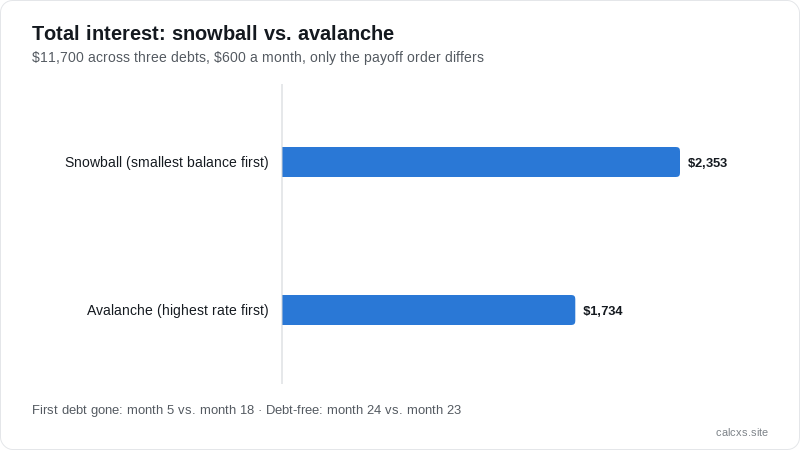 The avalanche saves about $620 and finishes a month sooner; the snowball clears its first debt 13 months earlier.
Why the Results Differ by This Much
How much the avalanche saves depends on how your debts are arranged. The gap is largest when your biggest balance also carries the highest rate, as in this example, because the snowball leaves the most expensive debt for last. When your smallest balances happen to have the highest rates, the two methods produce the same order and identical results. Before choosing, it's worth running your own debts through both orders to see how big the difference actually is.
Which Method Should You Choose?
The avalanche is usually the better fit if:
- You're motivated by numbers and can stay committed without quick wins.
- Your interest rates are spread far apart, so the savings are large.
- Your highest-rate debt is a large balance that would otherwise sit untouched for a long time under the snowball.
The snowball is usually the better fit if:
- You've tried to pay off debt before and lost momentum.
- You have several small balances you could eliminate quickly.
- Your interest rates are fairly similar, so the snowball costs little extra.
- Reducing the number of bills and due dates would make your finances easier to manage.
Neither method matters if the plan doesn't stick. The biggest gains come from the decision to pay more than the minimums every month and to stop adding new debt: far bigger than the difference between the two orders.
Hybrid Approaches
You don't have to pick one method in its purest form. Common middle grounds include:
- Quick win, then avalanche. If you have one very small balance, pay it off first for the motivation, then switch to highest-rate-first for everything else. The cost of a single small detour is usually modest.
- Avalanche with a tiebreaker. When two debts have similar rates, target the smaller balance first. You give up very little interest and get a faster win.
- Snowball with an exception. Follow the snowball order but move any unusually high-rate debt (like a credit card with a penalty APR) to the front of the line.
- Switch partway through. Start with the snowball to build momentum, then move to the avalanche once your remaining debts are larger and longer-term.
Ways to Speed Up Either Plan
- Lower your rates. A balance transfer to a card with a low introductory rate, or a lower-rate consolidation loan, can cut interest costs significantly: as long as you understand the transfer fees, when the promotional rate ends, and don't run the old card balances back up.
- Direct windfalls at your target debt. Tax refunds, bonuses, and raises applied to debt can shorten the timeline by months.
- Keep a small emergency fund. Without one, an unexpected car repair goes straight onto a credit card and undoes your progress.
- Stop adding new debt. Neither strategy works if balances keep growing behind you.
Putting It Together
Both methods share the same engine: pay every minimum, send all extra money to a single target, and roll each paid-off payment into the next debt. The avalanche targets the highest interest rate and usually costs the least; the snowball targets the smallest balance and delivers wins sooner. Pick the one you're most likely to follow through on, or combine them.
The debt payoff calculator compares the snowball and avalanche on your own debts so you can see the exact difference in interest and timeline. For a single credit card balance, the credit card payoff calculator shows how fast different payments clear it, and the loan calculator helps you evaluate whether a consolidation loan would lower your costs.
Frequently Asked Questions
Which saves more money, the debt snowball or the avalanche? The avalanche usually does, because it pays off the highest-rate debt first. In this guide's example, it costs about $1,734 in interest versus about $2,353 for the snowball, a difference of roughly $620. The gap depends on your debts, and it disappears when your smallest balances also have the highest rates.
How do I figure out how much extra to put toward my target debt? Decide on a total monthly amount for all your debts, then subtract the sum of your minimum payments. In the example, $600 a month minus $370 in minimums leaves $230 a month for the target debt. That amount grows as each paid-off debt's payment rolls forward.
What if two of my debts have the same interest rate? A common tiebreaker is to target the smaller balance first. You give up very little interest and get a paid-off account sooner. The debt payoff calculator can show whether the order makes a meaningful difference for your balances.
Should I include my mortgage in the debt snowball or avalanche? You can include any debt, but many people focus these plans on consumer debts like credit cards and car loans. A mortgage is usually the largest balance and often carries a lower rate than consumer debt, so it would typically land at or near the end of the list under either method.