Do Credit Cards Compound Interest Daily?
How most credit cards turn an APR into a daily rate and add interest to the balance each day, how much that really costs, and how to check your own card.
Your credit card statement shows interest once a month, so it's easy to assume it's calculated once a month. On most cards it isn't. Interest is usually calculated every day, and on most cards each day's interest is added to the balance, so tomorrow's interest is charged on today's interest. This guide explains how daily compounding works on a credit card, how much it actually adds, how to check your own card's method, and how to keep it from costing you anything.
The Short Answer
Yes: most credit cards compound interest daily. The issuer converts your APR into a daily rate, applies it to your balance each day, and adds the result to the balance. The total is posted once per statement, which is why it looks monthly.
Daily compounding only matters if you carry a balance. If you pay your full statement balance by the due date every month, the grace period means new purchases are charged no interest at all, so there's nothing to compound.
How Daily Compounding Works
Step 1: Convert the APR to a Daily Rate
Issuers divide the APR by 365 (some use 360) to get the daily periodic rate:
Daily rate = APR ÷ 365
At a 24% APR: 0.24 ÷ 365 = 0.06575% per day.
Step 2: Apply It Every Day
Each day, the issuer multiplies that day's balance by the daily rate. With daily compounding, the interest is added to the balance immediately, so the next day's calculation starts from a slightly larger number:
Balance after d days = Starting balance × (1 + APR ÷ 365)^d
A One-Month Example
Take a $3,000 balance at 24% APR over a 30-day billing cycle, with no new purchases or payments:
- Without compounding: $3,000 × 0.0006575 × 30 = $59.18
- With daily compounding: $3,000 × [(1.0006575)^30 − 1] = $59.75
Daily compounding adds 57 cents this month. On its own, that's small.
How Much It Adds Over a Year
The effect grows over longer periods, because the interest keeps compounding on itself. On a $1,000 balance at 24% APR left untouched for a year:
| Method | Interest for the year | Effective annual rate |
|---|---|---|
| No compounding (APR × balance) | $240.00 | 24.00% |
| Compounded monthly | $268.24 | 26.82% |
| Compounded daily | $271.15 | 27.11% |
The effective annual rate (the rate after compounding) is the real annual cost of the balance. Credit card APRs don't include compounding, so the effective rate is always higher than the APR when you carry a balance:
| APR | Effective annual rate (daily compounding) |
|---|---|
| 18% | 19.72% |
| 24% | 27.11% |
| 30% | 34.97% |
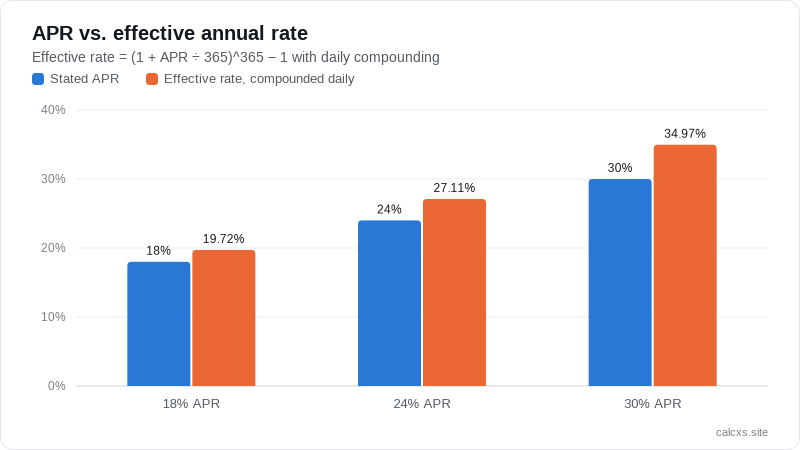 Daily compounding pushes the true annual cost above the stated APR.
Most of the difference between the APR and the effective rate comes from compounding at all, not from compounding daily instead of monthly. Daily compounding costs only about 0.3 percentage points more than monthly at a 24% APR. The bigger issue is the high APR itself.
How to Tell If Your Card Compounds Daily
Your card agreement explains it, usually in a section called something like "How We Calculate Your Balance" or "How Interest Is Calculated," just below the rate and fee table. Look for language like:
- "Daily balance method (including new transactions)": interest is calculated on each day's balance.
- "We add interest to your balance daily" or "interest charges are added to the daily balance": that's daily compounding.
- "Average daily balance (including new transactions)": interest is charged on the average of each day's balance. Many agreements using this method also add each day's interest to the next day's balance, which compounds it.
If the agreement isn't clear, call the issuer and ask: "Is interest added to my balance daily, and is it included in the balance that's charged interest the next day?"
Daily Compounding vs. Average Daily Balance
These are two different ideas that often appear together:
- Average daily balance is about which balance gets charged interest: the average of every day's balance in the cycle, rather than the balance on a single day.
- Daily compounding is about whether interest earns interest: whether each day's interest charge becomes part of the balance.
A card can use one, both, or neither. Most major cards use an average daily or daily balance method and compound daily. For a step-by-step look at the average daily balance calculation, see how credit card interest works.
Why Daily Compounding Makes Payment Timing Matter
Because interest accrues every day, when you pay matters, not just how much:
- Paying earlier in the cycle lowers the balance for more days, which lowers the interest.
- Splitting a payment in two (half mid-cycle and half by the due date) usually costs less interest than one payment on the due date.
- Large purchases start accruing interest the day they post if you're already carrying a balance.
On a $3,000 balance at 24%, paying $1,000 on day 1 of a 30-day cycle instead of day 30 saves about $19 in interest that month.
How to Avoid Compounding Interest Entirely
- Pay the full statement balance by the due date. The grace period covers new purchases, so no interest is charged and nothing compounds. See when credit card interest starts for how the grace period works.
- If you carry a balance, pay more than the minimum and pay as early as you can.
- Avoid cash advances, which typically start accruing interest immediately with no grace period.
- Consider a 0% balance transfer to stop interest while you pay down debt, after checking the transfer fee and the rate when the promotion ends.
Putting It Together
Most credit cards calculate interest daily and add it to your balance, so interest compounds. At a 24% APR, that makes the true annual cost about 27%. The extra cost from compounding is modest compared with the APR itself, and it disappears completely if you pay your statement in full each month.
To see how much interest your own balance will cost and how fast different payments clear it, use the credit card payoff calculator. For several cards or loans at once, try the debt payoff calculator.
Frequently Asked Questions
Do all credit cards compound daily? Most do, but not all. The method is spelled out in your card agreement. Some cards compound monthly, and the difference in cost between daily and monthly compounding is small.
Is credit card interest charged daily or monthly? It's usually calculated daily and billed monthly. Each statement shows the total interest for the billing cycle.
Does daily compounding mean I pay interest every day? Interest accrues every day you carry a balance past the grace period, but you pay it once a month as part of your statement.
How do I calculate daily credit card interest? Divide the APR by 365 and multiply by your balance. At 24% APR, a $3,000 balance accrues about $1.97 of interest per day.