How Are Credit Card Interest Rates Determined?
How issuers set your APR from the prime rate plus a margin, what decides your margin, and the federal rules that limit rate increases.
Two people can apply for the same credit card on the same day and get APRs several percentage points apart. Your rate isn't arbitrary, though. On most cards it's built from two parts: a benchmark rate that moves with the economy, and a margin the issuer sets based largely on you. This guide explains both parts, the factors that decide your margin, why card rates change over time, and what limits apply to how (and when) an issuer can raise them.
The Formula Behind Most Card Rates
Most credit cards have a variable APR:
APR = Index rate + Margin
- The index is almost always the prime rate: the benchmark rate banks use for many consumer loans. By convention, the prime rate is set at 3 percentage points above the top of the Federal Reserve's target range for the federal funds rate, so it moves when the Fed moves.
- The margin is a fixed number of percentage points the issuer adds on top. It's set when your account is opened and listed in your card agreement, often in a line like "Prime Rate + 14.99%."
Federal rules require a variable rate to be tied to an index the issuer doesn't control, like the prime rate. The issuer controls the margin.
Example
If the prime rate is 7.50% and your margin is 14.99%:
APR = 7.50% + 14.99% = 22.49%
If the Fed raises rates and the prime rate rises to 8.00%, your APR rises to 22.99% automatically, usually starting with the next billing cycle, as described in your agreement.
How the Prime Rate Moves Your APR
Because the index changes with Fed policy, card rates rise and fall with the economy even when nothing about you changes. During 2020 and 2021, the prime rate sat at 3.25%. After the Fed raised its target range eleven times in 2022 and 2023, the prime rate reached 8.50%: adding more than five percentage points to every card tied to it.
Here's how the same three illustrative margins translate into APRs at those two prime rates:
| Margin (illustrative) | APR at 3.25% prime | APR at 8.50% prime |
|---|---|---|
| 11 points (excellent credit) | 14.25% | 19.50% |
| 15 points (good credit) | 18.25% | 23.50% |
| 19 points (fair credit) | 22.25% | 27.50% |
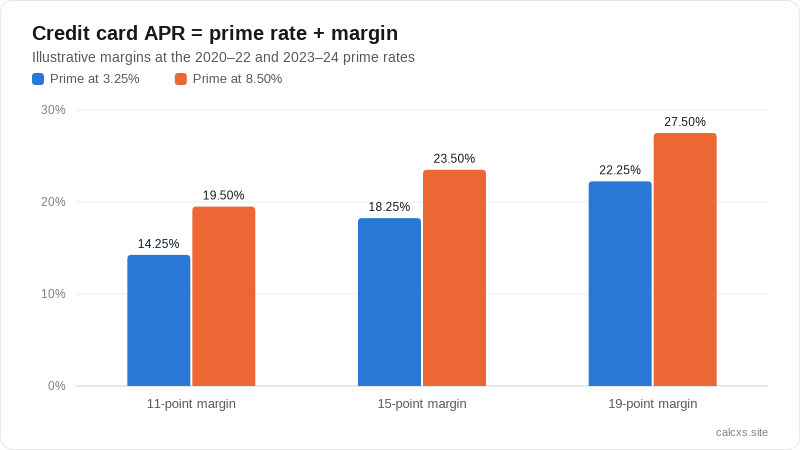 The prime rate moves every card's APR; the margin sets where you start.
What Determines Your Margin
The margin is where issuers price risk and make most of their profit. It has also been rising: the Consumer Financial Protection Bureau found that the average APR margin over prime reached an all-time high of about 14.3 percentage points in 2023, and that higher margins explained nearly half of the increase in average APRs over the prior decade.
Your Credit Profile
The biggest factor is how likely the issuer thinks you are to repay:
- Credit score. Higher scores generally get lower margins. Many cards list an APR range (such as "19.24% to 28.24%") and place you in it based on your credit.
- Credit history. Late payments, collections, high balances relative to your limits, and a short history all push the margin up.
- Income and existing debt. Issuers consider your ability to pay, which affects both your limit and sometimes your rate.
The Type of Card
- Rewards and travel cards often carry higher APRs to help pay for the rewards.
- Low-rate or "no-frills" cards trade rewards for a smaller margin.
- Secured cards and cards for limited credit tend to have higher rates.
- Store cards often have some of the highest APRs.
- Credit union cards tend to offer lower rates, partly because federal credit unions are subject to an interest rate ceiling.
The Issuer's Own Strategy
Issuers compete differently. Some target customers who pay in full and care about rewards; others target customers who carry balances. That's why margins for similar borrowers can differ meaningfully from one issuer to the next.
Different Rates for Different Balances
A single card usually has several APRs, each with its own margin:
- Purchase APR: the standard rate on everyday spending.
- Balance transfer APR, often a 0% or low introductory rate for a set period, then the standard rate.
- Cash advance APR, usually higher than the purchase APR, with no grace period.
- Penalty APR: a higher rate that may apply after a late payment.
- Introductory APR: a promotional rate, often 0%, on purchases or transfers for a limited time.
All of these appear in the rate and fee table that comes with the card offer and your agreement.
Rules That Limit Rate Increases
Federal rules restrict when an issuer can raise your rate on an existing account:
- During the first year, an issuer generally can't raise your APR, except when a variable rate's index rises, a promotional rate ends as disclosed, or you're more than 60 days late.
- Promotional rates must last at least six months.
- Advance notice. For most rate increases that aren't caused by the index, the issuer must give you 45 days' notice, and you generally have the right to reject the change by closing the account and paying off the balance under the old terms.
- Existing balances are protected. A higher rate usually applies only to new transactions. The issuer can raise the rate on existing balances mainly if you're more than 60 days late.
- Penalty rates must be reviewed. If a penalty APR was triggered by a late payment, the issuer must reduce it after six consecutive months of on-time payments.
There's no general federal cap on credit card interest rates. Most large issuers are national banks that can apply the rate rules of the state where they're based to customers nationwide.
How to Get a Lower Rate
- Improve your credit. Pay on time, lower your balances relative to your limits, and avoid opening several accounts at once.
- Ask your issuer. A customer with a solid payment history can sometimes get the margin lowered with a phone call.
- Compare low-rate cards if you tend to carry a balance; rewards rarely outweigh interest.
- Check credit unions, which often offer lower APRs.
- Use a 0% balance transfer to pause interest while paying down debt: after accounting for the transfer fee.
- Pay in full each month. With a grace period, the APR doesn't apply to purchases at all.
Putting It Together
Most credit card APRs equal the prime rate plus a margin. The prime rate follows the Federal Reserve and moves every card's rate up or down together. The margin is set by the issuer based on your credit, the type of card, and its own strategy, and it's the part you can influence. Federal rules limit how and when that rate can rise on an existing account, but they don't cap the rate itself.
To see what your current rate costs you, use the credit card payoff calculator. For how that rate turns into a monthly charge, see how credit card interest works and whether credit cards compound daily.
Frequently Asked Questions
Why is my credit card interest rate so high? Card rates combine the prime rate with a margin that issuers have increased over the past decade. Unsecured credit is riskier for lenders than a mortgage or car loan, so margins are high, and a lower credit score raises them further.
Does my credit card rate change when the Fed changes rates? If your card has a variable rate tied to the prime rate, yes. The prime rate typically moves the same amount as the Fed's target, and your APR follows, usually within a billing cycle or two.
Can a credit card company raise my rate without notice? Generally not. Most increases require 45 days' notice. Increases caused by the index rising, a disclosed promotional rate ending, or a payment more than 60 days late follow separate rules described in your agreement.
What is a good credit card APR? Anything well below the average for cards assessed interest is good. The Federal Reserve's G.19 release reports the current average.
Sources
- CFPB: Credit card interest rate margins at all-time high
- Federal Reserve: G.19 Consumer Credit Release
- Federal Reserve: Open Market Operations, federal funds target range history
- 12 CFR § 1026.55: Limitations on increasing annual percentage rates, fees, and charges
- OCC HelpWithMyBank: How often can the bank change the rate on my credit card?