How Credit Card Interest Works
How card issuers turn an APR into a daily rate, calculate interest on your average daily balance, and why grace periods and minimum payments matter so much.
Credit card interest feels opaque on purpose. Your statement shows an APR, a balance, and an interest charge, but not how one number turned into the other. Once you see the mechanics (a daily rate, an average balance, and a grace period that can quietly disappear) the charges stop being mysterious, and it becomes much clearer why carrying a balance is so expensive and why paying only the minimum can take decades. This guide walks through each piece with real numbers.
APR: The Starting Point
Every credit card has an annual percentage rate (APR). For most cards, the APR is the interest rate expressed on a yearly basis; unlike mortgage APRs, it doesn't fold in fees. A single card often has several APRs at once:
- Purchase APR for everyday spending.
- Balance transfer APR, sometimes a low promotional rate for a limited time.
- Cash advance APR, usually higher than the purchase rate, with interest that typically starts immediately.
- Penalty APR, which may apply after a late payment.
Most card APRs are variable, meaning they're tied to an index (commonly the prime rate) plus a fixed margin. When the index moves, your rate follows, as described in your card agreement.
Rates are high relative to other borrowing. The Federal Reserve's G.19 consumer credit release, which reports average rates at commercial banks, has shown average rates above 20% on credit card accounts assessed interest in its recent releases. The examples below use a 24% APR for round numbers.
From APR to a Daily Periodic Rate
Card issuers don't charge interest once a year. Most calculate it daily, using a daily periodic rate (DPR): the APR divided by 365 (some issuers use 360).
For a 24% APR:
24% ÷ 365 = 0.06575% per day
That looks tiny, but it applies to every dollar of your balance every day of the billing cycle.
The Average Daily Balance Method
The most common way to calculate the interest charge is the average daily balance method. The issuer records your balance at the end of each day in the billing cycle, adds those daily balances together, and divides by the number of days. Then:
Interest = average daily balance × daily periodic rate × days in the cycle
A Worked Example
Say you start a 30-day billing cycle with a $2,000 balance carried from the previous month, and you're not in a grace period:
- Days 1–10: The balance is $2,000.
- Day 11: You make a $500 purchase. The balance is $2,500 for days 11–20.
- Day 21: You make a $300 payment. The balance is $2,200 for days 21–30.
The average daily balance is:
(10 × $2,000 + 10 × $2,500 + 10 × $2,200) ÷ 30 = $67,000 ÷ 30 = $2,233.33
The interest charge for the cycle is:
$2,233.33 × 0.0006575 × 30 = $44.05
Two details stand out. First, the $500 purchase started costing interest the day it posted, because there was no grace period on a card carrying a balance. Second, timing matters: had the $300 payment been made on day 1 instead of day 21, the average balance (and the interest) would have been lower.
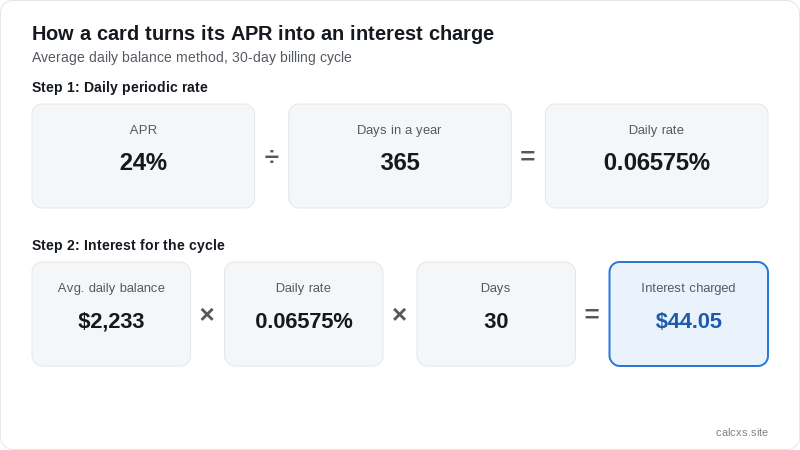 How the 24% APR in the worked example becomes a $44.05 interest charge.
Is Credit Card Interest Compounded Daily or Monthly?
On most cards, interest compounds daily: each day's interest is added to the balance, and the next day's interest is charged on that slightly larger amount. The charge only appears monthly because it's totaled and posted once per statement. Your card agreement says which method applies: look for the section explaining how the balance subject to interest is calculated, usually just below the rate and fee tables.
In the example above, daily compounding raises the charge to about $44.47: a small difference in one month, but it's part of why a 24% APR costs slightly more than 24% over a full year. A $1,000 balance compounded daily at 24% for a year accrues about $271 in interest, not $240.
Other Balance Calculation Methods
Average daily balance is the most common approach, but card agreements may describe others:
- Daily balance: interest is charged on each day's actual balance and the daily charges are added up. It produces nearly the same result as the average daily balance method.
- Previous balance: interest is based on the balance at the end of the last cycle, so payments made during the current cycle don't reduce it.
- Adjusted balance: interest is based on last cycle's balance minus payments and credits made this cycle, the most favorable to you, and the least common.
How to Estimate Your Monthly Interest
For a quick estimate, you don't need the full calculation:
Monthly interest ≈ balance × APR ÷ 12
A $3,000 balance at a 24% APR costs about $3,000 × 0.24 ÷ 12 = $60 a month. Using the daily rate over a 30-day cycle gives a nearly identical $59.18 ($3,000 × 0.24 ÷ 365 × 30). Either way, the figure is a useful gut check: every $1,000 carried at 24% costs roughly $20 a month.
The Grace Period: How to Pay Zero Interest
A grace period is the window between the end of a billing cycle and the payment due date. If you pay your statement balance in full by the due date, most cards charge no interest on new purchases. Federal rules require issuers to deliver your statement at least 21 days before the payment due date, so you get at least three weeks to pay.
The catch is how easily the grace period is lost:
- Carry any balance past the due date and, on most cards, new purchases start accruing interest from the day they post: as in the example above.
- Getting it back usually requires paying the full statement balance for one or sometimes two consecutive cycles, depending on the card's terms.
- Residual (trailing) interest can appear even after you pay in full, because interest accrued between the statement date and the day your payment posted. Expect a small charge on the next statement.
- Cash advances and balance transfers often have no grace period at all.
For a cardholder who always pays in full, the APR is effectively irrelevant. For anyone carrying a balance, it determines the cost of nearly everything.
The Minimum Payment Trap
Card issuers set a minimum payment that keeps your account in good standing. A common formula is 1% of the balance plus that month's interest, with a floor of around $25. Because the minimum shrinks as the balance shrinks, paying only the minimum keeps you in debt for a very long time.
Running the Numbers
Take a $5,000 balance at a 24% APR (2% per month for simplicity), no new charges, and a minimum of 1% of the balance plus interest, with a $25 floor:
- First month: Interest is $5,000 × 2% = $100. The minimum is $50 + $100 = $150, and only $50 of it reduces the balance.
- As the balance falls, the required payment falls with it, so the payoff slows down rather than speeding up.
Here's how three payment strategies compare:
| Strategy | Time to pay off | Total interest |
|---|---|---|
| Minimum payment only | 234 months (19.5 years) | ≈ $8,887 |
| Fixed $150 a month | 56 months (4.7 years) | ≈ $3,322 |
| Fixed $200 a month | 36 months (3 years) | ≈ $2,001 |
Paying only the minimum costs nearly $8,900 in interest (more than the original $5,000 balance) and stretches over almost two decades. Simply locking in the first month's $150 payment and never letting it drop cuts the timeline to under five years and saves about $5,565. Bumping it to $200 a month clears the card in three years.
This is why your statement includes a minimum payment warning: federal rules require issuers to show how long payoff would take and how much you'd pay in total if you made only minimum payments, along with the monthly amount needed to pay off the balance in three years.
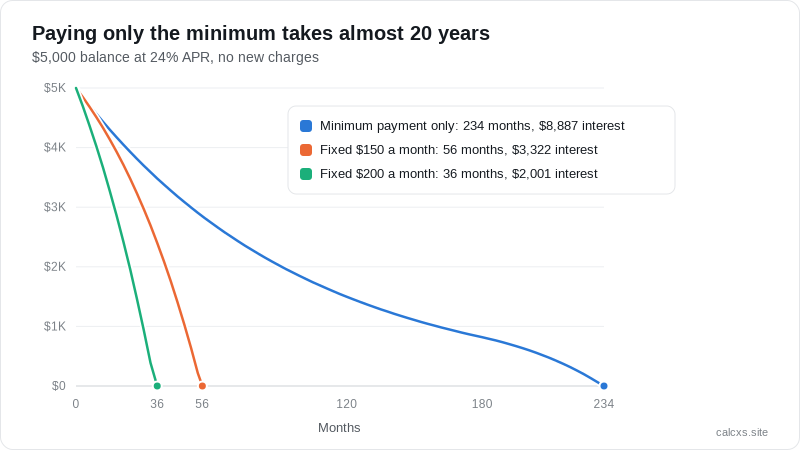 A fixed payment clears the same balance in a fraction of the time the minimum takes.
How Payments Are Applied
If your card has balances at different rates (say, purchases at 24% and a cash advance at 29%) the order in which your payment is applied matters. Issuers can apply the minimum payment however their terms allow, often to the lowest-rate balance first. But any amount you pay above the minimum must go to the balance with the highest interest rate, with special exceptions for deferred interest plans. That's one more reason to pay more than the minimum.
Ways to Pay Less Interest
- Pay the statement balance in full whenever you can to keep the grace period.
- Pay early or more than once a month. Lowering your balance earlier in the cycle lowers your average daily balance.
- Pay a fixed amount instead of the shrinking minimum. As the table shows, this is one of the most effective changes you can make.
- Ask for a lower rate. Issuers sometimes agree, especially for customers with a strong payment history.
- Consider a balance transfer or consolidation loan, but read the transfer fee, how long the promotional rate lasts, and what rate applies afterward, and avoid running the old card back up.
- Avoid cash advances, which usually carry a higher APR, an upfront fee, and no grace period.
- Prioritize the highest-rate card if you have several, or follow a structured method like the debt avalanche or snowball.
Putting It Together
Credit card interest comes down to a few mechanics: the APR is converted to a daily rate, that rate is applied to your average daily balance, and the grace period lets you avoid interest entirely, but only if you pay the full statement balance every month. Once you carry a balance, interest applies to new purchases right away, and minimum payments that shrink with your balance can keep you paying for decades.
To see how quickly different payment amounts clear your balance, try the credit card payoff calculator. If you have several cards or loans, the debt payoff calculator compares payoff strategies, and the debt-to-income calculator shows how your monthly debt payments stack up against your income.
Frequently Asked Questions
Do you have to pay interest on a credit card? Not if you pay the full statement balance by the due date every month. The grace period means new purchases cost nothing in interest. You pay interest only when you carry a balance, take a cash advance, or use a balance transfer outside a 0% promotion.
How are credit card interest rates determined? Most cards use a variable rate: an index, usually the prime rate, plus a margin the issuer sets. The margin you're offered depends largely on your credit history, which is why two people can get different APRs on the same card.
Why was I charged interest after paying in full? Usually because of residual interest: interest that accrued between your statement date and the day your payment posted, after a month when you carried a balance. It should stop once you've paid in full for a cycle or two.
Does paying twice a month reduce interest? Yes, if you carry a balance. An earlier payment lowers the balance for more days of the cycle, which lowers your average daily balance and the interest charged on it.