When Does Credit Card Interest Start?
How the grace period works, how many interest-free days you get, what happens when you carry a balance, and which transactions start charging interest immediately.
A new purchase on your credit card doesn't necessarily start costing interest the day you make it. Whether (and when) interest starts depends on one thing above all: whether you paid your last statement balance in full. This guide explains the grace period, how many interest-free days you really get, what happens when you lose the grace period, and the transactions that start charging interest immediately.
The Short Answer
- If you pay your full statement balance by the due date every month, interest on purchases usually never starts. The grace period covers them.
- If you carry a balance from last month, interest on new purchases usually starts the day each purchase posts.
- Cash advances (and often balance transfers outside a promotion) usually start accruing interest immediately, with no grace period.
What a Grace Period Is
A grace period is the time between the end of a billing cycle and the payment due date during which you can pay off purchases without being charged interest. Most cards offer one on purchases, but it isn't required by law: check your card agreement, which says whether you have one and how it works.
When a card does have a grace period, federal rules require the issuer to deliver or mail your statement at least 21 days before the payment due date. Many cards give about 21 to 25 days.
How Many Interest-Free Days You Actually Get
Because the grace period runs from the statement date, the total time between a purchase and the payment due date depends on where in the cycle you buy. Take a card with a 30-day billing cycle and a due date 25 days after the statement closes:
| Purchase made on | Days until the due date |
|---|---|
| Day 1 of the billing cycle | 54 days |
| Day 15 of the billing cycle | 40 days |
| Day 30 (the statement closing date) | 25 days |
A purchase early in the cycle can go nearly two months without interest; one the day the statement closes gets less than four weeks. Every one of them is interest-free if the statement balance is paid in full by the due date.
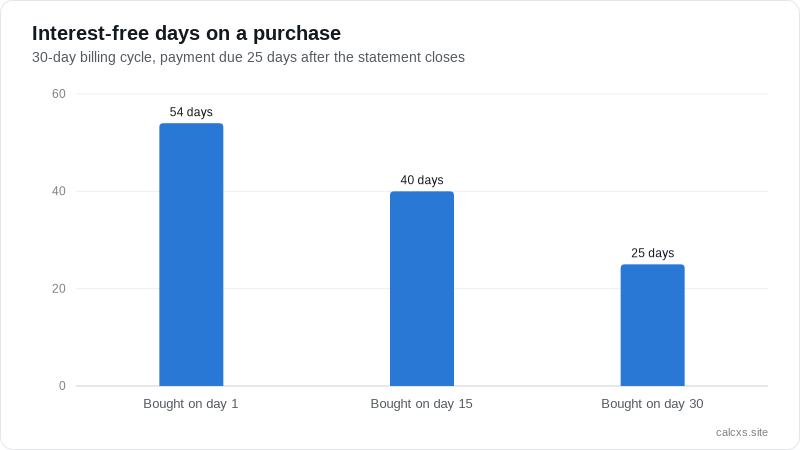 The earlier in the billing cycle you buy, the longer until the payment is due.
When Interest Starts on Purchases
If You Pay in Full
You pay the full statement balance by the due date. No interest is charged on those purchases, and the grace period continues for next month's purchases too.
Paying the statement balance is what counts, not the current balance that includes purchases made after the statement closed. Those newer purchases have their own grace period that runs to the next due date.
If You Pay Less Than the Full Balance
On most cards, carrying any part of the statement balance past the due date means:
- The unpaid balance starts accruing interest, typically back to the date of each purchase rather than the due date.
- New purchases lose the grace period and accrue interest from the day they post.
There's a limit on how far back the issuer can reach. Under the federal rule against double-cycle billing, a card issuer can't charge interest that results from losing a grace period on balances from billing cycles before the most recent one, or on any part of a balance you repaid before the grace period ended.
Example: You make a $1,000 purchase on day 5 of a 30-day cycle at a 24% APR. The due date is day 55. You pay $500 by the due date. The $500 you repaid can't be charged interest, but the unpaid $500 accrues interest from the purchase date: about $500 × (0.24 ÷ 365) × 50 days ≈ $16.44 through the due date, and it keeps accruing until you pay it off.
Residual Interest After You Pay in Full
If you were carrying a balance and then pay the statement in full, you may still see a small interest charge on the next statement. That's residual (or trailing) interest: interest that accrued between the statement closing date and the day your payment arrived. Paying in full again on the next statement usually clears it.
How to Get Your Grace Period Back
Once you lose it, most cards restore the grace period after you pay the full statement balance by the due date for one billing cycle; some require two consecutive cycles. Your card agreement says which. Until then, new purchases accrue interest from the day they post.
Transactions That Start Charging Interest Right Away
| Transaction | When interest usually starts |
|---|---|
| Purchases (paid in full each month) | Never, thanks to the grace period |
| Purchases (carrying a balance) | The day the purchase posts |
| Cash advances, ATM withdrawals | Immediately, plus a cash advance fee |
| Cash-like purchases (some money transfers, gambling, cryptocurrency) | Often treated as cash advances |
| Balance transfers (no promotion) | Usually immediately, plus a transfer fee |
| Balance transfers (0% promotion) | When the promotional period ends |
Deferred-interest promotions (common at retail stores, often described as "no interest if paid in full in 12 months") work differently from a 0% APR. Interest builds up in the background from the purchase date, and if any of the promotional balance is left when the period ends, you're charged all of it.
Does Interest Start on a New Card?
On a brand-new card with no balance, you begin with a grace period on purchases. If the card has a 0% introductory APR, no interest is charged on the covered balances until the promotion ends, but you still have to make at least the minimum payment each month, and a late payment can end the promotion early, depending on the terms.
Putting It Together
Interest on credit card purchases starts only when you don't pay the statement balance in full. Pay in full by the due date and the grace period keeps purchases interest-free, giving you anywhere from three weeks to nearly two months depending on when you buy. Carry a balance, and new purchases start accruing interest the day they post until you've paid in full again. Cash advances skip the grace period entirely.
If you're carrying a balance now, the credit card payoff calculator shows how long it will take to clear and how much interest it will cost. For the math behind the charges, see how credit card interest works and whether credit cards compound daily.
Frequently Asked Questions
Do you get charged interest if you pay the minimum on time? Yes, if you carry a balance. Paying the minimum on time avoids a late fee and keeps the account in good standing, but interest accrues on the unpaid balance.
Is interest charged from the purchase date or the statement date? If you've lost the grace period, interest is usually charged from the purchase or posting date. If you have a grace period and pay in full, no interest is charged.
How long is a credit card grace period? At least 21 days from when the statement is delivered or mailed to the due date, for cards that offer one. Many cards use 21 to 25 days.
Do I pay interest if I pay my balance before the statement closes? No. Paying before the statement closes reduces or eliminates the statement balance, so there's nothing left to charge interest on.