How to Calculate Your Debt-to-Income Ratio
The debt-to-income formula, what counts as debt, front-end vs. back-end ratios, a worked example, and how to lower your DTI before applying for a loan.
When you apply for a mortgage, a car loan, or a personal loan, the lender wants to know two things: how much you earn and how much of that income is already spoken for. Your debt-to-income ratio (DTI) answers both in a single percentage. It's one of the most important numbers in a mortgage application, and it's simple enough to calculate yourself in a few minutes. This guide explains the formula, what counts as debt and what doesn't, how lenders use the two different versions of the ratio, and how to lower yours before you apply.
The Basic Formula
Your DTI compares your recurring monthly debt payments to your gross monthly income: what you earn before taxes and other deductions come out.
DTI = Total monthly debt payments ÷ Gross monthly income × 100
If you pay $2,000 a month toward debts and earn $6,000 a month before taxes, your DTI is $2,000 ÷ $6,000 = 33.3%.
How to Work Out Your DTI in Three Steps
- Add up your monthly debt payments: rent or mortgage, car loans, student loans, minimum credit card payments, and any other required monthly debt payment.
- Find your gross monthly income: your annual salary before taxes divided by 12, plus any other regular income.
- Divide the first number by the second and multiply by 100. The result is your DTI as a percentage.
Two details trip people up:
- It uses gross income, not take-home pay. Your paycheck after taxes, retirement contributions, and health insurance is smaller, but lenders start from the pre-tax figure.
- It uses minimum required payments, not balances. A $9,000 credit card balance enters the formula as its minimum monthly payment, not as $9,000.
What Counts as Debt
Lenders count obligations that recur every month and appear on your credit report or in legal documents. The usual list:
- Housing. Your rent, or (for a mortgage application) the proposed monthly payment including principal, interest, property taxes, homeowners insurance, mortgage insurance, and any HOA dues.
- Auto loans and leases.
- Student loans, including ones that are deferred. Fannie Mae's guidelines let a lender use a payment equal to 1% of the outstanding balance when the credit report doesn't show a usable monthly payment.
- Credit card minimum payments, for every card with a balance.
- Personal loans, installment loans, and lines of credit.
- Court-ordered payments such as child support and alimony.
- Loans you co-signed, which often count even if someone else makes the payments, unless you can document that they do.
Fannie Mae's underwriting rules, for example, require installment debts (student loans, car loans, personal loans) to be counted if more than ten monthly payments remain.
What Doesn't Count
DTI is not a full budget. These everyday expenses are generally left out:
- Utilities, phone, and internet
- Groceries, gas, and transportation costs other than loan payments
- Health, auto, and life insurance premiums
- Subscriptions and memberships
- Income taxes and payroll deductions
- Child care (unless it's a court-ordered obligation)
That's why a "good" DTI can still feel tight. Two people with identical ratios can have very different amounts left over at the end of the month depending on taxes, child care, and commuting costs.
Front-End vs. Back-End DTI
Mortgage lenders often look at two versions of the ratio.
Front-end DTI (also called the housing ratio) includes only your proposed housing payment:
Front-end DTI = Monthly housing payment ÷ Gross monthly income × 100
Back-end DTI (the total ratio) includes housing plus every other debt payment:
Back-end DTI = (Housing payment + Other debt payments) ÷ Gross monthly income × 100
When people say "DTI" without qualification, they almost always mean the back-end ratio. A long-standing rule of thumb is the 28/36 rule: keep housing at or below 28% of gross income and total debt at or below 36%. It's a planning guideline, not a legal limit.
A Worked Example
Suppose you earn $78,000 a year. Your gross monthly income is $78,000 ÷ 12 = $6,500. Your current debts are:
| Debt | Monthly payment |
|---|---|
| Car loan | $450 |
| Student loan | $300 |
| Credit card minimums (two cards) | $120 |
| Total non-housing debt | $870 |
Today, While Renting
Your rent is $1,600. Your current back-end DTI is:
($1,600 + $870) ÷ $6,500 = $2,470 ÷ $6,500 = 38.0%
With a Proposed Mortgage
Now suppose you're shopping for a home with an estimated payment of $1,850 a month, including taxes and insurance.
- Front-end DTI: $1,850 ÷ $6,500 = 28.5%
- Back-end DTI: ($1,850 + $870) ÷ $6,500 = $2,720 ÷ $6,500 = 41.8%
The housing ratio sits right around the 28% guideline, but the total ratio is well above 36%. The house itself isn't the problem: the car loan, student loan, and credit cards are taking up a large share of income before the mortgage is even added.
What Changes the Picture
| Change | Back-end DTI |
|---|---|
| As above | 41.8% |
| Pay off both credit cards | 40.0% |
| Pay off the car loan | 34.9% |
Paying off the cards drops the ratio by about two points. Paying off the $450 car loan drops it by almost seven, bringing it under 36%. Alternatively, keeping all existing debts, the housing payment that fits within 36% is 36% × $6,500 − $870 = $1,470 a month, about $380 less than the home you were considering. And to carry the $1,850 payment with every current debt at a 36% ratio, you'd need an income of about $90,667 a year.
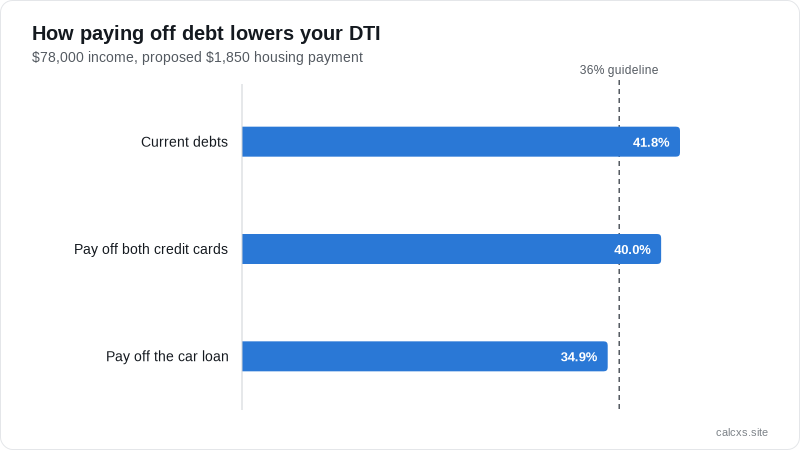 Paying off the car loan is the only change that gets this example under 36%.
What Lenders Look For
There is no single universal cutoff, because limits depend on the loan program, your credit score, your savings, and how the loan is underwritten. Fannie Mae's guidelines illustrate how this works for conventional loans:
- For manually underwritten loans, the maximum total DTI is 36%, and it can go up to 45% if the borrower meets additional credit score and reserve requirements.
- For loans run through Fannie Mae's automated underwriting system, the maximum allowable DTI is 50%.
Government-backed loans such as FHA and VA mortgages have their own rules, and individual lenders can set stricter limits than the agencies require. Being approved at a high DTI also isn't the same as being comfortable at one. A ratio near 50% means half your pre-tax income goes to fixed payments before you've paid for taxes, food, or anything else.
As a general guide, a back-end DTI in the low-to-mid 30s gives most households reasonable breathing room. Above the low 40s, loan options start to narrow and monthly budgets tend to get tight.
How to Lower Your DTI
You can improve the ratio from either side: reduce the debt payments on top, or raise the income on the bottom.
Reduce monthly debt payments:
- Pay off small balances completely. A paid-off card stops counting entirely, while a lower balance may only shave a few dollars off its minimum payment.
- Target the debt with the largest payment relative to its balance. A car loan with a few thousand dollars left but a $450 payment is often the fastest way to move the ratio.
- Avoid new debt before applying. Financing furniture or a car right before a mortgage application can push you over a limit.
- Refinance or consolidate carefully. A longer term lowers the monthly payment and the ratio, but usually increases the total interest you pay.
Increase documented income:
- Include all qualifying income. Lenders can count income from a second job, overtime, bonuses, or self-employment if it's stable and documented, usually over a two-year history.
- Add a co-borrower. A spouse or partner's income can lower the combined ratio, though their debts are added too.
Adjust the housing side:
- Look at a less expensive home or a larger down payment, both of which shrink the proposed payment.
- Shop for property taxes and insurance, which can vary meaningfully between neighborhoods and insurers.
DTI Isn't Your Credit Score
Your debt-to-income ratio doesn't appear on your credit report and isn't part of your credit score: credit reports don't include your income. Your credit utilization, which compares card balances to credit limits, is a different measure that does affect your score. Paying down cards can help both numbers at the same time, but they're calculated separately and used for different purposes.
Putting It Together
Add up every required monthly debt payment (housing, cars, student loans, card minimums, and other loans) and divide by your gross monthly income. Look at the front-end ratio to see whether the housing payment alone is reasonable, and the back-end ratio to see whether everything together fits. Lenders' maximums are often far above what's comfortable, so aim for a number you can live with, not just one you can qualify for.
The debt-to-income calculator computes both ratios from your own numbers. To see what home price your ratio supports, try the home affordability calculator, and if your DTI is too high, the debt payoff calculator shows how quickly you can eliminate the debts that are holding it up.
Frequently Asked Questions
Is DTI calculated with gross or net income? Gross income, meaning what you earn before taxes, retirement contributions, and health insurance come out. Using take-home pay instead would make your ratio look higher than the number a lender calculates.
Do utilities and insurance count toward DTI? Generally no. Utilities, phone, internet, and health, auto, and life insurance premiums are left out. The exception is housing: for a mortgage application, the proposed payment includes property taxes, homeowners insurance, mortgage insurance, and any HOA dues.
Do deferred student loans count in DTI? Usually, yes. Fannie Mae's guidelines let a lender use 1% of the outstanding balance when the credit report doesn't show a usable payment, so a $30,000 balance would count as $300 a month. Other loan programs and lenders can handle deferred loans differently.
How do I find the largest housing payment my DTI allows? Multiply your gross monthly income by the target ratio, then subtract your other monthly debt payments. In the example, 36% × $6,500 = $2,340, and $2,340 − $870 = $1,470 a month. The home affordability calculator turns a payment like that into a home price.