When Should You Refinance Your Mortgage?
How to calculate the refinance break-even point, why a lower payment can still cost more, and how to pick the new loan term.
Refinancing replaces your current mortgage with a new one, usually to get a lower interest rate or a lower payment. It makes sense when the savings repay the closing costs before you move or refinance again, and when the new loan costs less in total, not just per month. This guide shows how to calculate the break-even point, why a lower payment can still cost you more, and how to choose the new loan's term.
The Break-Even Formula
Break-even (months) = Closing costs ÷ Monthly savings
Refinancing has upfront costs: typically an application fee, appraisal, title insurance, lender fees, and any discount points. The monthly saving pays them back over time. The break-even point is the month when the cumulative savings equal the costs; every month after that is real savings.
If you expect to sell the house, or refinance again, before the break-even point, the refinance loses money.
Worked Example
You owe $300,000 at 7.5% with 27 years left. A lender offers 6.25% on a new 30-year loan, with $6,000 in closing costs paid in cash.
| Current loan | New 30-year loan | |
|---|---|---|
| Monthly principal and interest | $2,162.20 | $1,847.15 |
| Monthly savings | N/A | $315.05 |
| Break-even | N/A | $6,000 ÷ $315.05 → 20 months |
| Total of remaining payments (plus closing costs) | $700,553 | $670,974 |
| Lifetime savings | N/A | $29,579 |
The refinance pays for itself in under two years and saves about $29,600 over the life of the loan. But notice that the new loan runs three years longer than what you had left. Part of the lower payment comes from spreading the balance over more months, not just from the lower rate.
Matching the Term You Have Left
Instead of resetting to 30 years, you could take a shorter term closer to your remaining 27:
| New loan (6.25%, $6,000 costs) | Monthly payment | Monthly savings | Break-even | Lifetime savings |
|---|---|---|---|---|
| 30-year | $1,847.15 | $315.05 | 20 months | $29,579 |
| 25-year | $1,979.01 | $183.19 | 33 months | $100,850 |
| 15-year | $2,572.27 | −$410.07 | N/A | $231,544 |
The 25-year loan saves less each month and takes longer to break even, but it saves over $100,000 in total and pays the house off two years earlier than your current schedule. The 15-year loan raises the payment, so it has no break-even in the usual sense, but it saves more than $230,000, if the higher payment fits your budget. The 15 vs. 30-year mortgage guide goes deeper into that trade-off.
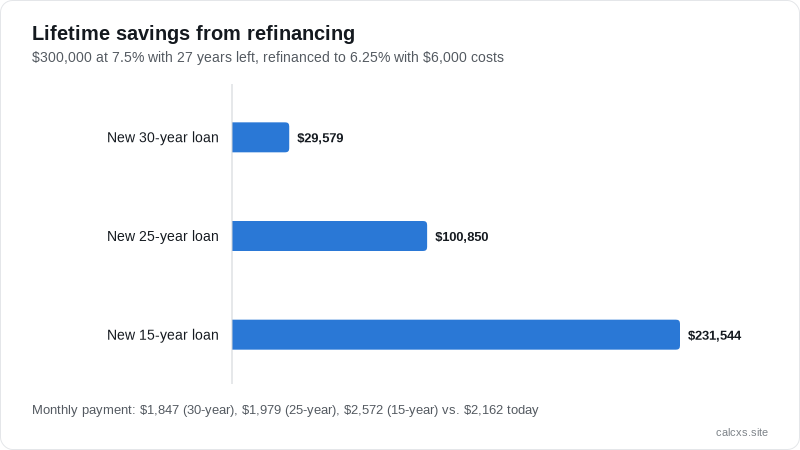 A shorter new term saves far more over the life of the loan.
When a Lower Payment Costs More
Now suppose the new rate is only 7.0% on a 30-year loan, with the same $6,000 in costs. The payment falls to $1,995.91, saving $166.29 a month, with a break-even of 37 months. That looks reasonable, but over the full term you'd pay about $23,975 more than by keeping your current loan, because the half-point rate cut isn't enough to offset three extra years of interest plus the closing costs.
This is the most common refinancing mistake: judging the deal by the monthly payment alone. Always compare the total remaining cost of both loans.
When Refinancing Usually Makes Sense
- The rate drop is meaningful. There's no universal threshold, but the larger your balance and the longer you'll stay, the smaller the drop that pays off. Run the break-even with the actual quoted costs.
- You'll stay well past the break-even point. If you might move in two years, a 33-month break-even doesn't work.
- You want to shorten the term. Moving from 30 to 15 or 20 years at a lower rate can save a large amount of interest, even with a similar payment.
- You want to remove mortgage insurance. If your home has gained value, refinancing an FHA loan into a conventional loan with at least 20% equity can eliminate mortgage insurance premiums.
- You want to switch from an adjustable to a fixed rate before an ARM resets. The fixed vs. adjustable-rate mortgage guide covers that decision.
When It Usually Doesn't
- You plan to sell before the break-even point.
- You're many years into a loan and would reset to a new 30-year term, so most of the saving comes from stretching the debt.
- Closing costs are high relative to the monthly saving.
- You'd roll closing costs into the loan and pay interest on them for decades without accounting for it.
"No-Closing-Cost" Refinances
A no-closing-cost refinance doesn't make the costs disappear. The lender either charges a higher interest rate and uses the extra income to cover the costs, or adds the costs to your loan balance. Either can be the right choice (a higher rate with no upfront cost can make sense if you may move or refinance again soon) but compare it against the version with costs paid upfront, using the total cost over the time you expect to keep the loan.
Getting and Comparing Offers
- Get Loan Estimates from several lenders. Lenders must give you a standardized Loan Estimate within three business days of your application, which makes rates, fees, and points easy to compare line by line.
- Compare on the same day. Rates change daily; quotes from different days aren't comparable.
- Ask about points. Paying discount points lowers the rate but raises the upfront cost, which pushes the break-even point later.
- Check for a prepayment penalty on your current loan.
- Track market rates. Freddie Mac's weekly Primary Mortgage Market Survey shows the national average rate, a useful benchmark for your quotes.
Putting It Together
Divide the closing costs by the monthly savings to find the break-even month, and make sure you'll keep the loan well beyond it. Then compare the total remaining cost of your current loan against the new one, including closing costs. That number, not the monthly payment, tells you whether refinancing saves money. Choosing a term no longer than what you have left captures more of the savings.
The refinance calculator runs this comparison with the break-even month and lifetime savings, and the mortgage calculator shows the full amortization schedule for the new loan. If you're mainly trying to save interest, compare refinancing with making extra mortgage payments, which has no closing costs.
Frequently Asked Questions
How much does it cost to refinance a mortgage? Refinancing typically costs a few percent of the loan amount, covering lender fees, appraisal, title insurance, and other charges. Your Loan Estimate itemizes the exact costs.
How much lower does my rate need to be to refinance? There's no fixed rule. What matters is whether the monthly savings repay the closing costs before you move, and whether the new loan costs less in total. A smaller rate cut can work on a large balance with low costs; a larger cut may be needed on a small balance.
Does refinancing restart my mortgage? Yes. A refinance is a brand-new loan with its own term, so a new 30-year loan starts a fresh 30-year schedule. You can choose a shorter term to avoid extending your payoff date.
Is it worth refinancing to save $100 a month? It depends on the closing costs and how long you'll stay. With $4,000 in costs, $100 a month breaks even after 40 months. Also check that the new loan doesn't cost more overall by extending the term.
Does refinancing hurt my credit score? Applying causes a hard inquiry, which may lower your score slightly for a short time. Multiple mortgage inquiries within a short shopping window are generally treated as one for scoring purposes.