How Much Should You Have in an Emergency Fund?
How to size an emergency fund from your essential expenses, where in the three-to-six-month range you should land, and how to build and store it.
An emergency fund is money set aside for the expenses you can't predict: a job loss, a car repair, a trip to the emergency room, a furnace that quits in January. It isn't an investment and it isn't a vacation fund. Its only job is to be there, in cash, when something goes wrong, so that a bad month doesn't turn into high-interest debt that lingers for years. This guide explains how to size an emergency fund for your situation, how to build one without stalling your other goals, and where to keep it.
Why an Emergency Fund Matters
Without savings, an unexpected bill has to go somewhere, and that somewhere is usually a credit card. The Federal Reserve's annual Survey of Household Economics and Decisionmaking asks adults how they would handle a hypothetical $400 emergency expense. In the survey conducted in October 2025, 63 percent said they would cover it entirely with cash, savings, or a credit card paid off at the next statement, which means more than a third of adults would need to borrow, sell something, or couldn't cover it at all.
To see what that costs, imagine a $1,500 car repair charged to a card with a 24% APR, paid down at $100 a month. It takes 19 months to clear and costs about $301 in interest: a 20% surcharge on a repair you had no choice about. An emergency fund turns that same repair into a withdrawal you replenish over the following months, with no interest at all.
There's a second, less obvious benefit: options. With several months of expenses in the bank, a layoff gives you time to find the right job instead of the first one. A fund lets you say no to a bad deal, leave an unsafe living situation, or handle a family crisis without making a money decision under pressure.
The Common Rule: Three to Six Months of Expenses
The most widely repeated guideline is to save three to six months of essential expenses. Two words in that rule do a lot of work.
Expenses, not income. You're sizing the fund to cover what you'd actually need to spend if your paycheck stopped, not to replace your salary. That number is usually well below your take-home pay, because some spending (retirement contributions, dining out, travel) would pause in a real emergency.
Essential. Count the bills that keep a roof over your head and keep you employable: housing, utilities, food, transportation, insurance, minimum debt payments, and basic phone and internet. Leave out streaming services, restaurant meals, and anything you'd cut the first week.
Calculating Your Number
Start by listing your essential monthly costs. Here's an example for a single renter:
| Essential expense | Monthly cost |
|---|---|
| Rent | $1,500 |
| Utilities | $200 |
| Groceries | $500 |
| Transportation (car payment, gas, insurance) | $350 |
| Health insurance and out-of-pocket costs | $250 |
| Minimum debt payments | $200 |
| Phone and internet | $100 |
| Total | $3,100 |
From there, the targets are straightforward:
- Three months: 3 × $3,100 = $9,300
- Six months: 6 × $3,100 = $18,600
If you don't know your spending, look at the last three months of bank and credit card statements and average them. Most people underestimate irregular costs like car registration or annual insurance premiums, so it's worth adding a monthly allowance for those as well.
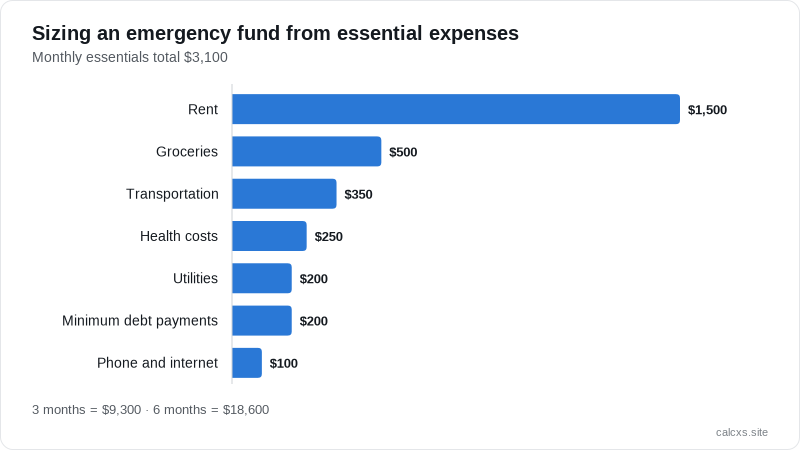 Size the fund from essential expenses, not total spending.
Where You Should Land in the Range
Three months is a reasonable floor for many households; six months or more makes sense when your risk of a long income gap is higher. Factors that point toward the higher end:
- One income supports the household. If that paycheck stops, nothing else covers the bills.
- Variable or commission-based pay. Freelancers, gig workers, and salespeople face uneven months even without an emergency.
- Self-employment. There's no unemployment insurance in most cases, and slow periods can last.
- Specialized or senior roles. Jobs that are harder to replace often take longer to find.
- Dependents, health conditions, or an older home or car. More people and more aging equipment mean more things that can go wrong.
Factors that can justify the lower end:
- Two stable incomes, where either one could cover essentials alone.
- In-demand skills in a field where job searches tend to be short.
- Other accessible resources, such as a large taxable brokerage account, though investments can fall in value at exactly the wrong time, so they're a backup, not a substitute.
Some households in especially uncertain situations aim for nine to twelve months. There's no single right answer; the goal is to match the size of the fund to the size and likelihood of the shocks you could face.
How to Build It Without Stalling Everything Else
Saving $9,300 or $18,600 can feel impossible when you're starting from zero. Breaking the goal into stages makes it manageable.
Stage 1: A starter fund. Aim for $1,000 to one month of expenses first. This alone handles the most common surprises (a repair, a deductible, a last-minute flight) and stops the cycle of putting every small emergency on a card.
Stage 2: Pay down high-interest debt. Once a starter fund is in place, many people focus extra money on credit card balances, since card interest rates are usually far higher than anything a savings account pays.
Stage 3: Build to your full target. With high-interest debt under control, direct savings back toward three to six months of expenses.
At $400 a month, here's how long the full targets take, assuming the money earns an illustrative 4% annual yield compounded monthly:
| Goal | Months at $400/month |
|---|---|
| $9,300 (three months) | 23 months |
| $18,600 (six months) | 44 months |
Without any interest, the three-month goal would take 24 months instead of 23. Interest helps at the margin, but the monthly contribution does nearly all the work, which is why automation matters more than chasing the highest rate.
Ways to speed things up:
- Automate a transfer on payday so saving happens before spending.
- Direct windfalls (tax refunds, bonuses, cash gifts) straight to the fund.
- Save raises. When your pay goes up, route the difference to savings for a few months before adjusting your lifestyle.
- Trim one recurring cost and redirect the exact amount.
The savings goal calculator shows how long your own target will take at different monthly amounts, and the salary calculator helps you see your take-home pay so you can set a realistic contribution.
Where to Keep Your Emergency Fund
An emergency fund needs to be safe, liquid, and separate:
- Safe. The balance shouldn't drop when the stock market does. Deposit accounts at FDIC-insured banks (checking, savings, money market deposit accounts, and CDs) are insured up to at least $250,000 per depositor, per ownership category, at each insured bank. Credit unions have similar coverage through the NCUA.
- Liquid. You should be able to reach the money within a day or two without penalties.
- Separate. Keeping the fund in a different account from everyday checking makes it less tempting to spend and easier to track.
A high-yield savings account at an insured bank checks all three boxes for most people. Yields change with interest rates, but the difference matters: on an $18,600 fund, a 0.5% yield earns about $93 a year, while a 4% yield earns about $744. Some people hold part of a larger fund in short-term CDs or Treasury bills for a bit more yield, keeping at least one or two months of expenses instantly accessible.
Stocks and stock funds are generally a poor home for emergency money. Job losses often coincide with economic downturns, when market values are also likely to be down, so you could be forced to sell at a loss right when you need the cash.
What Counts as an Emergency
Deciding this in advance prevents the fund from slowly draining. A useful test is whether the expense is unexpected, necessary, and urgent:
- Yes: Job loss, medical bills, essential car or home repairs, emergency travel for a family crisis, a security deposit after an unexpected move.
- No: Holiday gifts, annual subscriptions, a planned vacation, a new phone because the old one is slow.
Predictable but irregular costs (car registration, annual premiums, holiday spending) belong in separate "sinking funds" you contribute to monthly. That keeps the emergency fund reserved for real surprises.
When you do use the fund, don't feel guilty: that's what it's for. Then make rebuilding it the priority until it's back at your target.
Common Mistakes
- Sizing it to income instead of expenses. This often produces a target so large that people give up before starting.
- Investing it for higher returns. The extra yield isn't worth the risk of a 20% drop the month you lose your job.
- Never adjusting the target. A new baby, a mortgage, or a move to a higher-cost city changes your essential expenses. Revisit the number once a year.
- Holding far too much. Beyond about six to twelve months of expenses, extra cash may be better directed to retirement accounts or debt payoff, where it can do more work.
Putting It Together
Your emergency fund target is your essential monthly expenses multiplied by the number of months of protection you need: typically three to six, and more if your income is less stable. Start with a small starter fund, deal with high-interest debt, then build steadily toward the full amount with automatic transfers. Keep the money in an insured, easy-to-reach account, and use it only for genuine emergencies.
Use the savings goal calculator to plan your timeline, the salary calculator to find out how much of your paycheck is available to save, and the compound interest calculator to see how much interest your fund could earn in a high-yield account.
Frequently Asked Questions
Is $10,000 enough for an emergency fund? It depends on your essential expenses. For the single renter in this guide, with $3,100 a month in essentials, $10,000 covers a little over three months: within the common range but at the low end. With higher expenses or less stable income, it may not be enough.
Should I pay off debt or build an emergency fund first? Many people do both in stages: a starter fund of $1,000 to one month of expenses first, then extra money toward high-interest debt, then savings up to the full three- to six-month target. The starter fund keeps new emergencies off your credit cards while you pay them down.
Is a high-yield savings account a good place for an emergency fund? For most people, yes, as long as it's at an FDIC-insured bank or NCUA-insured credit union. It keeps the money safe, reachable within a day or two, and separate from everyday spending, while earning more than a low-yield account. Yields change with interest rates.
Do two-income households need a smaller emergency fund? Often. If either income could cover essential expenses alone, the lower end of the three- to six-month range may be reasonable. A household that relies on one income, or has variable pay, has more reason to aim higher.