The Compound Interest Formula, Step by Step
Each part of the compound interest formula explained, with worked examples for annual, monthly, and continuous compounding, regular deposits, and solving for time or rate.
The compound interest formula tells you what a balance will grow to when interest earns interest of its own. It has only four inputs, but each one can be misread: the rate has to be a decimal, the compounding frequency changes two parts of the formula, and regular deposits need a second formula of their own. This guide breaks the formula down piece by piece and works through examples step by step, including how to solve it backward for the rate or the time.
The Compound Interest Formula
A = P × (1 + r ÷ n)^(n × t)
| Symbol | Meaning | Example |
|---|---|---|
| A | Final amount (principal plus interest) | What you're solving for |
| P | Principal: the starting balance | $10,000 |
| r | Annual interest rate, as a decimal | 5% = 0.05 |
| n | Number of times interest compounds per year | Monthly = 12 |
| t | Time in years | 10 |
The interest earned is simply A − P.
Two parts of the formula use n: dividing the annual rate by n gives the rate per compounding period, and multiplying n by t gives the number of periods.
Example 1: Annual Compounding
$10,000 at 5% compounded once a year for 10 years.
- Rate per period: r ÷ n = 0.05 ÷ 1 = 0.05
- Number of periods: n × t = 1 × 10 = 10
- Growth factor: (1 + 0.05)^10 = 1.62889
- Final amount: $10,000 × 1.62889 = $16,288.95
Interest earned: $6,288.95. Simple interest at the same rate would have earned only $5,000 ($500 a year for 10 years). The extra $1,288.95 is interest earned on interest.
Example 2: Monthly Compounding
Same $10,000 at 5% for 10 years, compounded monthly.
- Rate per period: 0.05 ÷ 12 = 0.0041667
- Number of periods: 12 × 10 = 120
- Growth factor: (1.0041667)^120 = 1.64701
- Final amount: $10,000 × 1.64701 = $16,470.09
Monthly compounding adds about $181 compared with annual compounding.
How Much Compounding Frequency Matters
| Compounding | n | Balance after 10 years |
|---|---|---|
| Annually | 1 | $16,288.95 |
| Quarterly | 4 | $16,436.19 |
| Monthly | 12 | $16,470.09 |
| Daily | 365 | $16,486.65 |
| Continuously | N/A | $16,487.21 |
More frequent compounding helps, but the gains shrink quickly. Going from annual to monthly matters; going from daily to continuous is worth 56 cents. The rate and the time matter far more than the frequency.
Continuous Compounding
The limit of compounding more and more often is continuous compounding, which uses the constant e (about 2.71828):
A = P × e^(r × t)
For the example: $10,000 × e^(0.05 × 10) = $10,000 × 1.64872 = $16,487.21.
Example 3: Adding Regular Deposits
Most savers don't make a single deposit; they add money every month. The basic formula doesn't cover that. Add the future value of a series of deposits:
A = P × (1 + r/n)^(n×t) + PMT × [((1 + r/n)^(n×t) − 1) ÷ (r/n)]
where PMT is the deposit each period, made at the end of the period, with deposits on the same schedule as compounding.
$10,000 to start, plus $200 a month, at 5% compounded monthly for 30 years:
- Rate per period: 0.05 ÷ 12 = 0.0041667
- Number of periods: 12 × 30 = 360
- Growth factor: (1.0041667)^360 = 4.46774
- Starting balance grows to: $10,000 × 4.46774 = $44,677.44
- Deposits grow to: $200 × (4.46774 − 1) ÷ 0.0041667 = $166,451.73
- Total: $44,677.44 + $166,451.73 = $211,129.17
You contributed $82,000 in total ($10,000 plus 360 deposits of $200). The other $129,129 is interest. Without the monthly deposits, the account would hold $44,677.
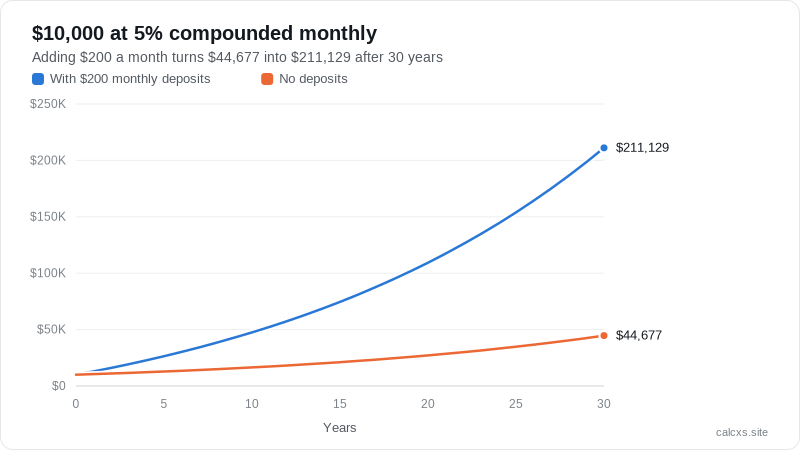 Regular deposits give compounding far more to work with.
If deposits are made at the start of each period instead, multiply the deposit part by (1 + r/n). That's the version spreadsheets call an "annuity due."
Solving the Formula Backward
How Long Will It Take?
To find the time needed to reach a target, solve for t with logarithms:
t = ln(A ÷ P) ÷ (n × ln(1 + r ÷ n))
How long until $10,000 doubles at 5% compounded monthly?
t = ln(2) ÷ (12 × ln(1.0041667)) = 0.69315 ÷ 0.04990 = 13.89 years
The Rule of 72 gives a quick estimate: 72 ÷ 5 = 14.4 years.
What Rate Do You Need?
To find the annual rate that grows P to A in t years with annual compounding:
r = (A ÷ P)^(1 ÷ t) − 1
What rate turns $10,000 into $20,000 in 12 years?
r = (20,000 ÷ 10,000)^(1 ÷ 12) − 1 = 2^0.08333 − 1 = 5.95%
Common Mistakes
- Using the rate as a whole number. 5% must be 0.05, not 5.
- Forgetting to divide the rate by n. With monthly compounding, the rate per period is the annual rate ÷ 12.
- Using t instead of n × t as the exponent. The exponent is the number of compounding periods, not the number of years.
- Mismatched deposit and compounding schedules. The deposit formula above assumes they match; if they don't, convert the rate to the deposit frequency first.
- Confusing APR and APY. An APY already reflects compounding. If a bank quotes 5% APY, the balance grows 5% a year: don't compound it again.
Doing It in a Spreadsheet
- Single deposit:
=10000*(1+0.05/12)^(12*10)returns $16,470.09. - With monthly deposits:
=FV(0.05/12, 360, -200, -10000)returns $211,129.17. The negative signs mark money you pay in. - Time to a target:
=NPER(0.05/12, 0, -10000, 20000)/12returns 13.89 years.
Putting It Together
The compound interest formula, A = P(1 + r/n)^(nt), comes down to a rate per period raised to the number of periods. Add the deposit formula when you contribute regularly, and rearrange it to solve for the time or rate you need. Frequency matters a little; rate, time, and steady contributions matter a lot.
The compound interest calculator runs these calculations with your own numbers, including monthly deposits, and the savings goal calculator works backward from a target. For the bigger picture, see how compound interest works and simple vs. compound interest.
Frequently Asked Questions
What is the formula for compound interest compounded monthly? A = P × (1 + r/12)^(12 × t). Divide the annual rate by 12 and multiply the number of years by 12.
How do I calculate compound interest by hand? Find the rate per period (r ÷ n), add 1, raise it to the number of periods (n × t), and multiply by the principal. Subtract the principal to get the interest.
What's the difference between the compound interest formula and the simple interest formula? Simple interest is P × r × t and grows by the same amount each year. Compound interest multiplies by (1 + r/n) each period, so each period's interest is earned on a larger balance.
What is the compound interest formula for daily compounding? Use n = 365: A = P × (1 + r/365)^(365 × t).