Do Savings Rates Rise With Inflation?
How inflation reaches your savings rate through the Federal Reserve and your bank, why yields usually lag behind, and how to keep your cash from losing ground.
When prices climb quickly, it's natural to expect your savings account to pay more to keep up. Sometimes it does. Often it doesn't, or not right away, and not one-for-one. The link between inflation and the rate on your savings runs through the Federal Reserve, then through your bank's own decisions, and both steps can be slow and uneven. This guide explains how that chain works, why savings yields so often trail inflation, and what you can do so your cash doesn't quietly lose ground.
The Short Answer
Savings rates tend to rise when inflation rises, but indirectly, with a lag, and usually by less than inflation itself. No law or contract ties the rate on a typical savings account to the inflation rate. Banks set deposit rates themselves, and they respond mostly to the interest rates set by the Federal Reserve and to competition for deposits.
A few things follow from that:
- Rates on high-yield online savings accounts usually move quickly when the Fed raises rates.
- Rates on many traditional savings accounts barely move at all.
- CDs lock in their rate, so an existing CD doesn't change when inflation does.
- I bonds and TIPS are the products that are directly tied to inflation by design.
How Inflation Reaches Your Savings Rate
The chain usually runs in four steps:
- Inflation rises. Prices increase faster than the Fed's longer-run goal of 2 percent a year.
- The Fed raises its policy rate. To slow the economy and bring inflation down, the Federal Open Market Committee raises the target range for the federal funds rate: the rate banks charge each other for overnight loans.
- Market rates follow. Treasury yields, the prime rate, and the rates banks earn on their own cash and loans rise.
- Banks decide how much to pass on. Some raise deposit rates quickly to attract or keep customers; others raise them slowly or not at all.
The weak point is step four. Banks earn more when the rates they charge borrowers rise faster than the rates they pay depositors, so they have an incentive to move deposit rates slowly unless competition forces them to.
What Happened in 2022 and 2023
The most recent inflation surge shows the pattern clearly. Consumer price inflation picked up through 2021 and 2022, and the Fed began raising its target range in March 2022 from near zero. It raised rates at eleven meetings, reaching a range of 5.25% to 5.50% in July 2023.
- Inflation came first. Prices were already rising quickly for months before the first rate increase.
- Online savings accounts followed. Many high-yield accounts moved from well under 1% to roughly 4% to 5% as the Fed's rate rose.
- Average savings rates stayed low. The FDIC's national average rate for savings accounts, which reflects many large traditional banks, remained far below the Fed's rate throughout. As of October 2026, the FDIC's national rate for savings accounts was 0.38%.
So the honest answer to "do savings rates rise with inflation?" depends on which account you have. The best rates rose substantially. The typical rate didn't.
Real Return: The Number That Matters
The rate your bank advertises is the nominal rate. What you actually care about is the real return, how much your purchasing power grows after inflation:
Real return = (1 + nominal rate) ÷ (1 + inflation rate) − 1
A quick approximation is simply nominal rate minus inflation.
Here's what $10,000 is worth after one year, in today's dollars, at 3% inflation:
| Account | Nominal rate | Balance after 1 year | Value in today's dollars | Real return |
|---|---|---|---|---|
| Average savings account | 0.38% | $10,038 | $9,746 | −2.54% |
| Middling savings account | 2.0% | $10,200 | $9,903 | −0.97% |
| High-yield savings account | 4.0% | $10,400 | $10,097 | +0.97% |
The average account's balance went up by $38, and lost about $254 of purchasing power. Only the account paying more than inflation grew in real terms.
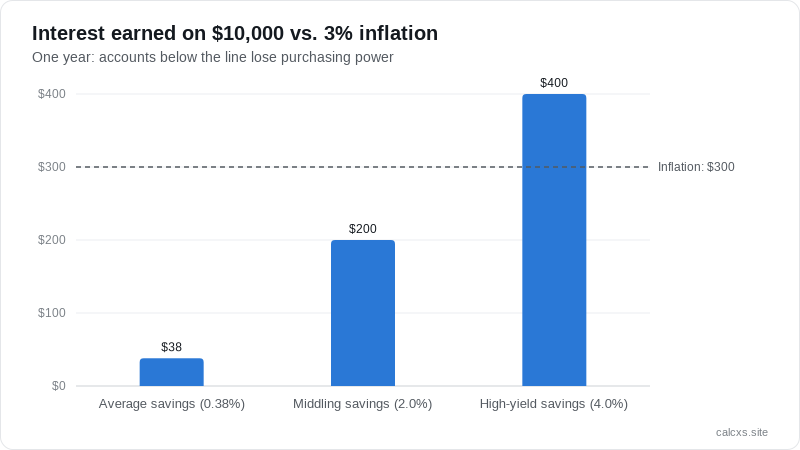 Only interest above the $300 that inflation takes leaves you ahead.
Taxes Shrink the Gap Further
Savings interest is generally taxed as ordinary income, and the tax applies to the nominal interest. At a 22% federal rate, a 4% account earns 3.12% after tax. With 3% inflation, the after-tax real return is only about 0.12%: essentially treading water.
Why Savings Rates Lag Inflation
- The Fed reacts to inflation; it doesn't anticipate every move. Rate increases tend to come after inflation shows up in the data.
- Banks pass increases along slowly. Deposit rates usually rise later and by less than the Fed's rate, especially at banks with many customers who rarely switch.
- Fixed-rate products are locked. A two-year CD at 1.5% keeps paying 1.5% even if inflation hits 4%. Over two years, $10,000 in that CD would be worth about $9,525 in today's dollars.
- Rates can fall before inflation does. When the Fed starts cutting, high-yield savings rates often drop quickly, even if prices are still rising faster than before.
Do Savings Rates Fall When Inflation Falls?
Usually, yes: again with a lag, and through the same chain. As inflation cools, the Fed eventually lowers its target range, and variable savings rates follow it down. The Fed cut rates several times in late 2024 and 2025, and many high-yield accounts reduced their yields along the way.
This is where a CD can help: locking in a rate before cuts protects your yield for the CD's term, just as an old low-rate CD hurts you when rates rise.
Accounts That Actually Track Inflation
If you want savings that respond to inflation directly rather than through the Fed and your bank, two U.S. Treasury products are built for it:
- Series I savings bonds. The rate combines a fixed rate with an inflation rate that resets every six months based on changes in consumer prices. There's an annual purchase limit, and you can't cash them in during the first year.
- Treasury Inflation-Protected Securities (TIPS). The principal adjusts with inflation, and the fixed interest rate is paid on the adjusted principal, so payments rise with prices.
Neither is a full replacement for a savings account: I bonds have a holding period, and TIPS prices can move before maturity if you sell. They work well as a complement for money you won't need immediately.
How to Keep Your Savings From Falling Behind
- Check your actual rate. Many people are still earning a fraction of a percent at a traditional bank without realizing it.
- Move idle cash to a high-yield account. Look for FDIC insurance (or NCUA insurance at a credit union) and no monthly fees.
- Ladder CDs. Splitting money across CDs that mature at different times lets you capture higher rates as they appear without locking everything up at once.
- Use I bonds or TIPS for longer-term cash. They're designed to keep pace with inflation.
- Invest money you won't need for years. Savings accounts are for safety and access; long-term goals usually need investments with a better chance of outrunning inflation.
Putting It Together
Inflation pushes the Fed to raise rates, and higher Fed rates eventually push savings rates up, but banks control the last step, so many accounts lag far behind. Judge your savings by the real return, not the advertised one, and don't assume your bank will raise your rate on its own.
The inflation calculator shows how quickly prices erode a fixed balance, and the compound interest calculator compares how different savings rates grow over time. For a broader look at protecting purchasing power, see how inflation affects your savings.
Frequently Asked Questions
Do banks have to raise savings rates when inflation goes up? No. Most savings accounts have variable rates that the bank can change at its discretion. Nothing requires a bank to match inflation or the Fed's rate.
Do high-yield savings accounts keep up with inflation? Sometimes. When the Fed's rate is well above inflation, high-yield accounts can earn a small positive real return. When inflation spikes before the Fed responds, even the best accounts can fall behind for a while.
Are CDs better than savings accounts during inflation? A CD locks in today's rate. That helps if rates later fall and hurts if they keep rising. Short-term CDs or a CD ladder balance the two.
Is it worth keeping money in savings when inflation is high? For an emergency fund or money you'll need soon, yes: safety and access matter more than keeping up with prices. Just make sure it's earning a competitive rate.