How Inflation Affects Your Savings
How inflation erodes purchasing power, the difference between nominal and real returns, the Rule of 72, and ways to protect your savings.
A dollar saved today is still a dollar ten years from now, but it won't buy as much. Inflation is the gradual rise in the prices of goods and services, and it quietly erodes the value of money that sits still. That doesn't mean saving is pointless; it means the number on your statement isn't the whole story. What matters is how much your savings can actually buy. This guide explains purchasing power, the difference between nominal and real returns, and how to keep inflation from shrinking the money you've worked to save.
What Inflation Does to Purchasing Power
Inflation is usually expressed as an annual percentage. If inflation runs at 3% a year, something that costs $100 today costs about $103 next year, and the increase compounds from there. In the U.S., the Federal Reserve aims for inflation of 2 percent over the longer run, as measured by the price index for personal consumption expenditures: a target, not a guarantee. Actual inflation has been higher or lower than that in different periods.
The flip side of rising prices is falling purchasing power: each dollar buys less. To see how that adds up, here's what $10,000 held in cash is worth in today's dollars if inflation averages an illustrative 3% a year:
| Years | Purchasing power of $10,000 | Cost of a $100 basket of goods |
|---|---|---|
| 5 | $8,626 | $115.93 |
| 10 | $7,441 | $134.39 |
| 20 | $5,537 | $180.61 |
| 30 | $4,120 | $242.73 |
After 20 years, your $10,000 still reads $10,000, but it buys only what about $5,537 buys today. After 30 years, it has lost close to 60% of its purchasing power. Nothing was withdrawn and no fee was charged; the loss is entirely from rising prices.
The rate matters a lot. Over 20 years, $10,000 keeps about $6,730 of purchasing power at 2% inflation, but only about $4,564 at 4%.
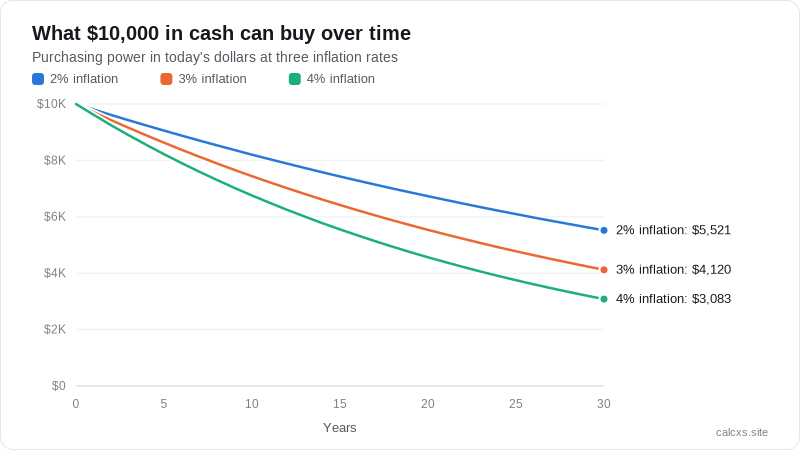 What $10,000 left in cash is worth in today's dollars after 30 years.
The Rule of 72 for Inflation
The Rule of 72 is usually used to estimate how long it takes an investment to double, but it works just as well in reverse. Divide 72 by the inflation rate to estimate how many years it takes for prices to double, and for the purchasing power of idle cash to fall by half:
| Inflation rate | Years for prices to double (Rule of 72) | Exact |
|---|---|---|
| 2% | 36 years | 35.0 years |
| 3% | 24 years | 23.4 years |
| 4% | 18 years | 17.7 years |
| 6% | 12 years | 11.9 years |
At 3% inflation, the cost of living roughly doubles in about 24 years. Someone who is 40 today could see prices double by the time they're in their mid-60s: right around the time many people retire.
Nominal vs. Real Returns
The return your bank or brokerage reports is the nominal return: the percentage your balance grew in dollars. The real return is what's left after accounting for inflation, and it measures how much your purchasing power actually grew.
The quick approximation is:
Real return ≈ nominal return − inflation rate
The precise version is:
Real return = (1 + nominal return) ÷ (1 + inflation rate) − 1
For example, a savings account paying 4.5% when inflation is 3% has a real return of about 1.46% (the approximation gives 1.5%). Your balance grows 4.5% in dollars, but your ability to buy things grows only about 1.5%.
When the nominal rate is below inflation, the real return is negative. A savings account paying 0.5% while inflation runs at 3% loses roughly 2.4% of purchasing power a year, even though the balance keeps rising.
Don't Forget Taxes
Interest from savings accounts and CDs is generally taxed as ordinary income, and taxes apply to the nominal return, not the real one. If that 4.5% account is taxed at a 22% federal rate, the after-tax return is 4.5% × (1 − 0.22) = 3.51%. Subtract 3% inflation and the after-tax real return is only about 0.5% a year. Money held in a savings account can roughly keep pace in this scenario, but it's barely growing in real terms.
Do Savings Interest Rates Rise With Inflation?
Often, but not automatically, and not one-for-one. The link runs through the Federal Reserve: when inflation runs above its target, the Fed typically raises its policy interest rate to cool the economy. Banks' own borrowing and lending rates follow, and savings yields usually rise with them.
A few things weaken that link in practice:
- There's a lag. Inflation tends to show up first, and rate increases follow over the following months. Savings yields can trail behind both.
- Banks pass increases along unevenly. Online high-yield accounts tend to raise rates quickly to compete for deposits; many traditional savings accounts barely move. Two accounts at different banks can pay very different rates in the same month.
- Yields can stay below inflation. Even after rates rise, a savings account can still pay less than the inflation rate, leaving a negative real return.
- Fixed-rate products don't adjust. A CD locks in its rate for its term, so a CD opened before rates rose keeps paying the old, lower rate until it matures.
The practical takeaway: when inflation and rates are rising, check what your account actually pays. Moving cash to a higher-yield account, or keeping CD terms short so they can be renewed at newer rates, helps savings keep up.
Comparing Real Growth Over 20 Years
Here's what $10,000 becomes over 20 years at three illustrative nominal returns, with inflation at 3% a year (before taxes):
| Nominal return | Ending balance | Value in today's dollars |
|---|---|---|
| 0.5% (low-yield savings) | $11,049 | $6,118 |
| 4.5% (high-yield savings or CDs) | $24,117 | $13,353 |
| 7% (long-term diversified portfolio, illustrative) | $38,697 | $21,426 |
The low-yield account technically "grew" by $1,049, and lost almost 40% of its purchasing power. The high-yield account roughly kept its value and added about a third in real terms. The 7% scenario more than doubled in real terms. That higher return isn't guaranteed and comes with the risk of losses along the way, but over long periods it's the kind of growth that can outrun inflation by a meaningful margin.
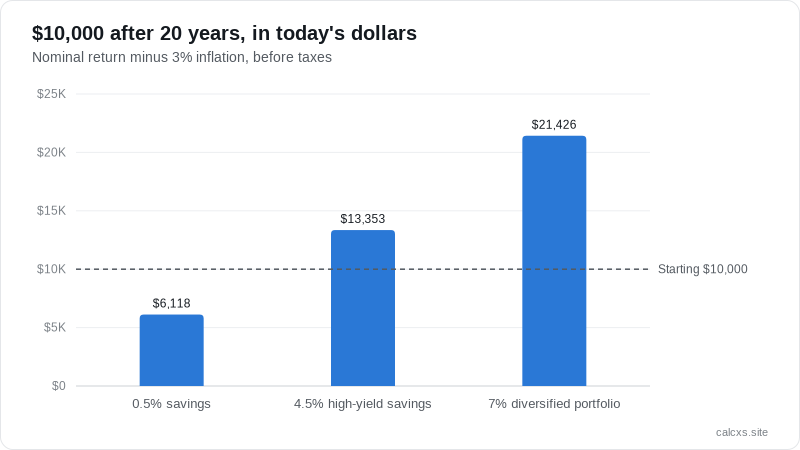 Only returns above inflation grow purchasing power.
What This Means for Different Kinds of Savings
Inflation doesn't mean every dollar should be invested. The right approach depends on when you'll need the money.
Emergency funds and short-term goals (within about three years). Safety and access matter more than beating inflation. A modest loss of purchasing power is the price of knowing the money will be there. Keep it in an insured high-yield savings account, money market account, or short-term CDs, and choose the best yield you can find among safe options.
Medium-term goals (roughly three to ten years). A mix of safe assets and some investments can make sense, depending on how flexible the goal is. Treasury inflation-protected options, covered below, are worth a look.
Long-term goals like retirement. Over decades, inflation is one of the biggest risks to your plan. Money that only keeps pace with inflation won't grow much in real terms, which is why long-term savings are usually invested in a diversified mix that includes stocks, accepting short-term volatility in exchange for a better chance of real growth.
Inflation-Protected Options
The U.S. Treasury offers two products designed specifically to protect purchasing power:
- Series I savings bonds. I bonds earn a combined rate made up of a fixed rate plus an inflation rate that's reset every six months. Interest compounds semiannually, and you buy them electronically through TreasuryDirect. There are annual purchase limits and a minimum holding period, so they aren't a substitute for an emergency fund's most liquid layer.
- Treasury Inflation-Protected Securities (TIPS). TIPS are marketable Treasury securities whose principal adjusts with inflation. They pay a fixed rate of interest every six months on the adjusted principal, so the interest payments rise when inflation does. At maturity you receive the greater of the adjusted or original principal.
Both are backed by the U.S. government. Check the current rates and rules directly on TreasuryDirect before buying, since they change over time.
Planning With Inflation in Mind
Inflation affects future goals, not just existing savings. If you want to cover $40,000 a year of today's expenses 20 years from now, you'll need about $59,438 a year at 2% inflation, $72,244 at 3%, or $87,645 at 4%. A plan that ignores inflation can look comfortable on paper and fall short in real life.
A few practical habits:
- Think in today's dollars. When you project a goal, convert the result back into current purchasing power to see what it really means.
- Use a conservative inflation assumption. Testing your plan at 3% rather than 2% builds in a margin of safety.
- Revisit your budget and goals regularly. As prices change, so do the amounts you need to save.
- Look for rate increases on cash. Banks don't always raise savings yields automatically; moving idle cash to a higher-yield account is one of the simplest ways to narrow the gap.
- Let raises keep pace. If your income doesn't rise with prices, your savings rate and lifestyle will both get squeezed. The raise guide shows how to work out your real raise after inflation, and the raise calculator checks whether a raise beats it.
Putting It Together
Inflation reduces what each dollar can buy, and the effect compounds over time: at 3% a year, prices roughly double in 24 years. The return that matters is the real return: what's left after inflation, and ideally after taxes. Short-term savings should prioritize safety and accept a small real loss; long-term savings generally need investments with a real chance of outpacing inflation.
Use the inflation calculator to see how prices change over time, the compound interest calculator to compare nominal growth at different rates, and the retirement calculator to see whether your long-term plan holds up once rising costs are factored in.
Frequently Asked Questions
How does inflation impact the money in your savings account? The balance doesn't shrink, but what it can buy does. If your account pays less than the inflation rate, your purchasing power falls each year even as the dollar amount grows.
Is it bad to keep money in savings during inflation? Not for money you may need soon: safety and quick access are worth a small real loss. It becomes a problem for money you won't need for many years, where a long run of negative real returns can add up to a large loss of purchasing power.
How much does $10,000 lose to inflation in 10 years? At 3% inflation a year, $10,000 kept in cash buys what about $7,441 buys today: a loss of roughly a quarter of its purchasing power.
What savings accounts beat inflation? None are guaranteed to. High-yield savings accounts and CDs can pay more than inflation in some periods and less in others. I bonds and TIPS are designed to track inflation directly.