How Much Do I Need to Retire?
Estimate your retirement number from expected spending, Social Security, and the 4% rule, with a worked example and the caveats that matter.
"How much do I need to retire?" is one of the most common money questions, and one of the hardest to answer with a single number. The honest answer depends on how much you'll spend, when you'll stop working, how long retirement lasts, what other income you'll have, and how your investments perform. You can't control all of those, but you can build a reasonable estimate, understand the assumptions behind it, and adjust as you go. This guide walks through the most common approaches, with a full worked example.
Start With Spending, Not a Magic Number
You'll see round-number targets thrown around (a million dollars, ten times your salary) but the number that matters is built from what you'll spend each year in retirement. Everything else follows from that.
There are two common ways to estimate it.
The Income Replacement Approach
A widely used rule of thumb is that retirees need roughly 70% to 80% of their pre-retirement income to maintain a similar lifestyle. The logic is that several big costs typically drop or disappear in retirement:
- You're no longer saving for retirement.
- Payroll taxes for Social Security and Medicare stop when wages stop.
- Commuting and work-related costs fall.
- Many people have paid off a mortgage by then.
Other costs can rise, especially health care and, for some people, travel in the early years. The replacement ratio is a starting point, not a rule: some people spend more in retirement than they did while working.
The Expense-Based Approach
The more accurate method is to estimate your actual retirement budget. Start with your current spending, then adjust line by line: remove costs that will end, add costs that will begin (like health insurance premiums before Medicare eligibility at 65, or long-term care), and account for goals like travel or helping family. If you're within 10 to 15 years of retiring, this approach is worth the effort.
Subtract Guaranteed Income
Your savings don't need to cover your whole budget, only the part that other income doesn't. For most Americans, the largest source of other income is Social Security.
Your benefit depends on your earnings history and the age you start collecting. You can start as early as 62, but your monthly benefit is permanently reduced if you claim before your full retirement age, and it increases for each year you wait, up to age 70. After 70, there's no further increase from waiting. The best way to get your number is to create a my Social Security account at the Social Security Administration's website, which shows personalized estimates at different claiming ages based on your actual earnings record.
Other sources of guaranteed or predictable income include:
- Pensions from current or former employers.
- Annuities you purchase.
- Rental income or part-time work, if you plan on it.
Subtract these from your annual spending need to find the gap your savings must fill.
Turn the Gap Into a Savings Target
Once you know the annual gap, you need a way to translate it into a total nest egg. The most common shortcut is the 4% rule.
The 4% Rule
The 4% rule comes from research by financial planner William Bengen, published in 1994, and later studies such as the "Trinity study." Using historical U.S. stock and bond returns, Bengen found that a retiree who withdrew 4% of a stock-and-bond portfolio in the first year of retirement, then adjusted that dollar amount for inflation each year after, would have seen the money last at least 30 years in every historical period he examined. Later research reached broadly similar conclusions for balanced portfolios over 30-year horizons.
Turned around, the rule gives you a simple multiplier:
Savings target = annual gap ÷ 0.04 = annual gap × 25
That's why you'll often hear the advice to save 25 times your annual expenses (net of other income).
Important Caveats
The 4% rule is a research-based guideline, not a guarantee:
- It's based on the past. Future returns, inflation, and interest rates may be better or worse than the historical periods studied.
- It assumes about 30 years. Retiring early, or living well into your 90s, stretches the money over a longer period, which generally calls for a lower withdrawal rate.
- It assumes a particular portfolio mix. A very conservative portfolio may not support 4% withdrawals over 30 years; a very aggressive one may swing more than you can tolerate.
- Sequence of returns matters. A severe market drop in the first few years of retirement does far more damage than the same drop later, because you're selling investments while prices are low.
- Fees and taxes reduce what you can spend. Withdrawals from traditional 401(k)s and IRAs are generally taxed as income.
- Real spending isn't rigid. Most retirees adjust: spending less after a bad year, or more on travel early on. Flexible spending can make a plan much more resilient.
Because of these uncertainties, many planners test more conservative rates like 3% or 3.5%, especially for early retirees.
A Worked Example
Consider someone earning $80,000 a year, planning to retire in about 30 years. All figures are in today's dollars.
Step 1: Estimate spending. Using a 75% replacement ratio:
$80,000 × 0.75 = $60,000 a year
Step 2: Subtract guaranteed income. Suppose their my Social Security estimate shows about $2,000 a month at their planned claiming age, $24,000 a year. (This is an illustrative figure; your own estimate could be higher or lower.)
$60,000 − $24,000 = $36,000 a year that savings must provide
Step 3: Apply a withdrawal rate.
| Withdrawal rate | Savings target |
|---|---|
| 4% (× 25) | $900,000 |
| 3.5% | $1,028,571 |
| 3% | $1,200,000 |
At 4%, they'd withdraw $36,000 in year one. If inflation runs at 3% that year, the next year's withdrawal becomes $37,080, and so on: the withdrawal keeps its purchasing power regardless of how the portfolio performs.
Step 4: Work out the monthly savings. To reach $900,000 in today's dollars, they need to save the following amounts each month at an assumed 6% annual return (expressed in real terms, after inflation):
| Years until retirement | Monthly savings needed |
|---|---|
| 40 | ≈ $452 |
| 30 | ≈ $896 |
| 20 | ≈ $1,948 |
Starting 10 years earlier cuts the required monthly amount roughly in half; starting 10 years later more than doubles it. Time is the most powerful variable in the plan.
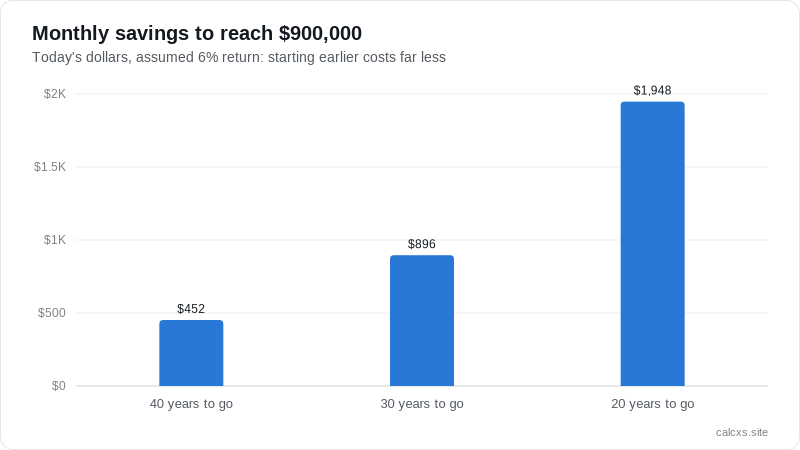 Each decade of delay roughly doubles the monthly amount.
Why Today's Dollars Matter
The example above keeps everything in today's dollars, which is the easiest way to think about it. But your actual account balance will need to be much larger in future dollars. At 3% inflation, $60,000 of spending today becomes about $125,627 a year in 25 years. A $900,000 target in today's dollars corresponds to a far larger number on your future statement.
That's not a reason to panic (your income and investments will also grow in nominal terms) but it is a reason to be consistent. Either use real (after-inflation) return assumptions with today's-dollar targets, or nominal returns with inflated future targets. Mixing the two makes a plan look far rosier than it is.
Other Factors That Change the Number
- Retirement age. Retiring earlier means fewer years of saving, more years of withdrawals, and possibly a gap before Social Security and Medicare. Working a few extra years has a triple effect: more contributions, more growth, and fewer years to fund.
- Health care. Medicare generally begins at 65, but premiums, deductibles, and costs it doesn't cover remain. Retiring before 65 means paying for coverage on your own.
- Longevity. Planning to age 90 or beyond protects against the risk of outliving your money. Pensions and annuities that pay for life can help manage that risk.
- Taxes. Money in traditional 401(k)s and IRAs is taxed when withdrawn; qualified Roth withdrawals are not. The mix of account types affects how much you can actually spend.
- Big one-time costs. A new roof, a car, or helping a child can require larger withdrawals in some years.
Using Your Employer Plan and IRAs
Tax-advantaged accounts make reaching the target more achievable. A 401(k) or 403(b) lets you save directly from your paycheck, and many employers match part of your contribution: free money that's usually worth capturing first. IRAs add another layer of tax-advantaged savings. Contribution limits change periodically, so check current limits each year.
Putting It Together
To estimate how much you need to retire, start with your expected annual spending, subtract Social Security and other guaranteed income, and multiply the remaining gap by about 25 (the 4% rule) or by more if you want a larger safety margin or expect a long retirement. Then work backward to the monthly savings that gets you there, and revisit the estimate every year or two as your income, spending, and the markets change.
Run your own numbers with the retirement calculator, see how different savings rates and returns play out with the investment calculator, and use the inflation calculator to translate today's expenses into future dollars.
Frequently Asked Questions
Is $1 million enough to retire? It depends on your spending and other income. Under the 4% rule, $1 million supports about $40,000 in the first year, adjusted for inflation after that, on top of Social Security or a pension. If you expect a long retirement and use a 3% rate instead, it supports about $30,000.
How much should I save each month for retirement? Work backward from your savings target. In this guide's example, reaching $900,000 at an assumed 6% real return takes about $896 a month over 30 years, or about $452 a month over 40 years. The retirement calculator runs the same math with your own numbers.
Does Social Security reduce how much I need to save? Yes. Your savings only need to cover the gap between your spending and guaranteed income. In the example, $60,000 of spending minus $24,000 of Social Security leaves $36,000, which needs $900,000 at 4% instead of the $1,500,000 that $60,000 alone would require.
Does the 4% rule work for early retirement? It's less reliable, because it was based on retirements of about 30 years. A longer retirement generally calls for a lower withdrawal rate, and many planners test 3% or 3.5% for early retirees. At 3%, the example's $36,000 gap requires $1,200,000 instead of $900,000.