Simple vs. Compound Interest
The difference between simple and compound interest, side-by-side examples over 10 to 30 years, how compounding frequency matters, and where you see each type.
Interest is the price of using money. When you borrow, you pay it; when you save or invest, you earn it. But two loans or accounts with the same stated rate can produce very different results depending on one question: is interest calculated only on the original amount, or on a balance that already includes past interest? That's the difference between simple and compound interest, and over long periods it becomes enormous. This guide explains both, shows the math side by side, and covers where you'll run into each one.
Simple Interest
Simple interest is calculated only on the principal: the original amount borrowed or deposited. The formula is:
Interest = principal × rate × time
If you deposit $10,000 at 5% simple interest, you earn $10,000 × 5% = $500 every year, no matter how long the money stays put. After 10 years you've earned $5,000 in interest; after 30 years, $15,000. The interest each year is identical because the base it's calculated on never changes.
Simple interest grows in a straight line. If you plotted the balance on a chart, it would rise by the same amount every year.
Compound Interest
Compound interest is calculated on the current balance, which includes interest you've already earned. Each period's interest is added to the balance, and the next period's interest is calculated on that larger amount. The formula for a balance compounded once a year is:
Future value = principal × (1 + rate) ^ years
The same $10,000 at 5% compounded annually earns $500 in year one, bringing the balance to $10,500. In year two, 5% applies to $10,500, earning $525. Year three earns about $551, and so on. The rate never changes, but the dollar amount of interest grows every year:
| Year | Interest earned that year |
|---|---|
| 1 | $500.00 |
| 10 | $775.66 |
| 20 | $1,263.48 |
| 30 | $2,058.07 |
By year 30, compounding is producing more than four times as much interest per year as simple interest does on the same deposit.
Side-by-Side Comparison
Here's $10,000 at 5% over different time horizons:
| Years | Simple interest balance | Compound interest balance | Difference |
|---|---|---|---|
| 10 | $15,000 | $16,289 | $1,289 |
| 20 | $20,000 | $26,533 | $6,533 |
| 30 | $25,000 | $43,219 | $18,219 |
Over 10 years, compounding adds a modest $1,289. Over 30 years, it adds more than $18,000: more than the original deposit itself. The gap doesn't grow steadily; it accelerates, because compounding is exponential while simple interest is linear.
At higher rates the effect is even stronger. $10,000 at 7% for 30 years grows to $31,000 with simple interest but about $76,123 with annual compounding.
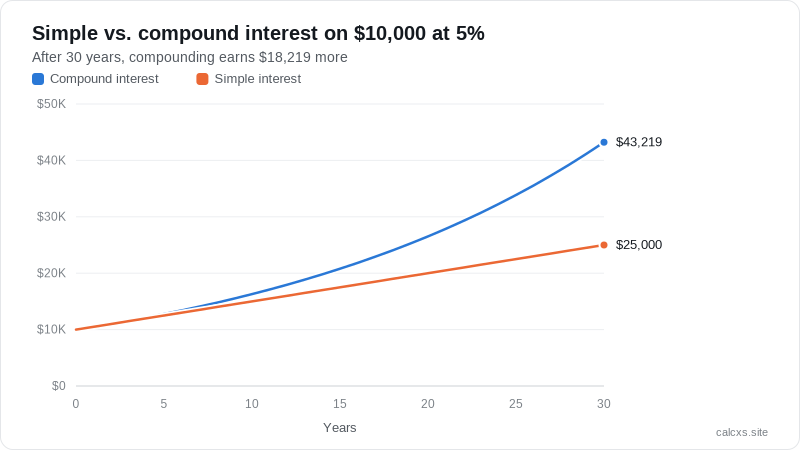 The gap between the two widens every year.
How Compounding Frequency Changes the Result
Compound interest can be added annually, quarterly, monthly, or daily. The more often it compounds, the sooner each bit of interest starts earning its own interest. For a balance compounded n times per year:
Future value = principal × (1 + rate ÷ n) ^ (n × years)
Here's $10,000 at a 6% stated rate for 10 years:
| Compounding | Balance after 10 years | Effective annual yield |
|---|---|---|
| Annually | $17,908 | 6.00% |
| Quarterly | $18,140 | 6.14% |
| Monthly | $18,194 | 6.17% |
| Daily | $18,220 | 6.18% |
Going from annual to monthly compounding adds about $285 over a decade. Going from monthly to daily adds only about $26 more. Frequency matters, but with sharply diminishing returns: the rate and the length of time matter far more.
The effective annual yield column is why banks advertise savings accounts using APY (annual percentage yield), which builds in the effect of compounding. When you compare savings accounts, compare APYs. When you compare loans, remember that the stated APR doesn't always reflect how often interest compounds.
Where You'll See Each Type
Simple interest (or interest on principal only) shows up in:
- Many auto loans and personal installment loans, where interest accrues on the outstanding principal and unpaid interest isn't added to the balance. As you pay down principal, the interest portion of each payment falls.
- Mortgages, which work similarly: each month's interest is based on the remaining principal, and a fixed payment covers that interest plus some principal.
- Bonds that pay out their interest, such as Treasury notes paying a fixed coupon every six months. If you spend the coupons instead of reinvesting them, your return behaves like simple interest.
Compound interest shows up in:
- Savings accounts, money market accounts, and CDs, which typically compound daily or monthly.
- Credit cards, which commonly compound daily on unpaid balances: compounding working against you.
- Investments where earnings are reinvested, such as mutual funds with dividends reinvested. Market returns aren't a fixed interest rate, but reinvested growth compounds in the same way.
- Some student loans, where unpaid interest can be capitalized (added to the principal) after certain events, so you then pay interest on interest.
Compounding Works Both Ways
Compounding is a powerful ally when you're saving and a costly one when you're borrowing. A $1,000 credit card balance at a 24% APR, compounded daily and left untouched for a year, accrues about $271 in interest, not the $240 a simple 24% would suggest. Leave it longer and the balance snowballs, because each month's interest becomes part of the balance that next month's interest is charged on.
That's why paying off high-rate compounding debt is often one of the best "returns" available: every dollar you pay down stops compounding against you.
Adding Regular Contributions
Most people don't make a single deposit and walk away; they save a little every month. Compounding applies to every contribution from the day it lands.
Suppose you save $200 a month at a 6% annual return, compounded monthly:
- After 30 years: you've contributed $72,000, and the balance is about $200,903. Nearly two-thirds of the ending balance is growth, not money you put in.
- After 40 years: the same $200 a month grows to about $398,298, almost double the 30-year figure from just ten more years of saving.
This is the practical case for starting early. Someone who starts saving $200 a month at 25 and stops at 65 ends up with roughly twice as much as someone who starts at 35, even though they contributed only $24,000 more.
The Rule of 72
A quick way to estimate compounding's effect is the Rule of 72: divide 72 by the annual interest rate to approximate how many years it takes for money to double. At 6%, money doubles in about 72 ÷ 6 = 12 years (the exact answer is about 11.9). At 9%, it doubles in about 8 years.
The rule only applies to compound interest. With simple interest at 6%, it takes a full 100 ÷ 6 ≈ 16.7 years to double, and it never accelerates after that.
How to Tell Which One You're Getting
The paperwork usually tells you, if you know where to look:
- Savings accounts and CDs must disclose an APY. If the APY is higher than the stated interest rate, interest compounds; the gap shows how much compounding adds.
- Loan agreements describe how interest accrues. Look for phrases like "interest accrues daily on the unpaid principal balance" (interest on principal only) or "unpaid interest will be capitalized" (interest on interest).
- Credit card agreements explain the balance calculation method and whether interest is compounded daily.
- Investment statements show whether dividends and distributions are reinvested or paid out as cash.
When in doubt, ask the lender or bank directly how often interest is calculated and whether it is ever added to the balance.
Putting It Together
Simple interest is calculated only on the original principal and grows in a straight line. Compound interest is calculated on a growing balance and accelerates over time, with the effect becoming dramatic over decades. More frequent compounding helps slightly, but the rate and (above all) time do most of the work. When you save, compounding is your best friend; when you carry high-rate debt, it's working just as hard against you.
Model your own numbers with the compound interest calculator, see how regular contributions grow in a portfolio with the investment calculator, or find out how much you need to save each month to reach a target with the savings goal calculator.
Frequently Asked Questions
Is simple or compound interest better? It depends on which side you're on. When you save or invest, compound interest earns more: $10,000 at 5% for 30 years grows to $43,219 with annual compounding versus $25,000 with simple interest. When you borrow, interest charged only on principal costs less.
How much more does compound interest earn than simple interest? The gap depends on the rate and, above all, the time. On $10,000 at 5%, compounding adds $1,289 over 10 years, $6,533 over 20 years, and $18,219 over 30 years.
Do mortgages use simple or compound interest? A standard mortgage charges each month's interest on the remaining principal, and the fixed payment covers that interest plus some principal. As long as payments are made on schedule, unpaid interest isn't added to the balance. The loan agreement describes exactly how interest accrues.
Do credit cards charge compound interest? Usually yes. Credit cards commonly compound daily on unpaid balances, so a $1,000 balance at a 24% APR left untouched for a year accrues about $271 instead of $240. The card agreement explains the balance calculation method, and terms vary by issuer.