How Much Rent Can I Afford?
The 30% rule, the 50/30/20 budget, and the landlord 40x income rule explained, plus how debts and hidden costs change what rent you can really afford.
Rent is the biggest monthly bill for most renters, which makes it the single most important number to get right in a budget. Set it too high and every other goal (saving, paying down debt, handling an emergency) gets squeezed. There's no one correct figure, but there are a few well-known rules of thumb, each answering the question from a slightly different angle. This guide explains how each one works, where it falls short, and how to combine them into a number that fits your actual finances.
The 30% Rule
The most familiar guideline says to spend no more than 30% of your gross monthly income on rent. Gross income means pay before taxes and deductions.
Maximum rent = Gross monthly income × 30%
On a $60,000 salary, gross monthly income is $60,000 ÷ 12 = $5,000. Thirty percent of that is $1,500 a month.
The 30% benchmark has deep roots: it's the standard federal housing agencies have long used to define whether a household is "cost-burdened" by housing. It's simple, easy to remember, and a reasonable starting point.
Where the 30% Rule Falls Short
- It uses gross income, not take-home pay. Two people earning $60,000 can take home very different amounts depending on their state taxes, health insurance premiums, and retirement contributions.
- It ignores debt. Someone with a $400 car payment and a $300 student loan payment has far less room for rent than someone with no debt, even at the same salary.
- It doesn't scale well. At low incomes, 30% may leave too little for food, transportation, and other essentials. At high incomes, 30% may be far more than anyone needs to spend.
- It ignores local reality. In expensive cities, many renters spend well over 30% because there's no practical alternative, and the rule doesn't tell you what to cut elsewhere to make that work.
Think of 30% as a ceiling to stay under when you can, not a target to spend up to.
The 50/30/20 Budget
The 50/30/20 framework takes a broader view. It divides your after-tax income into three buckets:
- 50% for needs: rent, utilities, groceries, insurance, transportation, minimum debt payments.
- 30% for wants: dining out, entertainment, travel, subscriptions.
- 20% for savings and extra debt payments: emergency fund, retirement, paying down debt beyond the minimums.
Rent doesn't get its own percentage here. It shares the 50% needs bucket with every other essential, which forces you to see it in context.
A Worked Example
Suppose you earn $60,000 a year and take home $3,900 a month after taxes and deductions. Half of that, $1,950, is your needs budget. Now list your other needs:
| Need | Monthly cost |
|---|---|
| Groceries | $350 |
| Utilities | $120 |
| Phone and internet | $90 |
| Transportation | $180 |
| Renters insurance | $15 |
| Total (excluding rent) | $755 |
That leaves $1,950 − $755 = $1,195 for rent.
Notice the gap. The 30% rule said this person could spend $1,500 on rent; the 50/30/20 approach says about $1,200. The difference comes from using take-home pay instead of gross income and from accounting for other essential costs. If this person also had a $250 minimum student loan payment, their rent budget would fall to $945.
The 50/30/20 split is a guideline, not a rule. Plenty of people reasonably shift a few percent from wants to needs in an expensive city. The value is in making the tradeoff visible: every dollar of rent above your needs budget has to come out of wants or savings.
The Landlord's View: The 40x Rule
Many landlords and property managers screen applicants with an income requirement, most commonly that your gross annual income be at least 40 times the monthly rent.
Maximum rent landlords will typically approve = Gross annual income ÷ 40
For $60,000 in income: $60,000 ÷ 40 = $1,500.
That matches the 30% rule exactly, and not by coincidence. Rent equal to 1/40 of annual income is 12/40 of monthly income, which is 30%. Some landlords instead require gross monthly income of at least 3 times the rent, which works out to 36 times rent annually: slightly looser than 40x. In competitive markets, some ask for more.
Keep in mind what this rule is: a landlord's tool for estimating whether you'll pay on time. Passing the screen tells you a landlord will rent to you. It doesn't tell you the rent is a comfortable fit for your budget. Many landlords also check your credit, and some look at your existing debts or ask for a guarantor if your income falls short.
Account for Your Debts
If you carry debt, adjust your rent budget for it directly. A simple approach borrowed from mortgage lending is to look at your total housing cost plus debt payments as a share of gross income. Mortgage lenders have long used guidelines such as housing costs at or below about 28% of gross income and total debt payments at or below about 36%: the "28/36" rule.
Applied to renting, that suggests that if your monthly debt payments already take up a large share of your income, your rent should be correspondingly lower. On $5,000 of gross monthly income, 36% is $1,800. If you pay $500 a month toward a car loan and student loans, that leaves about $1,300 for rent under this approach: less than the $1,500 the 30% rule alone would allow.
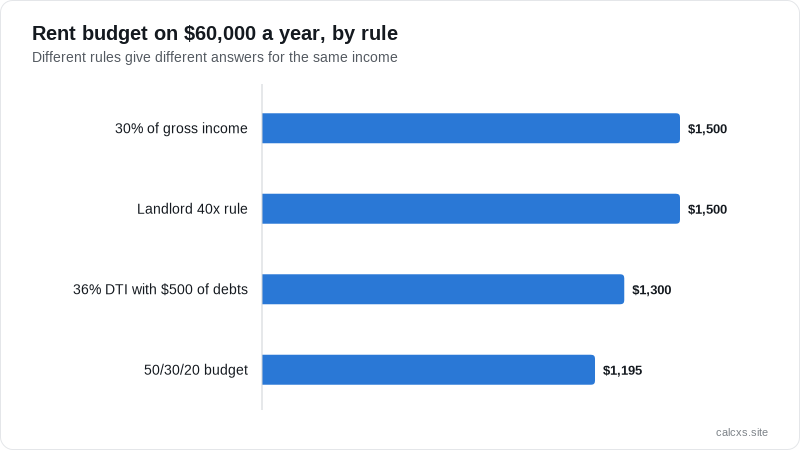 The rules in this guide, side by side for the same $60,000 salary.
The Hidden Costs of Renting
Rent is the headline number, but it's rarely the full monthly cost of a place to live. Before signing, find out which of these apply:
- Utilities. Electricity, gas, water, sewer, and trash may or may not be included. Ask the landlord or previous tenant for typical monthly bills.
- Internet. Almost never included, and almost always needed.
- Renters insurance. Inexpensive relative to what it covers, and some leases require it.
- Parking. In many cities a parking space carries a separate monthly fee.
- Pet fees. Monthly pet rent, a one-time pet fee, a pet deposit, or a combination.
- Amenity or service fees. Some buildings charge monthly fees for trash valet, package lockers, or shared amenities.
These add up. A $1,500 apartment with $150 in utilities, $15 for renters insurance, and $75 for parking is really a $1,740-a-month housing cost. On $5,000 of gross monthly income, that's 34.8%: over the 30% guideline even though the rent alone was right at it.
Move-In Costs
Moving into a new place requires cash up front, often:
- First month's rent, due at signing.
- Security deposit, frequently equal to one month's rent. Many states cap how much a landlord can charge and set rules for returning it.
- Last month's rent, in some markets.
- Application fees for each place you apply to.
- Broker fees in some cities.
- Moving costs, whether a truck rental or professional movers.
For that $1,500 apartment, first month plus a one-month security deposit alone is $3,000: before application fees and the move itself. Make sure you can cover move-in costs without draining your emergency fund.
How to Set Your Own Number
Put the rules together rather than relying on any single one:
- Start with the 30% rule on gross income to get a quick upper bound.
- Check it against your take-home pay with the 50/30/20 approach, after listing your other essential costs and debt payments.
- Add the hidden monthly costs (utilities, insurance, parking) to the rent you're considering and make sure the total still fits.
- Confirm you'll pass the landlord's screen, typically 40 times the monthly rent in annual income.
- Make sure you have the cash for move-in costs on top of an emergency fund.
The lowest number from steps 1 through 3 is usually the safest rent to aim for. If it's lower than what's available in your area, that's useful information too: it tells you how much you'd need to trim elsewhere, whether a roommate makes sense, or whether a different neighborhood is worth a look.
Putting It Together
The 30% rule is a fine quick check, but it doesn't see your taxes, your debts, or the costs that come with an apartment beyond the rent. A budget built from your take-home pay (with debts and hidden costs included) gives a more realistic number, and the landlord's 40x rule tells you whether you'll qualify.
The rent affordability calculator applies these rules to your own income and debts and shows a comfortable rent range. To see what your salary looks like after taxes, use the salary calculator, and if you're wondering whether it's time to buy instead, the rent vs. buy calculator compares the two over time.
Frequently Asked Questions
Is it okay to spend more than 30% of your income on rent? Many renters do, especially in expensive cities where there's no practical alternative. Federal housing agencies use 30% as the line for being "cost-burdened," so going over it means less room for savings, debt payments, and emergencies. Every dollar above your budget has to come out of wants or savings.
How much income do I need to rent a $2,000 apartment? Under the common 40x rule, landlords would look for gross annual income of at least $80,000. Landlords that require monthly income of 3 times the rent would look for $6,000 a month, or $72,000 a year. Requirements vary by landlord, and some ask for more in competitive markets.
Is the 30% rent rule based on gross or net income? Gross income, before taxes and deductions. Budgeting from take-home pay usually gives a lower number: in this guide's example, $60,000 a year supports $1,500 under the 30% rule but about $1,195 under a 50/30/20 budget. The rent affordability calculator shows both views.
How much money do I need to move into an apartment? Often at least the first month's rent plus a security deposit, which is frequently equal to one month's rent: $3,000 on a $1,500 apartment. Some markets also require last month's rent or broker fees, and application fees and moving costs come on top. Many states cap security deposits, so the amount varies by location.