How to Convert Hourly Pay to an Annual Salary
The 2,080-hour formula, how unpaid time off and overtime change the result, and how to compare hourly and salaried offers once benefits are counted.
If you're paid by the hour, a job offer quoted as an annual salary can be hard to compare against what you earn now, and the reverse is just as true. The conversion itself is simple multiplication, but the right answer depends on how many hours you actually work, whether your time off is paid, whether you earn overtime, and what benefits come with each job. This guide walks through each of those pieces so you can turn an hourly rate into an honest annual number, and an annual salary back into an honest hourly one.
The Standard Formula: The 2,080-Hour Year
The starting point for almost every hourly-to-salary conversion is the full-time "standard year":
40 hours per week × 52 weeks per year = 2,080 hours per year
Multiply your hourly rate by 2,080 and you get the annual equivalent of working full time, every week of the year, with every hour paid:
Annual pay = Hourly rate × Hours per week × Weeks paid per year
At $25 an hour, that's $25 × 2,080 = $52,000 a year. At $30 an hour, it's $30 × 2,080 = $62,400.
From the annual figure you can work out other pay periods:
- Monthly: divide by 12. $52,000 ÷ 12 = about $4,333.
- Biweekly (26 paychecks): divide by 26. $52,000 ÷ 26 = $2,000.
- Weekly: divide by 52. $52,000 ÷ 52 = $1,000, which is simply $25 × 40.
A useful mental shortcut follows from the 2,080 figure: since 2,080 is close to 2,000, doubling your hourly rate and adding "thousand" gets you in the right neighborhood. $25 an hour is roughly $50,000 a year; $40 an hour is roughly $80,000. The shortcut runs a little low (the exact numbers are $52,000 and $83,200) but it's handy for a quick sanity check.
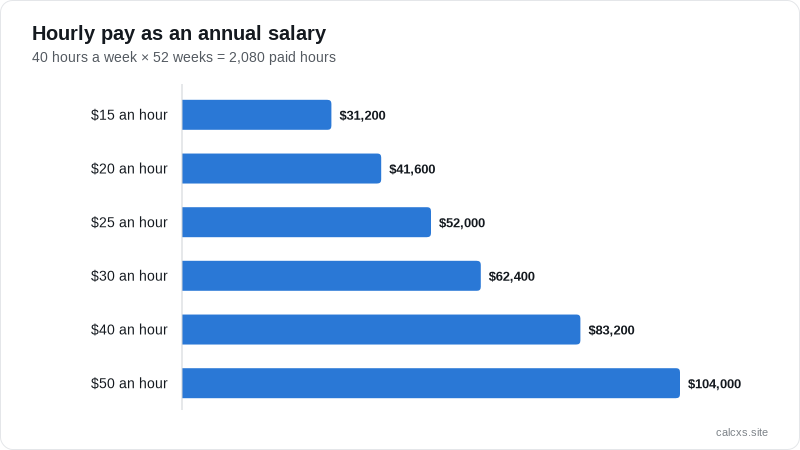 Common hourly rates at 40 hours a week, 52 weeks a year.
Going the Other Way: Salary to Hourly
To convert a salary into an hourly rate, divide by the hours you work in a year:
Hourly equivalent = Annual salary ÷ Hours worked per year
A $65,000 salary divided by 2,080 hours is $31.25 an hour. That's the number to compare against an hourly offer, but only if the salaried job really involves 40-hour weeks.
Salaried roles often don't. If that $65,000 job routinely requires 50 hours a week, the real hours are 50 × 52 = 2,600 a year, and the effective rate drops to $65,000 ÷ 2,600 = $25.00 an hour. Many salaried employees are classified as "exempt" under the federal Fair Labor Standards Act (FLSA), which means they aren't entitled to overtime pay no matter how many hours they work. When you compare a salaried offer against hourly work, ask what a typical week actually looks like, and use that number rather than the nominal 40.
Paid vs. Unpaid Time Off
The 2,080-hour formula quietly assumes you're paid for all 52 weeks. For salaried employees with paid vacation and holidays, that's usually true: the salary doesn't shrink when you take a week off. For many hourly workers, it isn't.
If you don't get paid when you don't work, count only the weeks you'll actually work. Say you earn $25 an hour and expect to take two weeks off a year (one for vacation, plus scattered holidays and sick days that add up to another week) none of it paid. Your real annual pay is:
$25 × 40 hours × 50 weeks = $50,000
That's $2,000 less than the 2,080-hour figure. If you take four unpaid weeks, it's $25 × 40 × 48 = $48,000.
The same logic applies to part-time work or variable schedules. If you average 32 hours a week, use 32, not 40. The conversion is only as accurate as the hours you put into it.
Adding Overtime
Under the FLSA, non-exempt employees must be paid at least one and a half times their regular rate for hours worked beyond 40 in a single workweek. Some states have stricter rules (California, for example, also requires overtime for hours beyond 8 in a single workday) so check your own state's law if overtime is a meaningful part of your pay. The overtime pay guide covers the regular-rate rules and double time in detail.
To fold regular overtime into an annual estimate, calculate it separately and add it on. Suppose you earn $25 an hour, work 45 hours a week, and work 50 weeks a year:
- Overtime rate: $25 × 1.5 = $37.50 an hour
- Regular pay per week: $25 × 40 = $1,000
- Overtime pay per week: $37.50 × 5 = $187.50
- Weekly total: $1,187.50
- Annual total: $1,187.50 × 50 = $59,375
Overtime alone adds $187.50 × 50 = $9,375 to the year. That's a meaningful amount, but be realistic about whether it's reliable. Overtime that depends on busy seasons or a manager's discretion can disappear, so it's prudent to budget around your base pay and treat overtime as a bonus rather than a guarantee.
Comparing an Hourly Offer to a Salaried Offer
Cash pay is only part of what a job is worth. When you compare two offers, the benefits package can easily close (or widen) a gap that looks large on paper. The most common items to put a dollar value on are:
- Health insurance. The share of the premium your employer pays is real compensation. If one job covers most of your premium and the other offers nothing, you'd have to buy coverage yourself with after-tax dollars.
- Retirement contributions. A 401(k) match is money you receive only if the plan exists and you contribute. A 4% match on a $65,000 salary is $2,600 a year.
- Paid time off. As shown above, paid vacation and holidays are worth their full hourly value if the alternative is unpaid time.
- Other benefits. Disability and life insurance, tuition assistance, commuter benefits, or a stipend for equipment all have a cost you'd otherwise bear.
A Worked Comparison
Imagine choosing between two offers:
Offer A pays $32 an hour. There's no paid time off, no health insurance, and no retirement match. You plan to take four weeks off a year, unpaid, so you'll work 48 weeks.
Offer B pays a $65,000 salary with three weeks of paid vacation, a 4% 401(k) match, and employer-paid health coverage that would cost you an estimated $6,000 a year to replace on your own. (That $6,000 is a hypothetical figure for this example: your actual cost depends on your plan, location, and household.)
The cash comparison first:
- Offer A: $32 × 40 × 48 = $61,440
- Offer B: $65,000
On hourly rate alone, Offer A looked better: $32 an hour versus Offer B's $65,000 ÷ 2,080 = $31.25. But because Offer A's time off is unpaid, its annual cash pay is already lower.
Now add benefits to Offer B:
- Salary: $65,000
- 401(k) match: $65,000 × 4% = $2,600
- Health coverage value: $6,000
- Total: $73,600
Offer A's total stays at $61,440, since it has no benefits to add. The gap between the two offers is $73,600 − $61,440 = $12,160 a year: far bigger than the hourly rates suggested, and in the opposite direction.
This assumes both jobs involve 40-hour weeks. If Offer B regularly ran to 50 hours with no overtime pay, and Offer A paid overtime for any extra hours, the comparison would shift again. Run the numbers under the schedule you actually expect.
A Note on Contract (1099) Work
If an hourly offer is for independent contractor work rather than employment, there's one more adjustment. W-2 employers pay half of Social Security and Medicare taxes (7.65% of wages) on your behalf; self-employed workers pay both halves, for a combined 15.3% self-employment tax on net earnings, subject to the Social Security wage cap. Contractors also typically cover their own equipment, insurance, and retirement savings. That's why contract hourly rates usually need to be noticeably higher than employee rates to come out even.
Common Mistakes to Avoid
- Assuming 2,080 paid hours when time off is unpaid. It overstates annual pay for many hourly workers.
- Assuming a 40-hour week for salaried jobs. Long weeks quietly lower your effective hourly rate.
- Counting irregular overtime as guaranteed income. Budget on base pay; treat overtime as upside.
- Comparing gross pay without benefits. Health coverage and retirement matches can be worth thousands of dollars a year.
- Confusing gross and take-home pay. Everything above is before taxes. Your paycheck will be smaller after federal and state income tax, Social Security and Medicare, and any pre-tax deductions for benefits or retirement.
Putting It Together
Start with your hourly rate and multiply by the hours you'll actually be paid for in a year: 2,080 for a full-time schedule with paid time off, fewer if your time off is unpaid or your hours vary. Add regular overtime at time-and-a-half if you can count on it. When comparing a salaried offer, convert its salary to an hourly rate using the hours the job really demands, then put a dollar value on benefits like health coverage, retirement matching, and paid leave before deciding which offer is worth more. For a quick lookup, the hourly to salary chart lists the weekly, monthly, and annual pay for every common wage from $10 to $100 an hour.
The hourly to salary calculator handles the conversion for any rate, schedule, and number of weeks worked, and breaks the result down into monthly, biweekly, and weekly pay. To see how overtime changes a paycheck, try the overtime calculator, and to estimate what an annual salary looks like after taxes, use the salary calculator.
Frequently Asked Questions
How much is $20 an hour a year? At 40 hours a week for 52 weeks, $20 an hour is $20 × 2,080 = $41,600 a year, or about $3,467 a month before taxes. If you take two weeks off unpaid, it's $20 × 40 × 50 = $40,000.
How many working hours are in a year? A full-time standard year is 40 hours × 52 weeks = 2,080 hours. If you work 50 paid weeks, it's 2,000 hours, and at 32 hours a week for 52 weeks, it's 1,664. Use the hours you're actually paid for, not the standard figure.
Is a salary better than hourly pay? It depends on the hours and the benefits. Many salaried employees are exempt from overtime, so long weeks lower their effective hourly rate, while hourly workers may earn time-and-a-half beyond 40 hours. Paid time off, health coverage, and a retirement match can outweigh a difference in the base rate.
How do I estimate take-home pay from an hourly wage? Convert the hourly rate to annual pay first, then subtract federal and state income tax, Social Security and Medicare, and any pre-tax deductions. The result varies by state and by your withholding and benefit choices. The salary calculator estimates it for you.