How to Calculate Overtime Pay
The overtime pay formula with worked examples for time and a half and double time, what counts as your regular rate, and who qualifies.
Overtime pay in the United States follows a simple federal rule: most hourly workers earn at least one and a half times their regular rate for every hour over 40 in a workweek. Working out the dollar amount takes three steps, but the details (what counts as the "regular rate," which week the hours fall in, and whether your state adds daily overtime) can change the answer. This guide gives you the formula, worked examples for time and a half and double time, and the rules that decide who qualifies.
The Overtime Pay Formula
Overtime rate = Regular hourly rate × 1.5
Overtime pay  = Overtime rate × Overtime hours
Total pay     = (Regular rate × Regular hours) + Overtime pay
Under the Fair Labor Standards Act (FLSA), "overtime hours" are the hours worked beyond 40 in a single workweek, a fixed, recurring period of seven consecutive days that your employer sets. Hours aren't averaged across two weeks: working 50 hours one week and 30 the next still means 10 hours of overtime in the first week.
Worked Example: Time and a Half
You earn $20 an hour and work 48 hours in a week.
- Overtime rate: $20 × 1.5 = $30 an hour.
- Regular pay: 40 hours × $20 = $800.
- Overtime pay: 8 hours × $30 = $240.
- Total for the week: $800 + $240 = $1,040.
Your effective hourly rate for the week is $1,040 ÷ 48 hours = $21.67, and overtime makes up about 23% of the paycheck.
If you worked that schedule every week of the year, the annual total would be $1,040 × 52 = $54,080, compared with $41,600 for 40 hours a week.
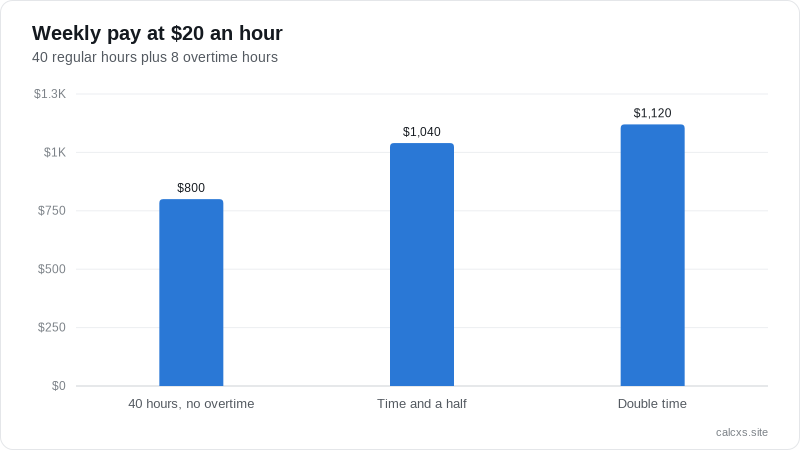 Eight overtime hours add $240 at time and a half, or $320 at double time.
Double Time
Federal law doesn't require double time, but some employers offer it for holidays or long shifts, union contracts often include it, and California requires it in certain cases. The math is the same with a multiplier of 2:
| Schedule ($20/hour, 48 hours) | Overtime rate | Overtime pay | Weekly total |
|---|---|---|---|
| Straight time (no overtime premium) | $20 | $160 | $960 |
| Time and a half | $30 | $240 | $1,040 |
| Double time | $40 | $320 | $1,120 |
Another Example
At $25 an hour with 10 overtime hours a week:
- Overtime rate: $25 × 1.5 = $37.50
- Regular pay: 40 × $25 = $1,000
- Overtime pay: 10 × $37.50 = $375
- Weekly total: $1,375
Over 50 working weeks, that's $68,750, of which $18,750 comes from overtime.
What Counts as Your "Regular Rate"
The 1.5 multiplier applies to your regular rate of pay, which isn't always the same as your base hourly wage. Under the FLSA, the regular rate includes most compensation for the work, such as:
- Nondiscretionary bonuses: production, attendance, or safety bonuses you're promised for meeting a target.
- Shift differentials: extra pay for night or weekend shifts.
- Commissions.
Payments that are generally excluded include discretionary bonuses, gifts, pay for time not worked (vacation, holidays, sick days), and expense reimbursements.
For example, if you earn $20 an hour, work 45 hours, and receive a $90 production bonus for the week, your regular rate is ($20 × 45 + $90) ÷ 45 = $22. You're owed an extra half of that, $11, for each of the 5 overtime hours ($55) on top of the straight-time pay for all 45 hours and the bonus.
Who Qualifies for Overtime
The FLSA covers most private and public employees, but not everyone:
- Nonexempt employees must be paid overtime. Most hourly workers are nonexempt.
- Exempt employees aren't owed overtime. To be exempt under the most common "white-collar" exemptions, an employee generally must be paid a salary of at least $684 a week ($35,568 a year, the level the Department of Labor enforces) and perform executive, administrative, or professional duties as defined by the regulations.
Being paid a salary doesn't by itself make you exempt. A salaried employee who earns less than the threshold, or whose job doesn't meet a duties test, is still owed overtime. Some states set higher salary thresholds.
State Overtime Rules
States can require more than federal law, and when both apply, the rule more generous to the employee wins. California is the best-known example:
- Time and a half for hours over 8 in a workday or 40 in a workweek, and for the first 8 hours on the seventh consecutive workday.
- Double time for hours over 12 in a workday, and over 8 on the seventh consecutive workday.
A few other states, including Alaska, Nevada, and Colorado, also have daily overtime rules in some situations. Check your state labor department for the rules that apply to you.
Overtime and Taxes
Overtime pay is taxable wages. It's subject to federal income tax, Social Security, and Medicare like the rest of your paycheck, and to state income tax where it applies. A big overtime week can look like it's taxed at a higher rate, because withholding tables treat each paycheck as if you'll earn that amount every period. Any over-withholding is settled when you file your return. Federal tax rules for overtime pay have changed recently, so check the IRS's current guidance for any deduction you may qualify for.
Putting It Together
Multiply your regular rate by 1.5 to get the overtime rate, multiply that by the hours over 40 in the workweek, and add it to your straight-time pay. Include nondiscretionary bonuses and shift premiums in the regular rate, check whether your state adds daily overtime, and remember that a salary alone doesn't make a job exempt.
The overtime calculator does the math for any rate, hours, and multiplier, and annualizes the result. To turn an hourly wage into a yearly salary, see how to convert hourly to salary and the hourly to salary calculator, and the salary calculator estimates take-home pay after taxes.
Frequently Asked Questions
How do you calculate time and a half? Multiply your hourly rate by 1.5. At $18 an hour, time and a half is $27 an hour. Multiply that by your overtime hours to get the overtime pay.
Is overtime calculated daily or weekly? Under federal law, weekly: hours over 40 in a workweek. Some states, such as California, also require overtime for hours over 8 in a single day.
Do salaried employees get overtime? Some do. A salaried employee who earns less than $684 a week, or whose duties don't meet an exemption test, is nonexempt and must be paid overtime.
Do paid holidays and vacation count toward the 40 hours? Not under federal law. Overtime is based on hours actually worked, so a paid holiday doesn't count toward the 40 unless your employer's policy or a union contract says otherwise.
Can my employer make me take comp time instead of overtime pay? Private employers generally can't substitute comp time for overtime pay under the FLSA. Public-sector employers can offer comp time in some circumstances.
Sources
- U.S. Department of Labor: Fact Sheet #23, Overtime Pay Requirements of the FLSA
- U.S. Department of Labor: Fact Sheet #56A, Overview of the Regular Rate of Pay Under the FLSA
- U.S. Department of Labor: Fact Sheet #17A, Exemption for Executive, Administrative, Professional, Computer & Outside Sales Employees
- California Department of Industrial Relations: Overtime FAQ