How Much House Can I Afford? Chart by Salary
The home price the 28% rule supports at salaries from $40,000 to $200,000, with 10% and 20% down, and how rates and debts change it.
How much house you can afford on your salary comes down to one lender rule of thumb: your total housing payment should stay under 28% of your gross monthly income. This chart applies that rule to salaries from $40,000 to $200,000 and converts each housing budget into a home price, with 10% and 20% down. Use it to get a realistic price range before you start shopping, then run your own numbers.
How Much House Can I Afford? Chart by Salary
| Annual salary | Monthly housing budget (28%) | Price with 10% down | Price with 20% down |
|---|---|---|---|
| $40,000 | $933 | $109,000 | $127,000 |
| $50,000 | $1,167 | $141,000 | $165,000 |
| $60,000 | $1,400 | $174,000 | $203,000 |
| $70,000 | $1,633 | $206,000 | $241,000 |
| $75,000 | $1,750 | $222,000 | $260,000 |
| $80,000 | $1,867 | $239,000 | $279,000 |
| $90,000 | $2,100 | $271,000 | $317,000 |
| $100,000 | $2,333 | $303,000 | $355,000 |
| $120,000 | $2,800 | $368,000 | $430,000 |
| $125,000 | $2,917 | $384,000 | $449,000 |
| $150,000 | $3,500 | $466,000 | $544,000 |
| $175,000 | $4,083 | $547,000 | $639,000 |
| $200,000 | $4,667 | $628,000 | $734,000 |
Prices are rounded to the nearest $1,000 and assume no other monthly debts. The housing budget covers the whole payment: principal, interest, property taxes, homeowners insurance, and mortgage insurance.
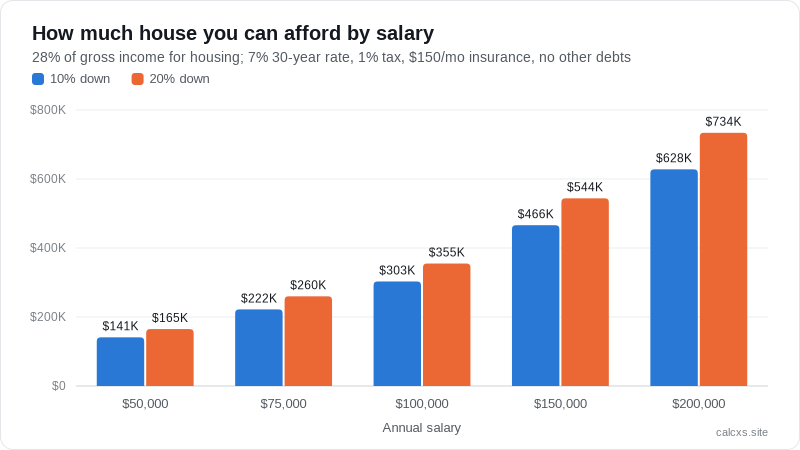 Affordable home price by salary under the 28% rule, with 10% or 20% down.
The Assumptions Behind the Chart
A housing budget only becomes a price once you fill in the costs that share the payment. The chart uses these example numbers; yours will be different:
- Mortgage: 30-year fixed at 7.00%. Freddie Mac's survey put the average 30-year rate at 7.18% in early November 2026. Your rate depends on your credit score, down payment, and loan type.
- Property taxes: 1.0% of the home's value per year.
- Homeowners insurance: $150 a month.
- Private mortgage insurance (PMI): 0.5% of the loan amount per year with 10% down. None with 20% down.
- No HOA dues and no other monthly debts.
These match the assumptions in the $60K salary guide, which breaks down one row of this chart line by line.
How the Numbers Are Calculated
Take a $100,000 salary as an example.
- Gross monthly income: $100,000 ÷ 12 = $8,333.
- Housing budget at 28%: $8,333 × 0.28 = $2,333 a month.
- Subtract fixed costs. Insurance takes $150, leaving $2,183 for the mortgage payment and property taxes.
- Solve for the price. With 20% down, a $354,682 home has a $283,745 loan. Principal and interest at 7% come to $1,888 a month and property taxes to $296, which uses up the $2,183.
So a $100,000 salary supports a home of about $355,000 with 20% down (about $71,000 in cash, plus closing costs), or about $303,000 with 10% down.
How Interest Rates Change the Answer
The rate has a big effect on the price a salary can carry. Here's the same budget at different rates, with 20% down:
| Mortgage rate | $75,000 salary | $100,000 salary |
|---|---|---|
| 6.0% | $284,000 | $388,000 |
| 6.5% | $272,000 | $371,000 |
| 7.0% | $260,000 | $355,000 |
| 7.5% | $249,000 | $340,000 |
| 8.0% | $239,000 | $326,000 |
Each half point of rate moves the affordable price by roughly 4% to 5%. On a $100,000 salary, a 6% rate instead of 8% adds about $62,000 of buying power. The mortgage payment chart shows the monthly payment for any loan amount and rate.
What If You Have Other Debts?
The chart assumes no other debts. Lenders also check a second limit, the 36% rule: all your monthly debt payments, including the new mortgage, should stay under 36% of gross income. If your car loan, student loans, and card minimums add up to more than 8% of your gross monthly income, that rule binds first and your housing budget shrinks.
For example, on a $75,000 salary the 36% limit is $2,250 a month. With $600 of other debts, only $1,650 is left for housing instead of $1,750, about $16,000 less house with 20% down. The 28/36 rule guide walks through how debts, down payment, and the full cost of ownership change your budget, and the guide to a good debt-to-income ratio explains the limits lenders actually use.
Putting It Together
Multiply your gross monthly income by 28% to get a housing budget, then use the chart to find the matching price at 10% or 20% down. Adjust for your real rate, property taxes, and debts: a lower rate, lower taxes, or a larger down payment raises the price, while other debts lower it. The home affordability calculator runs this for your exact income, debts, and costs, and the mortgage calculator shows the full monthly payment for any home you're considering.
Frequently Asked Questions
How much house can I afford on a $75,000 salary? Under the 28% rule, $75,000 a year supports a housing payment of about $1,750 a month. With this guide's assumptions and a 7% rate, that's a home of about $260,000 with 20% down or about $222,000 with 10% down.
How much house can I afford making $100,000 a year? About $355,000 with 20% down or $303,000 with 10% down, based on a $2,333 monthly housing budget, a 7% rate, 1% property taxes, and no other debts.
How much house can I afford on $50,000 a year? About $165,000 with 20% down or $141,000 with 10% down. In lower-cost areas with low property taxes, the same budget can stretch further.
Is the 28% rule too strict? It's a conservative starting point. Many lenders approve higher ratios, especially with strong credit, and some loan programs allow total debt ratios of 43% or more. Being approved for more doesn't mean the payment fits your budget, so leave room for savings, maintenance, and emergencies.
Should I use gross or take-home pay? Lenders use gross income, before taxes, which is what this chart uses. If you want a more cautious budget, aim for a housing payment of no more than about 25% of your take-home pay.