How Much Loan Do I Need When Trading In a Car?
The formula for your new car loan with a trade-in, including sales tax, fees, and positive or negative equity, with worked examples.
When you trade in a car, the loan you need isn't simply the price of the new car minus what the dealer gives you for the old one. Taxes, fees, your down payment, and (most importantly) whether you still owe money on your trade-in all change the amount you'll finance. This guide gives you the formula, works through examples with positive and negative equity, and shows how to keep the loan as small as possible.
The Formula
Loan amount = Price of new car
            + Sales tax and fees
            − Trade-in value
            + Payoff on your current loan
            − Cash down payment
            − Rebates and incentives
Two of these terms combine into your trade-in equity:
Trade-in equity = Trade-in value − Loan payoff
- Positive equity (the car is worth more than you owe) works like an extra down payment and shrinks the new loan.
- Negative equity (you owe more than the car is worth) is added to the new loan unless you pay it off in cash.
Step-by-Step Example: Positive Equity
You're buying a car with a negotiated price of $35,000. The numbers:
| Item | Amount |
|---|---|
| Negotiated price | $35,000 |
| Trade-in value offered | $15,000 |
| Payoff on your current loan | $12,000 |
| Sales tax (7%) | applied to $35,000 − $15,000 = $20,000 → $1,400 |
| Title, registration, and dealer fees | $800 |
| Cash down payment | $2,000 |
Your trade-in equity is $15,000 − $12,000 = $3,000.
Loan = $35,000 + $1,400 + $800 − $15,000 + $12,000 − $2,000 = $32,200
You need to finance $32,200. At 7% APR for 60 months, that's about $638 a month and roughly $6,056 in total interest.
How Sales Tax Treats Your Trade-In
Many states charge sales tax only on the difference between the new car's price and your trade-in value, which is why the tax above applies to $20,000 rather than $35,000. That tax break is one advantage of trading in rather than selling privately. Not every state offers it, and some cap it. In a state that taxes the full price, the tax in this example would be $2,450 and the loan $1,050 larger. Check your state's motor vehicle or revenue agency.
Example: Negative Equity
Now suppose you still owe $18,000 on the trade-in, which is worth $15,000. Your equity is $15,000 − $18,000 = −$3,000.
Loan = $35,000 + $1,400 + $800 − $15,000 + $18,000 − $2,000 = $38,200
The $3,000 you were underwater on your old car is now part of your new loan. Compared with the positive-equity example, you'd borrow $6,000 more:
| Scenario | Loan amount | Payment (7%, 60 months) | Total interest |
|---|---|---|---|
| $3,000 positive equity | $32,200 | $638 | $6,056 |
| $3,000 negative equity | $38,200 | $756 | $7,184 |
| Negative equity, stretched to 72 months | $38,200 | $651 | $8,692 |
Stretching the loan to 72 months brings the payment back near the original level, but it costs about $2,600 more in interest than the positive-equity loan, and it makes it more likely you'll be underwater again on the new car.
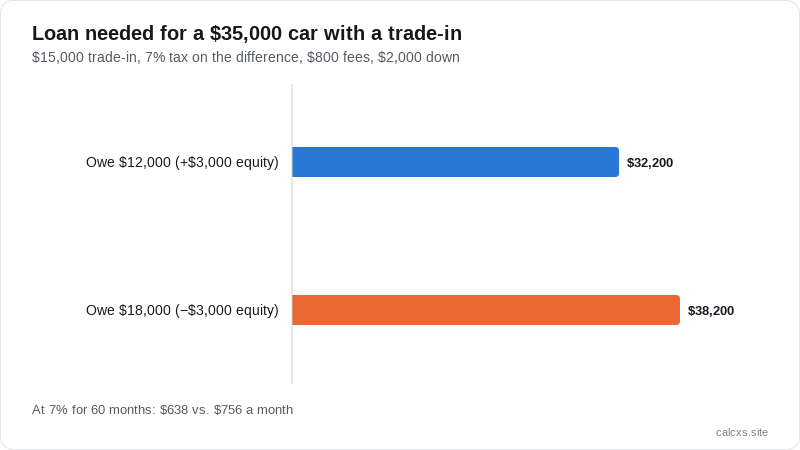 Negative equity on a trade-in is added to the new loan.
The Federal Trade Commission warns that some dealers promise to "pay off your trade-in no matter what you owe," then add the negative equity to the new loan or subtract it from your down payment. Either way, you still pay it: with interest. Check the amount financed on the contract before you sign.
How to Find Each Number
- Negotiated price. Negotiate the new car's price separately from your trade-in, so a generous trade-in offer isn't offset by a higher price.
- Trade-in value. Check valuation guides such as Kelley Blue Book, Edmunds, or J.D. Power (NADA), and get offers from more than one dealer or an online buyer.
- Loan payoff. Ask your current lender for a payoff quote, which includes interest through a specific date. It's usually a little more than the balance on your statement.
- Taxes and fees. Ask the dealer for an out-the-door price, which lists sales tax, title, registration, and documentation fees.
- Rebates. Manufacturer cash rebates reduce the amount you finance. Sometimes you have to choose between a rebate and special low-rate financing.
How Much Should You Borrow?
The formula gives the minimum you need to borrow for this deal. Whether it's a sensible amount is a different question:
- Watch the loan-to-value. If the loan is larger than the new car is worth, you start out underwater. Many lenders cap how much they'll lend relative to the car's value, which can limit how much negative equity you can roll in.
- Keep the term short. Cars lose value quickly, and longer loans keep your balance above the car's value for longer.
- Consider GAP coverage if you're underwater. If the car is totaled, insurance pays its value, not your loan balance. Guaranteed asset protection covers the gap, but compare prices, because it's often cheaper from an insurer than from the dealer.
- Fit the payment into your budget. A common guideline is to keep total car costs (payment, insurance, fuel, and maintenance) to a modest share of take-home pay. Lenders will also count the payment in your debt-to-income ratio.
Ways to Reduce the Loan
- Increase the down payment, even by a few thousand dollars.
- Pay off negative equity first. Paying down your current loan before trading in, or making a few extra principal payments, keeps the old debt out of the new loan.
- Sell privately. You'll often get more than a dealer's trade-in offer, though you may lose the sales tax credit and take on more hassle.
- Choose a less expensive car. The price is the single biggest number in the formula.
- Wait. If you're underwater, a few more months of payments may bring you to break-even.
Putting It Together
Start with the new car's price, add taxes and fees, subtract your trade-in value, add whatever you still owe on it, and subtract your cash down payment and rebates. If you have positive equity, it lowers the loan. If you have negative equity, it raises the loan, and you'll pay interest on it again. To check whether the resulting payment fits your budget, see how much car you can afford.
The auto loan calculator works out the monthly payment and total interest for any loan amount and term, and the loan calculator shows the full amortization schedule.
Frequently Asked Questions
Does a trade-in count as a down payment? Your trade-in equity does. If your car is worth $15,000 and you owe $12,000, the $3,000 difference reduces the loan the same way a cash down payment would.
Can I trade in a car that isn't paid off? Yes. The dealer pays off your existing loan as part of the deal, and the payoff amount is factored into the new loan.
What happens if I owe more than my trade-in is worth? The difference (negative equity) is usually added to your new loan, unless you pay it in cash. You'll pay interest on it over the new loan's term.
Should I tell the dealer about my trade-in up front? It's often better to agree on the new car's price first, then negotiate the trade-in separately, so you can see the value of each part of the deal.