How Much Car Can I Afford?
Use the 20/4/10 rule to turn your income into a car price, and see what longer loan terms really cost in interest.
How much car you can afford depends less on the price on the windshield and more on three numbers: the monthly payment your budget can carry, the interest rate, and the loan term. A dealer can make almost any car "fit" by stretching the loan, so it helps to work backward from what you can comfortably pay. This guide explains the 20/4/10 rule, shows how to turn a monthly budget into a car price, and compares what different loan terms really cost.
The 20/4/10 Rule
A widely used rule of thumb for buying a car with a loan:
- 20%: put at least 20% down.
- 4: finance for no more than 4 years (48 months).
- 10: keep total monthly car costs (the loan payment plus insurance, and ideally fuel and maintenance) under 10% of your gross monthly income.
It's a guideline, not a lending requirement, and it's conservative on purpose. A 20% down payment means you're less likely to owe more than the car is worth, and a four-year term keeps total interest down and gets you out of debt while the car still has value.
Step by Step: From Income to Car Price
Suppose you earn $72,000 a year.
- Monthly gross income: $72,000 ÷ 12 = $6,000.
- Car budget at 10%: $6,000 × 10% = $600 a month for all car costs.
- Subtract insurance and running costs. If insurance runs about $150 a month, that leaves $450 for the loan payment. (Get a real insurance quote for the car you're considering; it varies widely.)
- Turn the payment into a loan amount. At 7% APR for 48 months, a $450 payment supports a loan of about $18,792.
- Add the down payment. If the loan is 80% of the price, the car can cost $18,792 ÷ 0.8 ≈ $23,490, with a down payment of about $4,698.
So on a $72,000 salary, the 20/4/10 rule points to a car price of roughly $23,500, before sales tax and fees. If you'd also finance tax, title, and registration, aim for a lower sticker price so the total stays within the same loan amount.
The Loan Amount Formula
Step 4 uses the standard present-value formula for a loan:
Loan amount = Payment × [1 − (1 + r)^−n] ÷ r
where r is the monthly rate (APR ÷ 12) and n is the number of monthly payments. At 7% and 48 months, r = 0.07 ÷ 12 ≈ 0.005833 and n = 48, so $450 × [1 − 1.005833^−48] ÷ 0.005833 ≈ $18,792.
Longer Loans: More Car, More Interest
Here's what the same $450 monthly payment will finance at 7% APR as the term gets longer:
| Loan term | Loan amount | Total paid | Total interest |
|---|---|---|---|
| 48 months | $18,792 | $21,600 | $2,808 |
| 60 months | $22,726 | $27,000 | $4,274 |
| 72 months | $26,394 | $32,400 | $6,006 |
| 84 months | $29,816 | $37,800 | $7,984 |
Stretching to 84 months lets the same payment "afford" an $11,000 bigger loan, but you pay nearly three times as much interest and make payments for three more years.
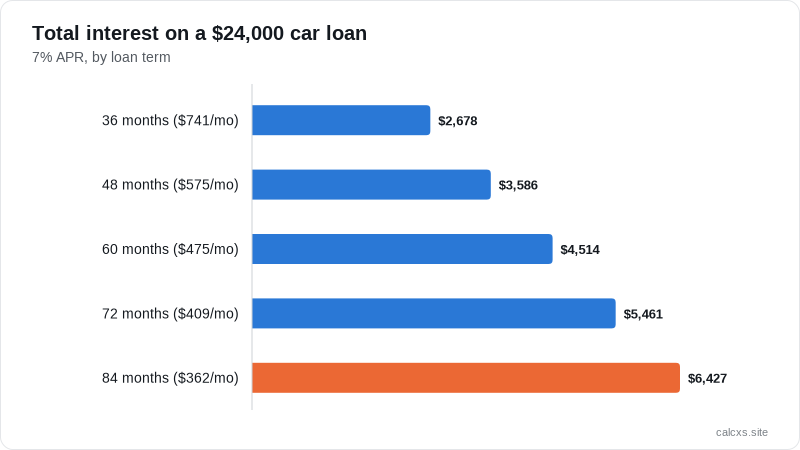 Every extra year on the loan adds roughly $900 to $1,000 of interest on $24,000.
Looked at the other way, here's a $24,000 loan at 7% across terms:
| Loan term | Monthly payment | Total interest |
|---|---|---|
| 36 months | $741 | $2,678 |
| 48 months | $575 | $3,586 |
| 60 months | $475 | $4,514 |
| 72 months | $409 | $5,461 |
| 84 months | $362 | $6,427 |
Long terms also make it more likely you'll be underwater (owing more than the car is worth) for years, because cars lose value fastest early on. If you need to sell or trade in early, or the car is totaled, you'd have to cover the difference. The trade-in loan guide shows how negative equity carries over into the next loan.
Don't Forget the Full Cost of Ownership
The loan payment is only part of what a car costs each month. Before you settle on a price, add up:
- Insurance: newer, more expensive cars usually cost more to insure, and lenders require full coverage while you have a loan.
- Fuel or charging.
- Maintenance and repairs: tires, oil changes, brakes, and the repairs that come with age.
- Registration and property tax: some states charge an annual tax based on the car's value.
- Parking and tolls, if they apply.
If these costs push your total above about 10–15% of gross income, a cheaper car or a larger down payment will give your budget more room.
How Lenders See It
Lenders don't use the 20/4/10 rule. They look at your credit score, your income, and your debt-to-income ratio: total monthly debt payments divided by gross monthly income. A new car payment raises that ratio, which can matter if you plan to apply for a mortgage soon. The guide to a good debt-to-income ratio explains the limits lenders use.
Being approved for a loan doesn't mean the payment fits your budget. Lenders may approve payments well above 10% of your income.
Ways to Afford a Better Car Without Overspending
- Shop for financing before you go to the dealer. A preapproval from a bank or credit union gives you a rate to compare against dealer financing.
- Compare the APR, not just the payment. The APR vs. interest rate guide explains why.
- Make a bigger down payment. Each extra $1,000 down reduces the loan by $1,000 and the interest on it.
- Consider a used car. A car a few years old has already taken its steepest drop in value.
- Negotiate the price, not the payment. Agreeing to a monthly payment first makes it easy to hide a longer term or add-ons in the deal.
Putting It Together
Start with 10% of your gross monthly income, subtract insurance and other running costs, and use what's left as your maximum loan payment. Convert that payment into a loan amount at a realistic rate and a term of four years or less, then add your down payment to get a price range. A longer loan can make a more expensive car look affordable, but it costs more interest and keeps you in debt longer.
The auto loan calculator shows the payment and total interest for any price, down payment, trade-in, tax rate, and term, and the debt-to-income calculator shows how a new payment changes your DTI.
Frequently Asked Questions
How much car can I afford on a $50,000 salary? With the 20/4/10 rule, $50,000 a year is about $4,167 a month, so total car costs should stay under roughly $417. After about $150 for insurance, that leaves around $267 for the payment: roughly an $11,140 loan at 7% over 48 months, or a car price near $13,900 with 20% down.
Is the 20/4/10 rule realistic? It's strict, especially with today's car prices, and many buyers use a longer term or spend more than 10%. Treat it as a target. The further you go beyond it, the more interest you pay and the higher your risk of being underwater.
What's a reasonable car payment? A common benchmark is a payment under 10% of take-home or gross pay, with total car costs under about 15–20% of take-home pay. The lower your other debts, the more room you have.
Should I get a 72- or 84-month car loan? Only if you've compared the total interest and are confident you'll keep the car well past the payoff date. Longer loans usually carry higher rates as well as more interest, and they keep you underwater longer.
Does the 20/4/10 rule apply to leasing? Not directly, since there's no loan term or down payment in the same sense. The 10% budget for total car costs is still a useful cap on the monthly lease payment plus insurance.