How to Analyze a Rental Property
How to evaluate a rental property using NOI, cap rate, cash flow, and cash-on-cash return, with realistic reserves and a fully worked example.
A rental property can look like a great deal when you compare the rent to the mortgage payment and see money left over. But that comparison leaves out most of what it actually costs to own a rental (vacancies, repairs, big-ticket replacements, management, taxes, and insurance) and it says nothing about how hard your cash is working compared to other investments. This guide walks through the standard measures investors use to analyze a rental, how they fit together, and a full worked example.
Start With Realistic Income
Begin with gross scheduled rent: what the property would collect in a year if it were rented every single month at market rent.
Gross scheduled rent = Monthly rent × 12
No property is occupied 100% of the time. Tenants move out, units need to be cleaned and repaired between leases, and finding a new tenant takes time. Investors account for this with a vacancy allowance, typically expressed as a percentage of gross rent. A figure around 5% to 8% is common for planning, though the right number depends on the local market and the property. Subtract it to get effective gross income: what you can realistically expect to collect.
Effective gross income = Gross scheduled rent − Vacancy allowance
If the property earns other income (laundry machines, parking fees, storage) add it here.
Then Count Every Operating Expense
Operating expenses are the ongoing costs of running the property. They do not include your mortgage payment; financing is handled separately. The usual categories are:
- Property taxes. Look up the actual current bill, and be aware that some areas reassess when a property sells.
- Insurance. A landlord policy, which differs from (and usually costs more than) a homeowners policy.
- Maintenance and repairs. Leaky faucets, broken appliances, a door that sticks. Many investors budget 5% to 10% of rent, more for older properties.
- Capital expenditures (CapEx). The big, infrequent replacements: roof, HVAC, water heater, flooring, appliances. They don't happen every year, but they will happen, so a monthly reserve smooths the cost. A common planning figure is another 5% to 10% of rent.
- Property management. Professional managers commonly charge a percentage of collected rent, often somewhere around 8% to 12%, plus fees for placing new tenants. Even if you plan to self-manage, it's worth including: your time has value, and you may not want to manage it forever.
- HOA dues, utilities the owner pays, landscaping, pest control, and accounting, where applicable.
Underestimating expenses is the most common way rental analyses go wrong. A property whose numbers only work with zero vacancy and no repairs isn't a good deal; it's a deal that hasn't been tested yet.
Net Operating Income (NOI)
Subtract operating expenses from effective gross income and you get net operating income:
NOI = Effective gross income − Operating expenses
NOI is the property's annual profit before mortgage payments and income taxes. Because it ignores financing, it describes the property itself, not the way any particular buyer chooses to pay for it. That makes it the foundation for the next metric.
Cap Rate
The capitalization rate compares NOI to the property's price:
Cap rate = NOI ÷ Purchase price
Cap rate tells you what return the property would produce if you bought it entirely with cash. It's the standard way to compare properties of different sizes and prices on equal footing. A higher cap rate means more income per dollar of price, but often comes with more risk, such as a weaker location, an older building, or less reliable tenants. A lower cap rate often reflects a more desirable, more stable property where buyers accept less income for that stability. There's no universally "good" cap rate; compare it to similar properties in the same market.
Cash Flow
Most investors don't buy with all cash. Once you add a mortgage, the payment on that loan (called debt service) comes out of NOI:
Annual cash flow = NOI − Annual debt service
Cash flow is the money left in your pocket each year after all operating costs and the mortgage. Positive cash flow means the property pays for itself; negative cash flow means you're feeding it money every month.
Cash-on-Cash Return
Cash flow in dollars doesn't tell you whether it's a good return on what you put in. Cash-on-cash return does:
Cash-on-cash return = Annual cash flow ÷ Total cash invested
Total cash invested includes the down payment, closing costs, and any up-front repairs or improvements: everything that came out of your pocket to get the property operating.
Cash-on-cash return lets you compare a rental against other uses of the same cash. Keep in mind that it only measures the cash the property throws off. It leaves out loan principal paydown, appreciation, and tax effects such as depreciation, all of which can add to your total return.
The 1% Rule: A Quick Screen
The 1% rule is a fast filter for deciding whether a property deserves a closer look: monthly rent should be at least 1% of the purchase price.
Monthly rent ÷ Purchase price ≥ 1%
A $200,000 property would need to rent for at least $2,000 a month to pass. The rule is crude (it ignores taxes, insurance, condition, and interest rates) and in many higher-priced markets, very few properties meet it. Treat it as a screening tool to quickly weed out listings, never as a substitute for a full analysis.
A Worked Example
Consider a single-family home listed at $200,000 that's expected to rent for $1,900 a month.
Quick screen: $1,900 ÷ $200,000 = 0.95%. Just under the 1% rule, not an automatic pass, but close enough to run the full numbers.
Income
- Gross scheduled rent: $1,900 × 12 = $22,800
- Vacancy allowance (5%): $22,800 × 5% = $1,140
- Effective gross income: $22,800 − $1,140 = $21,660
Operating Expenses
| Expense | Annual cost |
|---|---|
| Property taxes | $2,400 |
| Insurance | $1,200 |
| Maintenance (5% of gross rent) | $1,140 |
| CapEx reserve (5% of gross rent) | $1,140 |
| Property management (8% of collected rent: $21,660 × 8%) | $1,732.80 |
| Total operating expenses | $7,612.80 |
NOI and Cap Rate
- NOI: $21,660 − $7,612.80 = $14,047.20
- Cap rate: $14,047.20 ÷ $200,000 = 7.02%
Financing, Cash Flow, and Cash-on-Cash Return
Suppose you put 25% down and finance the rest with a 30-year fixed mortgage at 7%:
- Down payment: $200,000 × 25% = $50,000
- Loan amount: $150,000
- Closing costs (assumed): $5,000
- Total cash invested: $50,000 + $5,000 = $55,000
- Monthly principal and interest: $997.95
- Annual debt service: $997.95 × 12 = $11,975.40
Then:
- Annual cash flow: $14,047.20 − $11,975.40 = $2,071.80, or about $172.65 a month
- Cash-on-cash return: $2,071.80 ÷ $55,000 = 3.77%
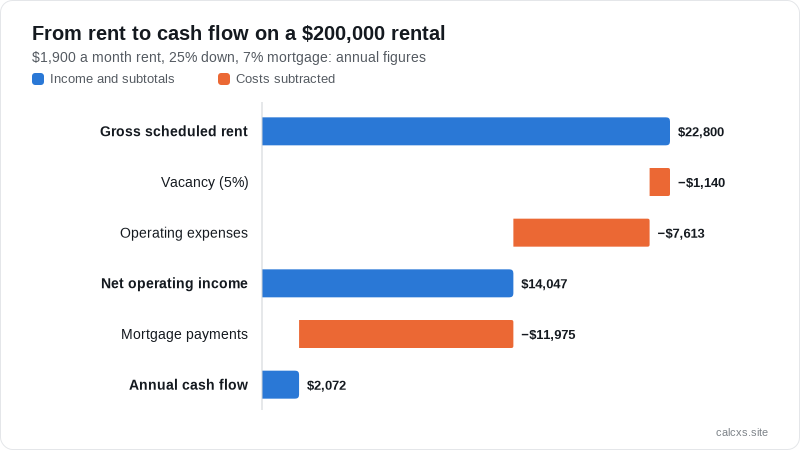 Most of the rent goes to expenses and the mortgage before any cash flow is left.
What the Example Shows
The property produces a 7.02% cap rate, but the investor's cash-on-cash return is only about 3.8%. That gap comes from the financing. The annual debt service is $11,975.40 on a $150,000 loan, or about 7.98% of the loan amount each year: more than the 7.02% the property earns on its price. When borrowing costs more than the property yields, leverage reduces your cash return rather than amplifying it. Investors call this negative leverage.
That doesn't automatically make it a bad investment. The owner is also paying down the loan principal every month and may benefit from appreciation and tax deductions. But it does mean the deal depends more on those factors and less on monthly cash flow. A small surprise (a two-month vacancy, a $5,000 roof repair) could wipe out a full year's cash flow.
Changing the inputs shows what drives the result. With a larger down payment, debt service drops and cash flow rises; because this deal has negative leverage, cash-on-cash return also rises toward the 7.02% cap rate, though more of your money is tied up in one property. A lower interest rate or a lower purchase price improves cash-on-cash return quickly.
Common Mistakes
- Comparing rent to the mortgage payment only. It ignores vacancy and operating expenses, which together come to about 38% of gross rent in the example above ($1,140 + $7,612.80 = $8,752.80 of $22,800).
- Assuming full occupancy. Even good properties sit empty between tenants.
- Skipping the CapEx reserve. Roofs and furnaces wear out on their own schedule, not yours.
- Using the seller's numbers. Verify rents against comparable listings and expenses against actual tax bills and insurance quotes.
- Leaving out your own time. Self-management saves the fee but costs hours and attention.
Putting It Together
Start with realistic income after vacancy, subtract every operating expense to find NOI, and divide by the price to get the cap rate. Then subtract debt service to find cash flow, and divide by the cash you put in to get cash-on-cash return. Use the 1% rule to screen listings quickly, but never to make the final decision.
The rental property calculator runs this full analysis (NOI, cap rate, cash flow, and cash-on-cash return) from your own inputs. To check the financing side in detail, use the mortgage calculator, and to compare the property's overall return with other investments, try the ROI calculator.
Frequently Asked Questions
What is a good cap rate for a rental property? There's no universal figure; compare it with similar properties in the same market. A higher cap rate means more income per dollar of price but often more risk, while a lower one often reflects a more stable property. The example in this guide works out to 7.02%.
What's the difference between cap rate and cash-on-cash return? Cap rate divides NOI by the purchase price, so it ignores financing and shows the return on an all-cash purchase. Cash-on-cash return divides cash flow after the mortgage by the cash you actually put in. In this guide's example, the cap rate is 7.02% but cash-on-cash return is only 3.77%.
Does NOI include the mortgage payment? No. NOI is income after vacancy and operating expenses but before mortgage payments and income taxes, so it describes the property rather than how it's financed. In the example, NOI of $14,047.20 minus $11,975.40 of debt service leaves $2,071.80 of annual cash flow.
How much should I budget for repairs on a rental property? Many investors budget 5% to 10% of rent for routine maintenance and another 5% to 10% as a reserve for big replacements like a roof or HVAC, with more for older properties. At 5% each, the example's $22,800 of gross rent sets aside $1,140 for each. The rental property calculator lets you test higher reserves.